In the early 1960s, a Northwestern-led team of economists arrived to study what was then one of the fastest-growing economies on earth. Liberia was booming. Iron ore was moving through new ports, rubber was flowing, and foreign capital was arriving faster than almost anywhere in the world. They spent years examining this miracle, and in 1966 they published their conclusion under a title that should have haunted us forever: Growth Without Development: An Economic Survey of Liberia.
By Sei Philip Pleiwon, contributing writer
Their verdict was simple and devastating. Liberia had enormous economic activity and almost no economic transformation. The concessions operated beside the country, not inside it. Money moved through Liberia without becoming Liberia.
Sixty years have passed. We have lived through the boom, the coup, the war, the recovery, and five national development strategies. Billions of dollars in aid, investment, and public spending have entered this country. And the central diagnosis of that book remains uncomfortably current.
We have just marked 179 years of independence. Here is the plainest way I can put our condition:
Liberia is trying to develop without building an economy.
Before anyone reaches for their political feelings, understand what this essay is not. A problem that has survived military rule, civil conflict, transitional governments, and successive elected administrations cannot be reduced to the failure of any president, past or present. It is an operating logic, diagnosed repeatedly in our own plans and never operationally corrected. Corruption is real, and it is a crime against this country. But in Liberia it is also partly a function of that same incoherence: where nothing is organized toward a defined national outcome, resources are easier to divert and far harder to miss.
Development is what accumulates
We have mistaken the ingredients of development for development itself. Foreign investment, roads, schools, agriculture, digital skills: these can improve lives directly, and that matters. But they are inputs, and the question is what the country does with them.
Here is the distinction six decades keep teaching and we keep refusing to learn. Investment, aid, public expenditure, exports, construction, and training are flows: things entering, moving through, or occurring within the country. Development is the accumulation of stocks: capable people, productive firms, domestic capital, functioning institutions, technical knowledge, and state capacity.
An economy compounds when today’s production becomes tomorrow’s productive capacity. Production creates wages, profits, and taxes; part of those flows must become savings, stronger firms, knowledge, infrastructure, and new investment.
Liberia’s cycle runs differently. Foreign capital finances production, but much of the equipment, expertise, contracting, and finance is imported. Commodities and a substantial share of the value leave. Wages and revenue enter an import-dependent economy and a recurrent budget. Too little becomes locally owned productive capital. The activity is real; the accumulation is weak. A new concession can therefore begin twenty years after the last one and meet the same shortage of Liberian engineers, suppliers, finance, and technical institutions that existed before.
That is the development gap: the failure to convert economic flows into accumulating national capability.
The evidence is not subtle. A child born in Liberia can expect to achieve roughly 32 percent of the productivity she would attain with full health and education, according to the World Bank’s Human Capital Index. Real income per person remains below its pre-war peak. After sixty years of flows, we are behind where we started.
Everything ends at its first output
Watch how development actually works here, and you will notice a pattern so common it has become invisible.
The road ends at the road. The training ends at the certificate. The project ends at the report. The study ends at the study. The concession ends at extraction and revenue. The education ends at the degree. The identity card ends at the card.
We complete the first output, hold the ceremony, and move on. But development lives in what the output enables. So does every government’s account of itself: kilometers paved, budgets grown, buildings dedicated, graduates counted, jobs announced. We have reduced development to new hospitals, new schools, new light posts. It is why the country feels the way it does, undirected and confused, a place where things are thrown at the wall to see what sticks.
The question we never ask
There is one question Liberia has never put at the center of its development, and everything else follows from its absence: what should our people become capable of doing?
Ask it of education first. In China, between 2021 and 2025, universities eliminated or suspended more than 12,000 undergraduate degree programs, over 30 percent of all offerings, and created 10,000 new ones, realigning higher education with where the economy is going. Set aside every debate about China’s model and notice only what the act reveals: a state that has decided what its people must become capable of doing, and treats education as the instrument for producing it.
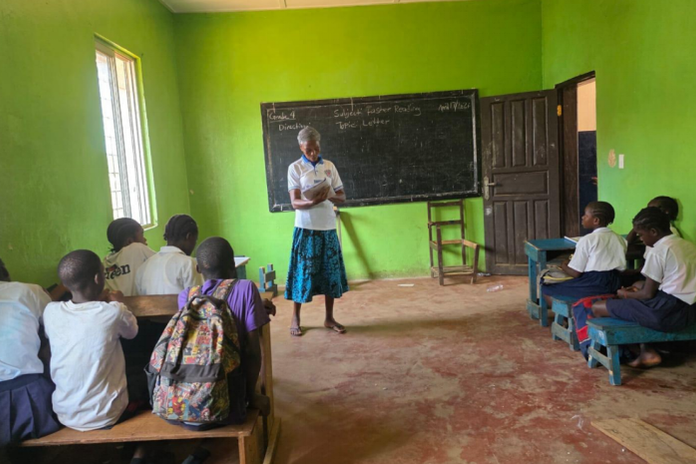
Now ask it here. Not how many are enrolled, or how many graduated, but what can a Liberian high school graduate actually do on the day she finishes, and what should she be capable of doing? No government has produced and enforced an answer specific enough to govern what programs are authorized, what public money funds, or who receives a scholarship. Universities open programs based on what they can staff and what students will enroll in. Students choose qualifications in a labor market the country does not measure, and they carry all the risk of guessing wrong. We are expanding an academic model inherited from the 1960s without deciding what the expansion is for. And this in a country of five and a half million people, small enough to know its own labor market. We graduate her into a void and call the ceremony an outcome. Education without an answer to what our people should be able to do is not education. It is attendance.
Now ask it of mining, where the answer has had sixty years to arrive. Visit any major concession and watch who does what. The machines are imported, and so, overwhelmingly, are the people who operate at the top of them: the engineers, the technicians, the laboratory and logistics contractors. Liberians are present, and mostly at the bottom of the ladder, in a country that has been mining iron ore since before their grandfathers were born. So what mining capability does Liberia now possess? How many mining engineers, geologists, and certified technicians has this country deliberately produced? Which categories of mining procurement can Liberian firms reliably supply?
The answers embarrass us, and the blame is not where we usually put it. Mining companies cannot be expected to design Liberia’s national capability system; that responsibility belongs to the state. In the absence of credible Liberian pipelines, a company will import engineers and contractors because it must operate. Government presses episodically, scholarships this year, employment numbers next, and companies comply with the demand of the moment. The demands change. Nothing connects. Extraction continues, accompanied by activities. When the ore runs out, and ore always runs out, we will convene conferences on diversification and discover what sixty years of extraction left behind.
Employers complain constantly about workforce quality, and the answer is always more training. But a workforce employers can rely on is built deliberately, occupation by occupation, against real demand. It is not a social program. It is a foundation of production.
The same missing answer explains why agriculture, our announced salvation in every plan since independence, still does not feed us. And it explains the hollowness of our newest prescription. Entrepreneurship at scale is not a trait to be trained into a population; it is an outcome of an economy, of paying customers, working capital, and reachable markets. Where those are absent, we rebrand survival self-employment and ask young people to absorb the risk of a missing economy while calling it empowerment.
A country of projects without a national project
Someone will object that Liberia has a plan. Liberia has always had a plan. That is the evidence, not the defense.
We have produced five major strategies since the war, from the interim poverty-reduction strategy through the Agenda for Transformation to the Pro-Poor Agenda and now the ARREST Agenda. Each diagnosed us honestly. The PAPD said it plainly in 2018, in the government’s own words: Liberia is rich in human and natural resources but deprived of development because its people lack the capability to transform those resources into wealth. That is this essay’s argument, published by the state itself, eight years ago. It described the country. It did not govern the country. On the present trajectory we will not meet Vision 2030 either, and nothing in our planning culture guarantees the public autopsy such a failure should require. We do not learn from our plans. We replace them.
The ARREST Agenda deserves a fair reading, because its own arithmetic is the X-ray. It requires US$8.38 billion over five years. Government expects to finance roughly 30 percent; the rest is expected from private investment, development partners, and diaspora remittances. That does not make the plan unserious; most national strategies depend partly on capital beyond the budget. But it makes alignment the decisive test. Seventy percent of the plan depends on actors government cannot command. Unless their investments are connected to a governing national architecture, the plan remains a destination whose vehicle belongs to someone else.
Beneath every plan sits the same structural silence. Education manages education. Mines manages mining. Public Works builds roads. Partners fund projects. Every actor owns a component and can defend it. But who is accountable for whether the components add up to a different country? Who ensures a thirty-year concession changes what our technical colleges teach? Who decides that scarce capital will complete one system before starting five others? No one. Everyone is accountable for activity. No one is accountable for accumulation.
Our development partners are trapped inside this same gap, and they should hear this as a plea, not an accusation. In the absence of a national architecture, each partner rationally builds a project-level one: its own unit, database, consultants, and indicators. Local rationality, national irrationality. When implementation skills cannot be found locally, partners procure international firms, because the project window leaves no time to build local capacity to do the work. The work gets done. The capability leaves on the same flight as the consultants. The next project reassembles everything from zero. Knowledge behaves the same way: two decades of assessments, baseline surveys, and value-chain studies, one set per project, often covering the same sectors and the same farmers. Liberia may be among the most studied and least known countries on earth, because the studies function as project products rather than national assets. Knowledge, too, is a flow here. We have never let it become a stock.
So the question must be asked directly, with respect: if project cycles cannot absorb the time and risk required to build local delivery capacity, then who will? The projects are not more important than the levers required to deliver them.
Direction, conversion, accumulation
The answer is not another plan. God spare us another plan. It is three disciplines, applied without mercy.
Direction. A short list of concrete national capabilities we are deliberately building, so short that it forces exclusion. Everything is a priority in Liberia, which is how the budget gets spread until nothing we fund is ever finished, foundational, and usable. We have to stop trying to do everything and nothing.
Conversion. Design the connections, not just the components. Every road answers: what production does it unlock? Every concession answers: which occupations and suppliers, on what schedule? Every degree program answers: what demand? Every donor program answers: which national system does it strengthen?
Accumulation. Measure what remains, not what moved. Firms that survived. Occupations localized. Systems still operating. Value retained and reinvested. One question before every major intervention is approved, and again after it closes: what will Liberia permanently be able to do because this existed?
The question of 2040
Countries do not purchase direction. They choose it, and then organize institutions, capital, and public authority around the choice. Decisions of that kind are not imported. They are made.
So let us be honest about time. 2030 is around the corner, and the dream attached to it will not be met. The more important question is the one nobody is asking: what are we doing today that should make anyone believe 2040 will be substantially different? By 2040 we will certainly have more roads, more graduates, more agencies, more completed projects. More flows. The question is which stocks. What will Liberia be able to do in 2040 that it cannot do now, and can anyone name the mechanism currently building that capability? If the answer is silence, then 2040 is already written, and it looks like 2026, which looked like 1966.
I ended The Death of Potential with the warning that the greatest danger was not what Liberia lacked but what we had learned to accept. We have learned to accept activity as achievement. We have learned to celebrate what enters and never audit what remains. Sixty years ago, economists looked at booming Liberia and named our condition: growth without development. Their book should have been our warning. We made it our biography.
But a biography is not a destiny. We are 179 years old, small enough to know ourselves, young enough to redirect ourselves, and rich enough, in ore, in land, and in the ferocious untapped intelligence of our children, to build an economy that compounds within a generation. It begins the day this country answers, operationally and out loud, the question it has avoided since 1847:
What are we deliberately trying to become able to do?
Everything we build before answering that question is furniture.
Everything we build after it is a nation.
Sei Philip Pleiwon is a Liberian economist and human capital expert. His work focuses on workforce, employment, and public-systems design in Liberia and across East Africa. He is the author of “The Death of Potential: Liberia’s Self-Inflicted Education Crisis.” He can be reached at [email protected]
Support Independent Journalism
Your support helps FrontPage Africa continue delivering independent, credible, and impactful journalism. Every contribution strengthens our ability to investigate, inform, and hold power accountable while keeping quality journalism accessible to our readers.
Support our journalism or subscribe to receive the latest FrontPage Africa stories and updates.