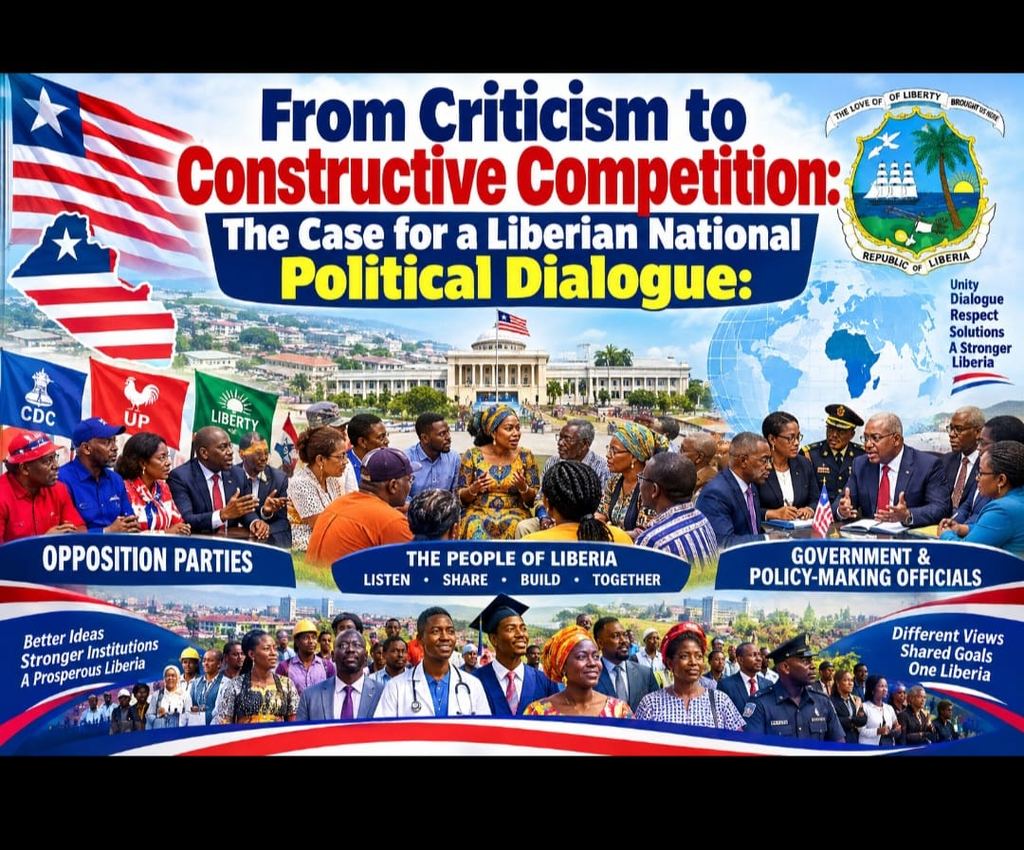
“From Criticism to Constructive Competition: Liberia must graduate from a politics in which every disagreement becomes a battle to a democracy in which every disagreement becomes an opportunity to test ideas. Let the opposition criticize. Let the government answer. Let citizens judge. Let political parties compete fiercely—but let Liberia win.”
“Criticism is the beginning of democratic accountability; constructive competition is its maturation. Liberia does not need political opponents who merely know how to attack—it needs political competitors who know how to propose, persuade, and build.”
President Joseph Nyuma Boakai has explicitly emphasized unity, respect, dialogue, cooperation, and the idea that disagreement need not become hostility. In his 2024 Independence Day remarks, he called for a culture of unity and respect and described stakeholder discussions as a way to promote dialogue and cooperation.
President Boakai has also emphasized the principle that national unity does not require uniformity of thought and that Liberians should be able to disagree while recognizing one another as Liberians first.
“A mature democracy does not fear criticism, because criticism exposes weakness; it does not fear competition, because competition produces better ideas; and it does not fear dialogue, because dialogue reminds political actors that beyond every party, personality, election, and ambition stands one enduring institution: the Republic of Liberia.”
President Boakai: “Liberia does not need uniformity of thought; it needs unity of purpose. We can disagree about the road while remaining committed to the same destination—a peaceful, democratic, and prosperous Liberia.”
Former President George Weah: “We belong to Liberia first before we belong to our inherited tribes, or chosen counties.”
Former President Ellen Johnson Sirleaf: “We must foster dialogue instead of violence, promote unity rather than disharmony, and engender hope rather than disillusionment and despair.”
Nelson Mandela — principle-inspired: “The greatness of political leadership is not measured by how effectively one defeats an opponent, but by how successfully one converts former divisions into possibilities for cooperation.”
Martin Luther King Jr. — principle-inspired: “Political disagreement must never become an excuse for denying the humanity of those with whom we disagree.”
Kwame Nkrumah — principle-inspired: “Political freedom acquires meaning when citizens transform their freedom to compete into a shared responsibility to build the nation.”
Abraham Lincoln — principle-inspired: “A nation divided against itself cannot permanently substitute political victory for national reconciliation.”
Julius Nyerere — principle-inspired:
“The purpose of political competition should not be to produce permanent enemies, but to produce better ideas and better servants of the people.”
“A democracy becomes stronger when yesterday’s political adversaries can become today’s partners in protecting the institutions that make tomorrow’s peaceful competition possible.”
“The political question is not merely, ‘Who is right?’ but ‘What is right for Liberia?’ A nation progresses when its leaders are willing to question themselves as seriously as they question their opponents.”
“An argument should not be defeated because it comes from an opponent; it should be examined, tested, and rejected only when reason demonstrates its weakness.”
In the spirit of Machiavelli: Machiavelli’s political thought emphasizes political realism, the preservation of the state, and the practical exercise of power. -Stanford Encyclopedia of Philosophy
“A wise political leader does not mistake victory over an opponent for victory over the nation; the preservation of the state must remain greater than the triumph of a faction.”
“Politics is not merely the art of acquiring power; it is the wisdom to understand what must be done with power once it has been acquired.”
In the spirit of Socrates: Socratic political thought is strongly associated with questioning assumptions and examining whether political action is directed toward genuine improvement rather than merely winning arguments.- PRESSto
Hon. Edward Wesee: “A national political dialogue should not be a marketplace where politicians trade accusations; it should be a national classroom where Liberians exchange ideas, examine failures, and design solutions.”
Hon. Alexander Torbor Kun: “Liberia’s political future must move from the politics of personalities to the politics of policies, from the language of accusation to the language of accountability, and from perpetual campaigning to responsible governance.”
By: Austin S Fallah- A True Son of the Planet Earth Soil:[email protected].
Liberia’s democratic future depends not only on the performance of the Unity Party Alliance government led by President Joseph Nyuma Boakai and Vice President Jeremiah Kpan Koung, but also on the maturity, discipline, and constructive engagement of opposition parties and political leaders.
Elections matter because they let citizens choose leaders, reject poor governance, and demand accountability.
However, democracy can not be reduced to elections alone.
Once an election is over, governing and opposition parties still have a shared responsibility to protect peace, strengthen institutions, improve livelihoods, and preserve national unity.
The leadership of the Boakai-Koung administration has the constitutional responsibility to govern, formulate policies, manage public resources, and lead Liberia’s social and economic development.
Yet the opposition also has an equally important democratic responsibility: to scrutinize the government while offering credible alternatives.
Opposition politics should not be limited to criticism, insults, social-media attacks, or predictions of failure.
Criticism is necessary in every democracy, but criticism without solutions can deepen public frustration and create the impression that political actors care more about power than national progress.
For this reason, the Unity Party Alliance government should call for a sustained national dialogue involving political parties, former candidates, legislators, civil society organizations, traditional leaders, youth groups, women’s organizations, labor unions, the business community, the media, and members of the Liberian diaspora.
Such a dialogue should not be a public-relations event or an attempt to silence opposition voices.
Rather, it should become a structured national process through which Liberians can debate policies, compare ideas, identify shared priorities, and build agreement on issues too important to treat as partisan weapons.
Liberia has experienced periods when political rivals, armed groups, civil-society representatives, and international partners worked together to ensure the nation’s survival and advancement.
These examples demonstrate that cooperation between those in power and those outside power is possible.
The challenge today is to move beyond the politics of constant accusation and establish a culture of constructive competition.
The Difference Between Destructive Criticism and Democratic Opposition:
A functioning opposition is indispensable in a democracy.
Opposition parties question government decisions, expose corruption, challenge weak policies, defend citizens whose voices may not be heard, and present alternatives during elections.
Without opposition, governments can become complacent, secretive, and disconnected from the population.
Therefore, the call for national unity must never be misunderstood as a call for political silence.
At the same time, opposition parties must distinguish between principled criticism and destructive criticism.
Principled criticism identifies a problem, presents evidence, explains the consequences of inaction, and recommends a realistic alternative.
Destructive criticism merely attacks individuals, spreads fear, or treats every government initiative as a failure regardless of its merits.
For example, if the government proposes a national road-rehabilitation program, a responsible opposition should not simply say the project is useless or that it was my idea.
It should ask practical questions: What is the projected cost? Which counties will benefit? Will contracts be awarded transparently?
How many Liberians will be employed? Are there less expensive alternatives? Could roads be prioritized according to agricultural production, access to hospitals, and school enrollment?
By raising such questions and proposing specific improvements, the opposition would contribute to better governance.
Similarly, when citizens complain about unemployment, high food prices, poor health services, electricity shortages, or weak public schools, political leaders should not merely blame one another.
Liberia needs competing development plans and ideas.
The Unity Party Alliance government should explain what it intends to do, how much it will cost, how it will be financed, and how it will measure success.
Opposition parties should then present their own policy programs and demonstrate why their approaches may be more effective.
The presidency is not the only place from which a person can contribute to national development.
Legislators can introduce bills. County officials can improve local governance.
Political parties can produce policy papers. Former presidential candidates can mobilize expertise and investment.
Constructive and positive civil society organizations can monitor public spending.
Contributive business leaders can create jobs. Journalists can investigate corruption while also informing citizens about workable solutions.
In a country recovering from the long-term effects of war, poverty, weak infrastructure, and institutional fragility, every capable Liberian has a role to play.
Responsibilities of the Boakai-Koung Administration:
Although national dialogue requires participation from all sides, the government carries a special responsibility because it controls the executive branch and sets the national agenda.
President Boakai and Vice President Koung should demonstrate that the Unity Party Alliance administration is confident enough to listen to criticism and humble enough to accept good ideas from political opponents.
An open-minded government gains strength, not weakness, when it consults broadly.
Governments often make better decisions when they hear concerns from farmers, market women, teachers, health workers, county authorities, business community, citizens, partners in progress, political parties, and technical experts.
A national dialogue could help the administration identify policies that have broad support and avoid unnecessary political conflict.
The government should therefore establish a transparent dialogue framework.
First, it should publish clear terms of reference. Participants should know the purpose of the dialogue, the issues to be discussed, the timeline, the expected outcomes, and how recommendations will be implemented.
Second, the government should ensure that participants include both major and smaller political parties, rather than inviting only those likely to agree with the administration.
Third, the dialogue should be linked to real policymaking. If participants spend days discussing youth employment, agricultural productivity, public integrity, or decentralization, their recommendations should be considered in the national budget, legislative agenda, and counties’ development plans.
The Boakai-Koung administration should also avoid treating all criticism as hostility.
There is a difference between an opponent seeking to destabilize the country and a citizen or party raising legitimate concerns about governance.
Even when criticism is politically motivated, it may contain information that the government needs to hear.
Public dissatisfaction with the cost of living, lack of jobs, poor roads, inadequate health facilities, or corruption can not be solved by dismissing critics. It must be addressed with evidence-based policy.
A government that welcomes credible ideas from outside its party sends an important message: Liberia belongs to all Liberians, not only those who voted for the ruling party.
Repeating the mistakes of past administrations harms the growth of the nation and democracy.
Responsibilities of Opposition Parties and Politicians:
Opposition parties must also rise above the expectation that their primary duty is to oppose everything.
The phrase “opposition parties” should not mean “anti-development parties.”
A political organization can criticize the government while still supporting policies that benefit ordinary Liberians.
The opposition should develop alternative national programs in key areas. These programs should be written, costed, and publicly accessible.
Instead of only saying that the government has failed, political parties should explain what they would do differently.
For example, an opposition party could propose a national youth-employment strategy focused on vocational education, apprenticeships, agribusiness, technology training, and incentives for small enterprises.
Another party could develop a detailed plan for reducing rice prices through increased domestic production, improved storage, better farm-to-market roads, and transparent import policies.
Such policy competition would improve Liberia’s democracy.
Citizens could compare ideas instead of personalities.
They could ask which party has the best plan for electricity, health care, education, sanitation, investment, public-sector reform, anti-corruption enforcement, and women’s economic empowerment.
Political debate would become more substantive and less dependent on insults, rumors, tribal appeals, and personal attacks.
Opposition leaders should also use the Legislature and other formal institutions effectively.
Members of the House of Representatives and the Senate can introduce legislation, demand hearings, amend budgets, investigate public agencies, and advocate for their constituencies.
Opposition lawmakers should use these powers to produce results. They should not wait for the next presidential election before presenting solutions to national problems.
Furthermore, opposition politicians have a duty to protect peace.
Liberia’s recent history shows the high cost of political division.
Leaders must be careful not to use language that encourages violence, ethnic hostility, or distrust in democratic institutions.
Electoral competition is normal, but national instability is not an acceptable political strategy.
Historical Examples of Cooperation for the Good of Liberia:
Liberia’s history provides verifiable examples of cooperation between competing political forces.
These examples do not suggest that past political actors always agreed or that all conflicts were resolved.
Rather, they show that Liberia has repeatedly found ways to bring rivals together when the nation’s survival, peace, and democratic credibility required it.
The 2003 Comprehensive Peace Agreement:
One of the most important examples is the Comprehensive Peace Agreement (CPA) signed in Accra, Ghana, on August 18, 2003.
The agreement was reached after years of civil conflict and involved the Government of Liberia, the Liberians United for Reconciliation and Democracy (LURD), the Movement for Democracy in Liberia (MODEL), political parties, and civil-society representatives.
The parties involved had deep disagreements and had been on opposing sides of a devastating conflict.
Nevertheless, they recognized that continued confrontation would destroy the country.
The CPA created a framework for a National Transitional Government of Liberia and set the stage for disarmament, political transition, institutional reconstruction, and democratic elections.
The significance of the CPA is that it did not require Liberians to forget their differences.
Instead, it created a process through which adversaries could move from violence to negotiation.
Political parties and former warring factions shared space in the transitional arrangement because the national interest demanded a political settlement.
The agreement helped open the way for the 2005 elections and Liberia’s gradual return to constitutional rule.
The CPA remains a powerful lesson for today’s politicians.
If Liberian leaders who had experienced war could sit at one table to rescue the country, then contemporary political parties should be able to meet peacefully to discuss employment, roads, food security, health care, education, and corruption.
The 2017 Farmington River Declaration:
Another important example is the Farmington River Declaration of 2017.
Ahead of the October 10, 2017, presidential and legislative elections, political parties signed the declaration under the auspices of Liberia’s National Elections Commission (NEC).
The document committed political actors to peaceful participation, respect for the electoral process, and the rejection of violence.
The 2017 election was historically significant because it marked Liberia’s first democratic transfer of power from one elected president to another since 1944.
The ruling Unity Party, which had governed under President Ellen Johnson Sirleaf, competed against the Coalition for Democratic Change (CDC), led by George Weah, as well as other parties.
Despite the intense competition, the political process ultimately produced a peaceful transition. President Weah was inaugurated in January 2018.
The Farmington River Declaration did not eliminate all political disputes.
There were legal challenges and public tensions, as is common in competitive elections.
However, the agreement demonstrated that the ruling party and opposition parties could make a collective commitment to peace and constitutional procedures.
That cooperation served the interest of the entire nation because it reduced the risk of violence during a sensitive political transition.
The 2023 Farmington River Declaration and Peaceful Electoral Commitment:
Liberia repeated this tradition before the 2023 general elections.
Political parties again signed a Farmington River Declaration, recommitting themselves to nonviolence, peaceful campaigning, and respect for the electoral process.
In that election, the CDC was the incumbent ruling coalition under President George Weah, while the Unity Party, led by current President Joseph Boakai, was a major opposition force.
The 2023 election was highly competitive. The presidential race required a runoff, and the final result was close.
Yet the country avoided the widespread violence that many Liberians feared.
After the runoff election, President Weah conceded defeat and President-elect Boakai prepared to take office.
This peaceful transition was not the achievement of one political party alone. It reflected the work of the NEC, security institutions, civil society, election observers, voters, and political leaders who accepted that national peace was more important than personal ambition.
The 2023 experience is especially relevant because it involved the same principal political forces that now occupy government and opposition positions.
The Unity Party, once in opposition, benefited from a constitutional transition.
The CDC, once in government, had the opportunity to demonstrate commitment to democratic continuity.
This reversal of roles should encourage both sides to practice restraint.
Today’s ruling party may become tomorrow’s opposition, and today’s opposition may return to power in the future.
For that reason, all parties should support rules, laws and institutions that protect everyone.
A Practical Agenda for National Dialogue:
A national dialogue should focus on concrete issues rather than speeches alone. At minimum, it should address the following priorities:
- Economic recovery and job creation. Liberia needs policies that expand employment for young people, support small businesses, strengthen vocational education, and attract responsible investment.
- Agriculture and food security. Political parties should debate practical strategies for increasing local rice production, supporting farmers, reducing post-harvest losses, improving rural roads, and making food more affordable.
- Health and education.The dialogue should identify ways to improve clinics, hospitals, teacher training, public schools, sanitation, and access to quality services in rural communities.
- nti-corruption and public integrity. Liberians need confidence that public resources are used honestly. Parties should support transparent procurement, asset declaration, independent oversight, and consequences for corruption.
- Decentralization and county development. Development must not remain concentrated in Monrovia. Counties should have a stronger voice in determining local priorities and monitoring public projects.
- Peacebuilding and responsible political communication. Parties should agree to reject hate speech, political violence, misinformation, and rhetoric that divides citizens along ethnic, regional, or party lines.
The outcome of the dialogue should be a public national compact: a document identifying areas of agreement, policy recommendations, implementation responsibilities, and methods for tracking progress.
The government may not adopt every opposition proposal, and opposition parties may not agree with every government policy.
However, they should be able to agree that Liberia’s peace, democracy, and development are larger than any party.
Liberia does not need the end of political competition; it needs better political competition.
The Unity Party Alliance government must govern with openness, humility, and a willingness to accept useful ideas from every sector of society.
Opposition parties must hold the government accountable while presenting clear, practical, and credible alternatives.
Neither side should confuse national progress with partisan victory.
The Comprehensive Peace Agreement of 2003, the 2017 Farmington River Declaration, and the 2023 Farmington River Declaration show that Liberian political actors have cooperated before when peace and national stability were at stake.
These examples should inspire a new era of dialogue centered on development rather than division.
President Boakai and Vice President Koung should therefore invite political parties and national stakeholders to a serious national dialogue.
Such a process would not weaken the government or empower disorder.
On the contrary, it would strengthen democratic legitimacy, encourage policy innovation, reduce political tension, and remind all Liberians that the nation belongs to everyone.
Liberia’s future should not fall in the dungeons where opposition parties fail to dialogue or the government fails to open to dialogue.
Support Independent Journalism
Your support helps FrontPage Africa continue delivering independent, credible, and impactful journalism. Every contribution strengthens our ability to investigate, inform, and hold power accountable while keeping quality journalism accessible to our readers.
Support our journalism or subscribe to receive the latest FrontPage Africa stories and updates.