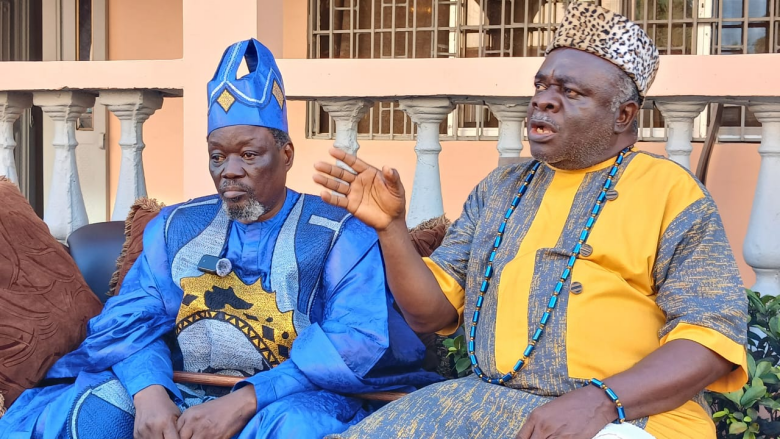
R2 Community, Paynesville City-R2 Community, Paynesville City Congolese traditional spiritual leader Mfumu Nkusu Kiambu Nzalampanda Nangola has called for greater African unity, cultural awareness, and self-reliance, saying Africans must reconnect with their ancestral roots and take a leading role in shaping the continent’s future.
By Jaheim T. [email protected]
Nangola serves as the Spiritual Chief of the traditional African religious movement known as Vuvamu (full name: Vutuka Vana Mpambu Uvidila), which roughly translates to “returning to the roots” or “the original path”.
The Vuvamu, unlike Western-style churches, this movement aims to preserve traditional African customs, ancestral worship, and indigenous knowledge, where they operate as a strict traditional revivalist movement.
The Vuvamu movement is rooted in the spiritual legacy of Simon Kimbangu, who is revered by its followers as the ultimate prophet and spiritual savior of Africa.
Kimbangu was arrested by Belgian colonial authorities in 1921 and later died in prison in 1951. Leadership of the core Kimbanguist movement passed directly to his immediate family before Nangola, who is leading a 13-member delegation from the DR. Congo on a two-week outreach mission in Liberia to assume the leadership.
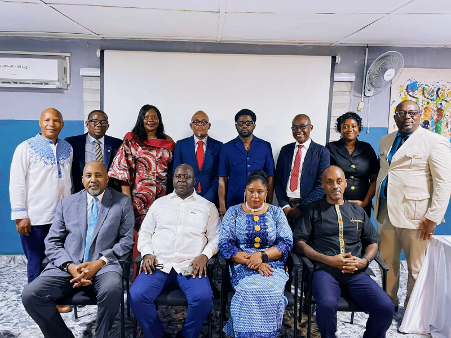
The delegation was invited by the Liberia Independent Elders Council for Peace and Reconciliation to engage government institutions, youth organizations, academics, women’s groups, and community stakeholders on issues affecting Africa’s development.
Speaking through his interpreter, Liongo Sanza, Nangola said the primary purpose of the visit is to rebuild the connection between Africans and their traditional heritage.
“So, how to explain his mission here in Liberia is first of all to recreate the connection with the people of Liberia and the African religion,” Sanza said on behalf of Nangola. “So as we have two weeks here, this whole time will be dedicated to this mission, to the reconnection.”
The Congolese leader said the mission seeks to encourage Africans, particularly young people, to take responsibility for their future and rediscover their identity and purpose.
“The objective of this mission, of these two weeks, is that at the end of this mission, black people have to understand that in the period that we are in, black people have to work, to use themselves, to use their brain, to use their hands, to come back, to be the people that they are supposed to be,” he said.
Nangola said Africans must gain a deeper understanding of their history, culture, and place in the world to become active participants in Africa’s transformation.
“Black people have to understand how the world works, actually, the creation of the world. You have to know it, to understand it, so he can no longer be just a passenger, but an actor inside of the evolution of the world, inside of the evolution of Africa,” he said.
According to the delegation leader, the message being shared in Liberia centers on self-determination, self-sufficiency, and independence in key sectors needed for Africa’s advancement.
“What Liberian youth could get from this message is actually self-determination, self-sufficiency, and spiritual, economic, and technological independence,” he said.
Nangola said Africa stands at a critical moment in its history because of the continent’s natural wealth and strategic importance. He urged young Africans to position themselves as leaders capable of managing the continent’s future.
“Africa is at a turning point, because Africa is the continent that all the races are actually fighting for,” he said. “If we, as young black people, don’t fight to become the leaders of Africa, we are risking coming again and being slaves.”
The traditional leader also spoke about African identity, arguing that colonial-era boundaries should not prevent Africans from recognizing their common heritage and shared destiny.
“If we call ourselves Liberian, Congolese, or all of the names that we can have, it’s because of the Berlin Conference,” he said. “Before that, there was no country, actually, in Africa.”
While promoting traditional African beliefs, Nangola said his message is not intended to exclude people based on religion and that the delegation is open to engagement with people of different faiths.
“We don’t care of you are Christian, you are Muslim, or what, because we want to talk to the black people,” he said. “Christians say that they believe in God. Muslims say that they believe in God. We too, we believe in God, so why not unite him?”
Responding to questions about why the mission focuses primarily on Black communities, Nangola used the example of repairing a vehicle engine to explain what he described as the need to address the most pressing challenges first.
“If you look at a car engine, and you want to repair it, and maybe you have four inductors, and one inductor is not working properly, you will not try to repair the three inductors that are working properly,” he said. “You will try to repair the inductor that is not working properly.”
He added: “In this time, in this era that we are in, black people are the inductor, the one that is not working properly. So if you want to repair the world, you have to start with the inductor that is not working properly.”
The delegation’s visit received the backing of the Liberia Independent Elders Council for Peace and Reconciliation, which said it reviewed the group’s objectives before extending an invitation to Liberia.
Chairman Elder Samuel O. Philips said the council found that the delegation’s message focuses on African unity, peace, and cooperation.
“I went and checked his profile, you know, what he can do, who are they?” Philips said. “The whole topic, the whole thing is black unity.”
Philips said Africa’s abundant natural resources make unity among Africans increasingly important, arguing that divisions on the continent often benefit outside interests.
“Because we have all the minerals, all the resources in Africa,” he said. “They don’t want us to be united, because if we are united, we’ll be controlling our own resources.”
The council chairman also stressed that the delegation’s outreach was not aimed at creating religious division but rather encouraging dialogue and peaceful coexistence.
“I think you heard him; he did not talk anything about separation in religion,” Philips said. “If he had said, ‘I don’t trust God, I don’t love God, I don’t believe in peace,’ the council was not going to invite them.”
Philips said the delegation will spend about two weeks meeting students, educators, women’s groups, youth organizations, traditional leaders, and other stakeholders across Liberia as part of efforts to promote discussions on African culture, identity, education, and development. “So they are here with us for 15 days,” he said.
According to the delegation, planned activities during the visit include meetings with Ministry of Education officials, university professors, students, youth groups, and women’s organizations.
A panel discussion will also be held to explore issues relating to African unity, traditional education, cultural preservation, youth participation, women’s empowerment, and the future development of the continent.
The delegation says it hopes the visit will encourage more Africans to embrace their cultural heritage while promoting dialogue on how traditional knowledge and values can contribute to the development of modern African societies.
Support Independent Journalism
Your support helps FrontPage Africa continue delivering independent, credible, and impactful journalism. Every contribution strengthens our ability to investigate, inform, and hold power accountable while keeping quality journalism accessible to our readers.
Support our journalism or subscribe to receive the latest FrontPage Africa stories and updates.