BUCHANAN/KAKATA – The Center for Democratic Governance (CDG) has warned that climate change is increasingly threatening livelihoods and community development in Liberia, calling for stronger local accountability, coordinated action, and greater community participation in the implementation of the country’s National Adaptation Plan (NAP).
By Patience M. Jones
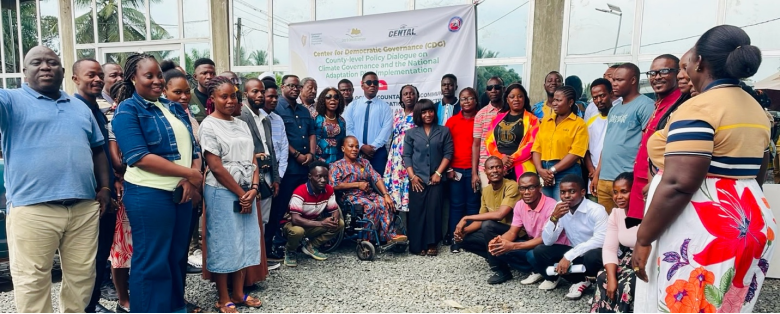
The call was made during a two-day County-Level Policy Dialogue on Climate Governance and NAP Implementation, held separately on November 4 and 11, 2026, in Buchanan, Grand Bassa County, and Kakata, Margibi County.
The dialogues, organized through the Governance Civil Society Organizations Consortium under the Strengthening Political Governance and Accountability in Liberia project, brought together more than 40 participants at each gathering, including county officials, civil society organizations, community leaders, women, youth, farmers, and other stakeholders concerned about climate change.
Held under the theme, “Strengthening Local Accountability, Community Participation and Collaboration for Effective Climate Change Adaptation and Resilience,” the engagements focused on addressing climate-related vulnerabilities while strengthening local institutions and community involvement in adaptation decisions.
Speaking during the Margibi County dialogue, Superintendent Hon. Ojay Godfavor Morris Jr. emphasized the urgency of confronting climate change, noting that its effects are no longer theoretical but increasingly visible in people’s everyday experiences.
He said the realities of global warming have made climate change a pressing concern that requires deliberate action, particularly at the county level, where communities are directly exposed to environmental challenges.
In Grand Bassa County, County Education Officer Hon. Jefferson Vobah commended CDG for promoting accountable climate governance and encouraged participants to move beyond discussions about climate change toward practical preparedness and action.
“The question is no longer what climate change is; the question is whether we are prepared to confront its consequences,” Vobah said.
He pointed to Grand Bassa’s natural resources, including rivers, wetlands, farmlands, and coastal areas, warning that environmental degradation could undermine the future of younger generations.
“If we pollute our rivers today, what will our children inherit tomorrow?” he asked, underscoring the need for responsible environmental management and collective action.
For his part, CDG Executive Director Cllr. George D. W. Sagbeh said climate change is already disrupting traditional livelihoods and altering the daily lives of ordinary Liberians, particularly farmers who depend on predictable weather patterns.
“Farmers no longer know when to plant because they cannot easily tell the difference between the dry and rainy seasons anymore,” Sagbeh said.
He explained that the county-level dialogues were designed to create a platform for government authorities, civil society actors, community representatives, and young people to collectively examine climate challenges and identify practical approaches to strengthening resilience.
Sagbeh further noted that the engagements seek to increase public understanding of Liberia’s National Adaptation Plan, identify county-specific adaptation priorities, strengthen inclusive accountability in decision-making, and improve collaboration among government institutions.
He stressed that climate adaptation efforts must reflect the actual needs of communities rather than remain limited to policy discussions at the national level.
“The dialogue supports efforts to improve climate resilience, strengthen local governance systems, and ensure that adaptation actions respond effectively to community needs and development priorities at the county level,” he said.
The dialogues also featured a technical presentation by Elizabeth Saysay Dede d’Almeida, Climate Change Assistant at the Environmental Protection Agency (EPA), who presented an overview of Liberia’s National Adaptation Plan and highlighted the agency’s local adaptation interventions aimed at addressing climate change impacts in the two counties.
Her presentation provided participants with information on ongoing adaptation efforts and the importance of translating national climate policies into practical interventions that benefit vulnerable communities.
Community representatives, including women, young people, farmers, and forest actors, also shared firsthand experiences and concerns about climate-related vulnerabilities affecting their livelihoods and surroundings.
Their contributions highlighted the importance of ensuring that local voices, particularly those of groups directly affected by environmental changes, are included in climate governance and adaptation planning.
A moderated panel discussion, plenary question-and-answer sessions, and small-group discussions further provided opportunities for participants to examine priority climate concerns and propose practical solutions.
One of the key outcomes of the engagements was the development of a County Climate Action and Accountability Matrix. The matrix outlines agreed actions, responsible institutions, implementation timelines, and follow-up mechanisms intended to improve coordination, monitor commitments, and strengthen accountability for climate adaptation activities in Grand Bassa and Margibi Counties.
The dialogues form part of broader efforts to strengthen democratic governance and public accountability by ensuring that climate change responses are inclusive, coordinated, and responsive to local realities.
The Strengthening Political Governance and Accountability in Liberia project is implemented by the Governance CSOs Consortium, comprising the Center for Democratic Governance (CDG), the Center for Transparency and Accountability in Liberia (CENTAL), and Naymote Partners for Democratic Development.
The project is supported by the Government and people of Ireland through the Embassy of Ireland in Liberia.