NEW YORK, NY – Global Climate Legal Defense (CliDef) joins the Carter Center, the People of the United States, environmental and human rights defenders, the country and the world in mourning the passing of President Jimmy Carter and honoring his legacy in advancing democracy and human rights, and his support for environmental protection.
The Nobel Peace Prize winner died at his home on Sunday at the age of 100.
“President Carter was a lifelong champion for human rights defenders like myself, knowing that those who speak out in closed societies for a better world are often the first to experience backlash. To best honor his legacy, we must all continue to advance his commitment to human rights for all people, no matter where they live,” said Alfred Lahai Gbabai Brownell Sr, Founding President of Global Climate Legal Defense. “We extend our deepest condolences to the Carter family and The Carter Center during this time of mourning.”
In 1978, during an anniversary speech for the Universal Declaration of Human Rights, President Carter called human rights, “the soul of our sense of nationhood,” and urged Americans to see human rights as foundational to the US creating a better, more peaceful, and free world.
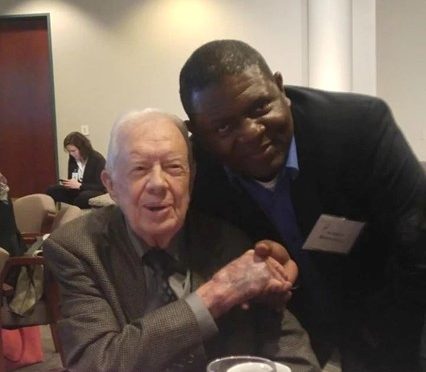
President Carter also worked to strengthen international standards for human rights and the voices of individuals defending those rights in their communities worldwide. In 2018, Brownell was invited by The Carter Center, alongside 70 fellow activists from 35 countries, for the annual Human Rights Defenders Forum for his work in West Africa to empower people victimized by resource exploitation. The group discussed authoritarianism and the backlash against human rights defenders, while also looking for ways to rebuild faith and recommit to the indivisibility of human rights.
President Carter shared directly with Brownell his theory that when defenders are protected, democracy and the rule of law thrive because environmental and human rights defenders are the world’s first line of defense in advancing and upholding the rule of law and democracy.
This was the first time Brownell heard a leader connect democracy to the work of human rights defenders, which today informs CliDef’s mission to embolden climate defenders to act by providing legal support.
President Carter was also an early advocate for conserving energy and boosting renewable electricity production. He asked his chief science adviser to write a historical memo on the dangers of fossil-fuels and carbon emissions, which also urged immediate action on the matter. By the end of the 20th century,
Carter also called for the United States to produce “20% of all the energy we use from the sun.” He also protected California’s redwood forest and 100 million acres in the Alaska Lands bill, which doubled the size of the National Park Service.
Brownell is a co-author of a series of landmark progressive legislations in Liberia that have shaped post-war governance, particularly in the realms of environmental stewardship, forestry management, extractive industries, energy production, and land use. Among his most impactful contributions are the comprehensive Environmental Protection and Management laws, which played a pivotal role in the establishment of Liberia’s Environmental Protection Agency (EPA), a crucial institution dedicated to safeguarding the country’s natural resources.
He also co-authored the Liberia Extractive Industries Transparency Initiative (LEITI) Act, the 2006 Reformed Forestry Laws, and the Community Rights Laws. Brownell also contributed to the creation of the Liberia Energy Laws, which encompass an Executive Order that initiated the Liberia Renewable Energy Agency, reflecting a commitment to sustainable energy solutions.
Perhaps Brownell’s most significant achievement lies in his groundbreaking work on Liberia’s land rights policy. He championed a progressive framework that recognizes customary land ownership as holding equal stature to private property rights, a transformative approach that empowers local communities. His exceptional leadership in the sphere of natural resource rights has earned him widespread recognition and respect.
Currently residing in the United States, Brownell serves as a Visiting Professor at the prestigious Georgetown University School of Law, where he holds the esteemed Robert F. Drinan, S.J. Chair in Human Rights. His academic journey includes a notable tenure as a Distinguished Scholar in Residence and Research Professor at Northeastern University School of Law in Boston, Massachusetts, followed by the role of Tom and Andi Bernstein Fellow at Yale Law School in New Haven, Connecticut.
Brownell is widely regarded as a preeminent leader in the fields of Natural resource rights, environmental rights law, and climate advocacy across the African continent. Over decades, he has dedicated himself to defending the rights of communities, human rights advocates, and Indigenous Peoples in West Africa and beyond. His advocacy focuses on protecting vital natural resources from exploitation and ensuring the right to a livable climate and a healthy, sustainable environment for every individual.
While residing in the U.S., he is actively engaged in building a robust support network for the Global Climate Movement. As the Lead Campaigner for the Environmental Rights Legal Framework Coalition for Africa (ERA-Africa), Brownell champions the development of an environmental rights’ legal framework, drawing on valuable insights from the Escazú Agreement in Latin America and the Caribbean, as well as the Aarhus Agreement in Europe. He also leads the African Climate Platform, coordinating a dynamic team of over fifty African public interest lawyers, along with nearly one hundred civil society organizations and frontline communities. Together, they are diligently preparing to submit a petition to the African Court, seeking an advisory opinion on the human rights obligations of African governments in the context of the ongoing climate crisis.
About CliDef
Global Climate Legal Defense (CliDef) emboldens climate defenders to act by providing legal support. We offer legal advice, coordination, and funds for legal defense and strengthen a community of diverse lawyers and legal organizations to serve the climate movement. To learn more, please visit our website: www.climatelegaldefense.org
Media Contact: [email protected]
Support Independent Journalism
Your support helps FrontPage Africa continue delivering independent, credible, and impactful journalism. Every contribution strengthens our ability to investigate, inform, and hold power accountable while keeping quality journalism accessible to our readers.
Support our journalism or subscribe to receive the latest FrontPage Africa stories and updates.