MONROVIA, Liberia – In central Monrovia, where vendors line the sidewalks with trays of biscuits, chocolate and soap, the national budget is not measured in billions. It is measured in how many customers stop, and how much they can spend.
By Rodney D Sieh
Patrick Mamligar, who sells snacks on those streets, told FrontPageAfrica earlier this year that the finance minister’s claims about an improving economy were simply not true.
His was one voice among many in that survey of traders and shoppers. Few of them could point to anything in their own lives that matched the government’s upbeat numbers.
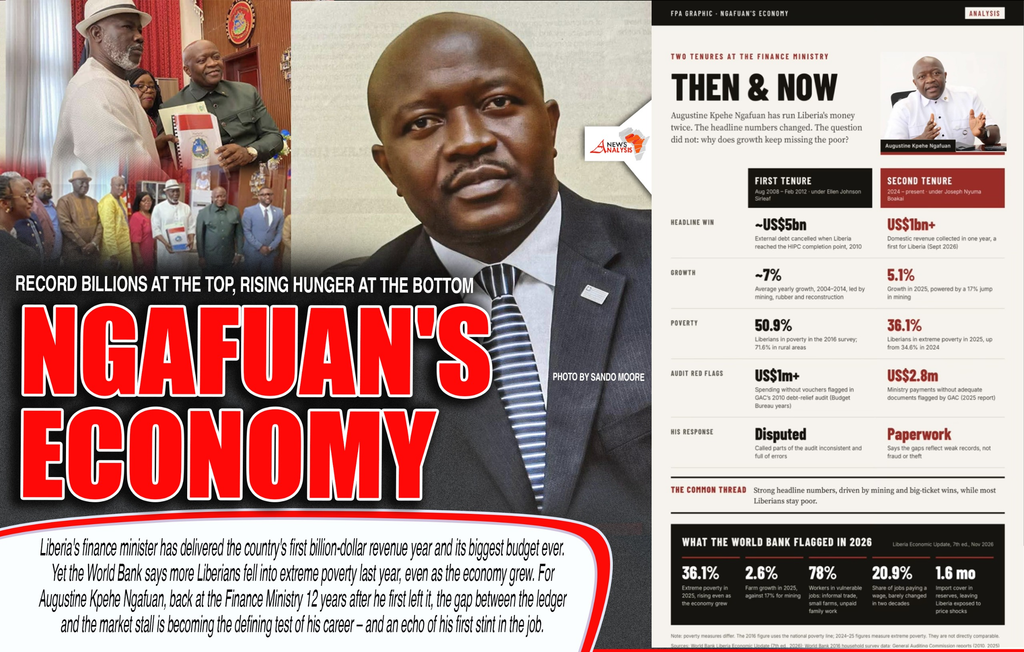
The finance minister has heard the complaint before. Pressed on whether Liberians were feeling relief, Augustine Kpehe Ngafuan asked whether the government was expected to hand out actual bread and butter before citizens accepted that their concerns were being addressed. The remark has followed him ever since.
The ledger and the street
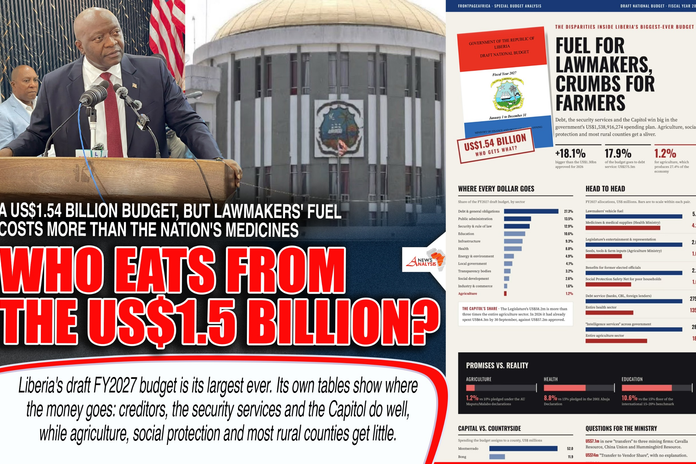
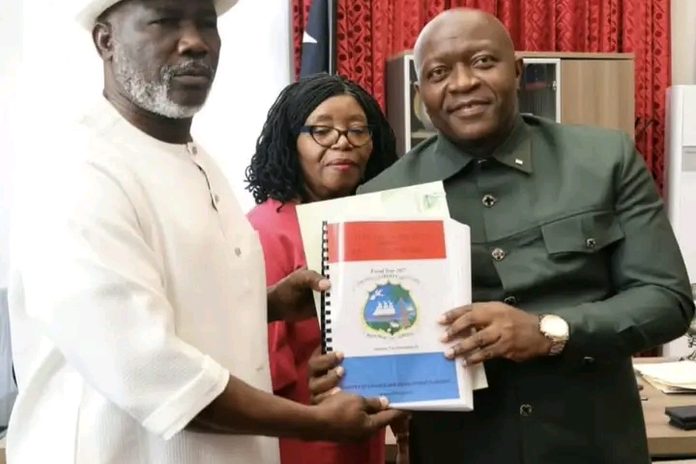
On paper, Ngafuan’s second tour at the Finance Ministry has been a run of records. In September, the Liberia Revenue Authority crossed US$1 billion in domestic collections for the first time in the country’s history. On Friday, the government sent lawmakers a US$1.538 billion budget for 2027, the largest Liberia has ever proposed.
The minister points to growth of 5.1 percent last year, inflation brought under control and the absence of the budget shortfalls that dogged the previous government. In one interview, he summed up his case in a line: Liberia is “not where we want to be,” but no longer where it was.
He also argues that patience is part of the plan. Stabilizing prices, revenue and public finances, he has said, must come before any expansion that ordinary people can feel. Roads now, he insists, mean jobs and cheaper goods later.
His critics hear something else. Opposition leader Alexander Cummings has turned the debate into a slogan about eating today rather than waiting for tomorrow.
The opposition Citizens Movement for Change recently praised Ngafuan as eloquent, then questioned his credibility, citing audit gaps and unreconciled revenue records between the ministry, the LRA and the Central Bank. Last year, the General Auditing Commission flagged US$2.8 million in ministry payments without adequate supporting documents; Ngafuan called it a paperwork problem, not theft. Critics, including opposition figures, independent analysts and a former director of the ministry’s own budget department, now describe the lapses at the Finance Ministry as among the most serious failings of President Joseph Boakai’s Unity Party-led government. Some have openly called for the minister’s removal.
The sharpest challenge, however, has come not from his political rivals but from one of the government’s closest partners.
The World Bank’s paradox
On November 3, the World Bank launched the seventh edition of its Liberia Economic Update, titled Beyond Growth. Its central finding cuts straight through the government’s narrative: the economy grew, and so did extreme poverty.
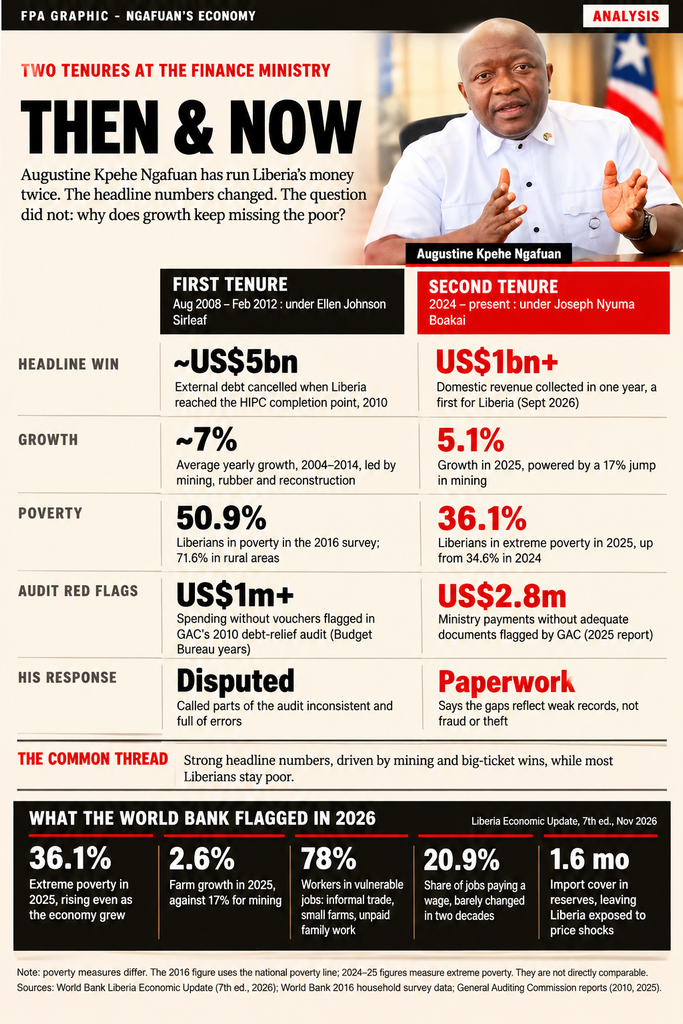
By the Bank’s estimate, the share of Liberians in extreme poverty rose from 34.6 percent in 2024 to 36.1 percent in 2025 – in the same year the economy expanded 5.1 percent. Country Manager Georgia Wallen called it the paradox at the heart of the report.
The explanation lies in where the growth came from. Mining output jumped 17 percent. Agriculture, which feeds most Liberian households and makes up about a third of the economy, grew just 2.6 percent. In short, Liberia is growing fastest where few Liberians work.
The labour figures are starker.
About 78 percent of workers are in what the Bank calls vulnerable employment – street trading, small-plot farming or unpaid family work. Wage jobs make up just 20.9 percent of employment, a share that has barely moved in two decades. Reserves covered only about 1.6 months of imports at the end of 2025, leaving the country exposed if oil or food prices spike.
The Bank expects extreme poverty to ease to 33.2 percent this year, but only if farming recovers. It also anticipates a value-added tax (VAT) starting in early 2027 – a change that could push up prices at the very stalls where Liberians already feel squeezed.
None of this is Ngafuan’s doing alone. But as the minister who sets budget priorities, he owns the question the Bank is asking: why does so little of Liberia’s new money reach the farms, markets and households where most people make their living? Agriculture, the “A” in President Joseph Boakai’s ARREST Agenda, has received less than 1 percent of recent national budgets.
‘Lower inflation is not the same as lower prices’
One of the sharpest readings of the paradox comes from a man who once sat in Ngafuan’s chair. Amara Konneh, who succeeded him as finance minister under Sirleaf and now serves as a senator, told FrontPageAfrica that Liberia’s macroeconomic numbers may be improving, but too many Liberians are still not feeling it in their pockets.
Konneh points to the Central Bank of Liberia’s own August 2026 figures. Headline inflation was 4.6 percent, down from 5.6 percent a year earlier. But domestic food prices were rising at 11.1 percent, transport at 7.6 percent and imported fuel at 6.2 percent. “Lower inflation is not the same as lower prices,” he said. A bag of rice that became expensive does not get cheaper simply because prices are rising more slowly.
He noted that the World Bank attributes the rise in poverty largely to inflation and sluggish farm growth. With mining up 17 percent, agriculture up only 2.6 percent and manufacturing shrinking 2.8 percent, he argued, growth is happening in sectors where few Liberians earn a living. Some 86 percent of Liberian firms are microenterprises.
Konneh also questions why a stronger Liberian dollar has not brought prices down. He blames the cost of moving goods from the Freeport of Monrovia to rural markets – port charges, delays, storage and unofficial fees along trade routes. “Is the stronger Liberian dollar increasing the purchasing power of Liberians?” he asked. “If not, we still have work to do.”
His most pointed figure goes to the heart of how Ngafuan’s ministry spends. Citing the World Bank, Konneh said government capital spending fell from 8.5 percent of GDP in 2024 to 5.7 percent in 2025 – from about US$406 million to US$297 million – even as revenue climbed to record highs. “That should concern us,” he said.
Konneh proposes three fixes before Christmas: a single published schedule of port charges with clearance targets; regular Commerce Ministry price monitoring to make sure a stronger currency reaches shoppers; and temporary relief for small businesses hit by delays beyond their control. He framed his comments as constructive, acknowledging the government’s progress on stability. But, he said, stability “is a means to an end. It is not the end itself.”
The first time around
Ngafuan has been here before. He first entered Ellen Johnson Sirleaf’s cabinet in 2006, at 35, as head of the Bureau of the Budget. He served as finance minister from August 2008 to February 2012, then moved to the Foreign Ministry until he resigned in 2015.
That first tenure is remembered for real achievements. Liberia reached the end of the World Bank and IMF debt relief process in 2010, wiping out close to US$5 billion in external debt. A new Public Financial Management Law passed in 2009, and civil servants began receiving salaries by direct deposit.
But it was also marked by the same tension that haunts him now. Growth in those years was strong, averaging about 7 percent a year between 2004 and 2014, according to the World Bank. Yet much of it came from mining, rubber and donor-funded reconstruction, and it did little to change daily life for most families. As late as 2016, more than half of all Liberians lived in poverty, and in rural areas the figure exceeded 70 percent.
Accountability questions surfaced then too. In 2010, a General Auditing Commission review of debt-relief-era spending asked Ngafuan and other former officials to account for more than US$1 million in expenditures made without vouchers during his time at the Budget Bureau. He rejected parts of the findings as riddled with errors.
The parallels are hard to miss: headline growth that bypasses the poor, audit queries that Ngafuan dismisses as paperwork, and a minister whose technical fluency wins praise from donors but not from the market. Last year he himself traced one of today’s documentation problems back to a 2011 contract he signed to modernize the ministry’s archives – a system, he admitted, that later broke down.
The case for the minister – and the test ahead
Ngafuan’s defenders say he inherited a broken budget, and that collecting more revenue is the first step to spending it well. They note that the 2027 plan raises health spending by 22 percent, sets new pay floors for teachers, adds about 4,350 public workers and, for the first time, commits to repaying nearly US$60 million the government owes the national pension fund.
Those are real promises. But Liberians have heard promises before, and the budget’s own numbers leave room for doubt. Part of this year’s billion-dollar milestone came from a one-off US$200 million signing bonus paid by steelmaker ArcelorMittal. Health still gets less than 9 percent of the budget, and agriculture barely features in the government’s summary at all.
The coming months will show whether Ngafuan’s economy can reach the street. Three markers matter most: whether extreme poverty falls toward the World Bank’s 33.2 percent projection; whether the planned VAT protects basic goods that poor families buy; and whether teachers, nurses and pensioners actually receive the money the budget promises them, on time.
Back on the sidewalks of central Monrovia, the verdict will not come from a report or a budget speech. It will come from whether more customers stop at the trays of biscuits and soap – and whether, at the end of the day, a vendor can carry home enough to feed a family.
Support Independent Journalism
Your support helps FrontPage Africa continue delivering independent, credible, and impactful journalism. Every contribution strengthens our ability to investigate, inform, and hold power accountable while keeping quality journalism accessible to our readers.
Support our journalism or subscribe to receive the latest FrontPage Africa stories and updates.