“It’s honestly sickening to scroll through social media and see so many people wasting their voices on empty propaganda, baseless claims, hatred, and recycled misinformation. Young people need to understand that social media is a powerful tool that can educate, organize, inspire, and create real change, not a dumping ground for ignorant rhetoric that benefits nobody. Before posting, ask whether your words add value, spread truth, or help your community in any meaningful way. If all you are doing is repeating nonsense, attacking people, and pushing lies, you are not helping your organization, your nation, or yourself.”
By: Austin S Fallah – A True Son of the Planet Earth Soil: [email protected]
President Joseph Nyuma Boakai: YOUTH RESPONSIBILITY AND NATIONAL DEVELOPMENT
“We must pay attention to youth issues.” — Joseph Nyuma Boakai, President of Liberia, as quoted by African Development Bank President Akinwumi Adesina in his July 22, 2025 address in Monrovia, referring to President Boakai’s March 13, 2025 Cabinet remarks.
Relevance: Youth engagement must be a national governance priority, not a political campaign slogan. Government must listen to young people and translate their concerns into practical policies.
“Criticism is not a threat to democracy; it is the essence.” — Joseph Nyuma Boakai, April 12, 2025, reaffirming his administration’s commitment to freedom of expression and public accountability.
Relevance: Young people must be free to question government performance, challenge political narratives, and demand accountability. However, criticism should be informed by evidence rather than misinformation.
D. Julius Kanubah, President of the Press Union of Liberia: MEDIA ETHICS AND INFORMATION INTEGRITY: “Information integrity is critical to protecting democracy, and the Press Union remains committed to supporting initiatives that strengthen these capacities, particularly among young people.” — Julius Kanubah, President of the Press Union of Liberia, in a United Nations in Liberia report on building informed digital citizens.
Relevance: Political misinformation is not merely a communication problem. It is a democratic challenge that requires responsible journalism, media literacy, fact-checking, and informed youth participation.
MISINFORMATION AND DEMOCRATIC INTEGRITY:
“And when information integrity is targeted, so is democracy – which depends on a shared, fact-based perception of reality.”
— António Guterres, June 24, 2024, launching the United Nations Global Principles for Information Integrity.
Relevance to Liberia: When political actors manipulate information, spread fabricated allegations, or deliberately mislead voters, they weaken public confidence in democratic institutions.
“False narratives, distortions and lies breed cynicism, disbelief and disengagement.” — António Guterres, June 24, 2024.
Relevance: Misinformation can discourage young people from participating in elections, community development, public debate, and national governance.
On youth engagement: “A nation that invites its young people to campaign but excludes them from decision-making is preparing voters for elections, not leaders for the future.”
On political misinformation:
“When political propaganda replaces evidence, citizens become instruments of manipulation rather than informed participants in democracy.”
On Liberian political leadership:
“Liberia does not need a generation of politically manipulated youths; it needs a generation of informed, courageous, and constructive citizens.”
On social media:
“Before sharing a political allegation, verify the facts. A smartphone should be an instrument of enlightenment, not a weapon of political destruction.”
On opposition and government: “Loyalty t o Liberia must be greater than loyalty to any political party, politician, or government.”
On democratic accountability:”Constructive criticism strengthens democracy, but deliberate misinformation weakens the very institutions that protect our freedoms.”
On national unity:”Liberia’s political future cannot be built on ethnic hostility, regional divisions, political hatred, or manufactured public outrage.”
On the responsibility of political leaders:”Political leaders must stop treating young people as electoral commodities and start recognizing them as partners in national development.”
Liberia stands at an important moment in its national development.
With a young population, expanding access to mobile technology, and growing participation in political discussions, the country possesses an enormous reservoir of energy, creativity, and ambition.
Young Liberians can become entrepreneurs, scholars, public servants, innovators, journalists, artists, and community leaders who help move the nation forward.
Yet youth participation is not automatically constructive simply because it is energetic or highly visible online.
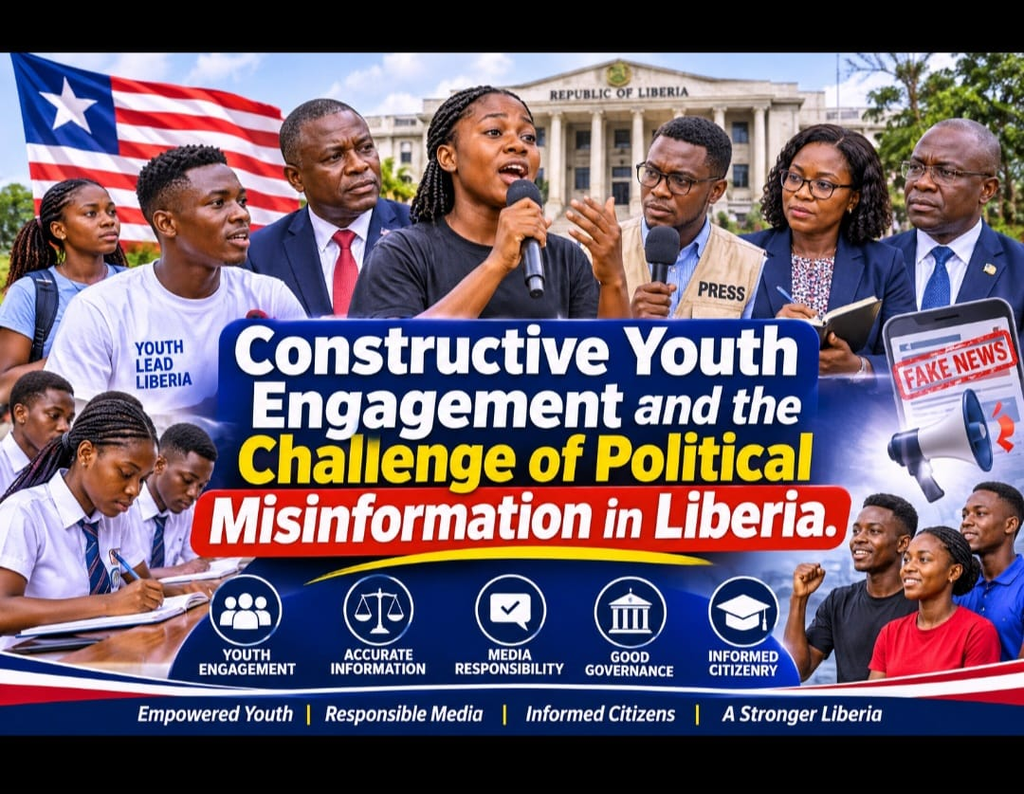
Like many countries worldwide, Liberia faces a contrast between two forms of youth political engagement: one grounded in education, evidence, civic responsibility, and national development, and another driven by misinformation, partisan hostility, personal insults, and simplistic narratives.
The Liberian government, civil society organizations, educational institutions, and political leaders should recognize this difference and actively engage young people who are prepared to contribute intellectually and responsibly to the country’s future.
Comparing constructive youth engagement with destructive political behavior shows why this issue matters.
Constructive young people seek knowledge, ask difficult questions, respect facts, and participate in public debate to improve society.
They may criticize the government, security institutions, political parties, or public officials, but their criticism is based on evidence and a desire for accountability.
In contrast, destructive political behavior often depends on rumor, propaganda, online harassment, tribal or partisan insults, and automatic opposition to any idea associated with a rival political group.
While the first approach strengthens democracy, the second weakens public trust.
It makes it more difficult for Liberia to address urgent national challenges such as unemployment, education, health care, infrastructure, corruption, and public security.
Young people worldwide are showing that modern citizenship requires more than speaking loudly on social media.
Across Africa, Europe, Asia, and the Americas, youth are using technology to build businesses, organize educational campaigns, monitor elections, promote climate awareness, create digital platforms, and advocate for transparent government.
They are learning coding, finance, agriculture, public policy, engineering, journalism, and law.
They are participating in global conversations while also finding practical solutions to local problems.
Liberia’s young people should be encouraged to see themselves as part of this international generation.
They should not be limited by the narrow politics of insults, rumors, or permanent party loyalty.
Instead, they should be equipped to compete in the 21st-century economy and to participate intelligently in democratic life.
The distinction between informed engagement and uninformed agitation is particularly clear in the age of social media. Social media has created valuable opportunities for communication.
A young person in Monrovia, Gbarnga, Buchanan, Voinjama, Harper,Sanniquelle, Tubmanburg, or Greenville can now share ideas with a broad audience.
Citizens can report local problems, follow national debates, promote businesses, and connect with educational resources.
Social media can also make public officials more accountable because information travels quickly and citizens can ask questions directly.
However, the same platforms can spread falsehoods faster than verified information.
A rumor posted online can become accepted as truth before journalists, investigators, or other responsible institutions have had a chance to examine the facts.
This danger is not unique to Liberia.
In the United States, for example, social media has contributed to polarization by encouraging people to consume information that supports their existing political beliefs.
In Kenya, Nigeria, South Africa, Ghana, and other African democracies, online misinformation has sometimes intensified electoral tensions and ethnic or partisan division.
The lesson from these countries is that technology alone does not create an informed society.
Digital access must be accompanied by digital literacy.
Young people need to learn how to identify reliable sources, distinguish opinion from fact, verify claims, recognize manipulation, and avoid sharing unconfirmed stories.
Without these skills, social media can become a tool for confusion rather than progress.
One of the most harmful forms of misinformation occurs when national security agencies are treated as if they belong personally to whichever president is currently in office.
In a democratic state, security institutions are not the private property of a president, political party, or influential individual.
They are public institutions established to protect the nation, enforce the law, and preserve public order within constitutional limits.
Their legitimacy depends on professionalism, impartiality, accountability, and respect for human rights.
When an officer commits a crime or acts improperly, that individual should be investigated and held accountable.
However, it is intellectually careless to assume that every wrongdoing by an individual member automatically proves that an entire institution is a personal political weapon.
At the same time, citizens have a right to question security agencies when they have legitimate concerns about abuse, selective enforcement, misconduct, or political interference.
Responsible civic engagement does not require blind loyalty to the government or state institutions.
Rather, it requires a balanced approach. Citizens should demand evidence, fair investigations, transparent procedures, and equal application of the law.
The proper question is not whether a security agency is popular with one political party or another.
The proper question is whether it is acting lawfully, professionally, and in the public interest.
This comparison is essential because political rhetoric often turns complex legal matters into simplistic partisan slogans.
When a member of a political party is investigated or prosecuted for an alleged crime, supporters may immediately describe the case as a “witch hunt.”
In some circumstances, political prosecution can indeed occur in weak democracies, and citizens should remain alert to that possibility.
Nevertheless, calling every investigation a witch hunt simply because the accused person is politically connected is not a serious defense of justice.
No individual should be considered above the law because of party membership, wealth, popularity, ethnicity, or family background.
Likewise, no person should be unfairly targeted because of political affiliation.
The standard must be consistent: evidence, due process, fair trial rights, and impartial enforcement.
A mature democracy requires citizens who can hold two ideas at once.
First, government power must be monitored because institutions can make mistakes or be abused.
Second, public officials, party leaders, and their supporters cannot use claims of persecution to escape accountability whenever credible allegations arise.
This kind of intellectual maturity is especially necessary among young people, who will inherit the country’s institutions and political culture.
Liberia cannot develop a stable democracy if every legal case is interpreted through the lens of party loyalty.
Nor can it move forward if every criticism of a government official is dismissed as opposition propaganda.
The country needs a civic culture in which facts matter more than political slogans.
The Liberian government should therefore create meaningful avenues for engagement with serious, motivated, and development-oriented youth.
Such engagement should not be limited to ceremonial youth programs or political rallies.
It should include youth advisory councils, internships in public institutions, town hall meetings, debate forums, leadership fellowships, vocational training, and support for youth-led businesses.
Young people who are studying public administration, agriculture, information technology, law, education, health sciences, environmental management, and engineering should be given opportunities to contribute their knowledge.
Government ministries can benefit from listening to young citizens who understand both local realities and global trends.
For example, young Liberians can contribute significantly to agricultural modernization.
Liberia has fertile land and considerable agricultural potential, yet many communities still face food insecurity, limited market access, and inadequate processing facilities.
A youth engagement strategy could support young farmers, agricultural researchers, agribusiness owners, and technology developers.
Rather than focusing only on political disputes online, young people could help introduce improved farming methods, mobile market systems, climate resilient crops, and local food processing enterprises.
This would create employment while reducing dependence on imported goods.
Education offers another important point of comparison.
An uninformed political culture often rewards people for repeating popular statements without checking whether they are accurate.
An educated civic culture, by contrast, rewards research, dialogue, and independent thinking.
Liberia should invest in schools, libraries, teacher development, digital learning centers, and civic education programs that teach students how government works.
Young people should understand the responsibilities of the executive, legislature, judiciary, police, military, and other public agencies.
They should also learn the meaning of constitutional rights, due process, freedom of expression, peaceful assembly, and civic duty.
When citizens understand institutions, they are less likely to be manipulated by those who use fear or politicsal anger for personal advantage.
Political parties also have responsibilities in this process.
Too often, parties mobilize young people primarily as campaign workers, online defenders, rally participants, or instruments of confrontation.
This approach wastes the potential of a generation.
Political leaders should not encourage youths to insult opponents, spread unverified information, or threaten critics.
Instead, they should train young members in policy analysis, peaceful campaigning, public speaking, conflict resolution, and ethical leadership.
A political party that respects young people should prepare them to become competent leaders, not merely loud defenders of party interests.
The language used in public discourse matters as well.
It is understandable that frustration may arise when people encounter false information, reckless accusations, or aggressive partisan behavior.
However, national progress requires more than responding to poor arguments with personal insults.
Terms that demean others may attract attention online, but they rarely persuade anyone or improve public debate.
The goal should be to challenge misinformation firmly while maintaining a standard of dignity.
Young Liberians should learn that being intellectually serious means criticizing ideas without degrading people.
A person may be wrong, misinformed, or politically biased, but the best response is evidence, logic, and respectful correction.
This does not mean that young people should become silent or passive.
On the contrary, Liberia needs bold youth voices.
It needs young people who question poor policies, expose corruption, demand better services, and defend constitutional rights.
But boldness should be combined with discipline.
A young person who researches an issue, presents evidence, listens to opposing views, and proposes solutions is far more powerful than someone who merely spreads anger.
The former earns credibility at home and abroad; the latter may gain temporary online attention but contributes little to lasting change.
Ultimately, the question is not whether Liberian youth should participate in national affairs.
They must participate, because they are central to Liberia’s future.
The real question is what kind of participation the country will encourage.
Liberia can cultivate a generation that is globally aware, academically prepared, technologically skilled, politically responsible, and committed to the common good.
Or it can allow public discourse to be dominated by misinformation, personal attacks, blind partisanship, and distrust of every institution.
The Liberian government should prioritize engagement with young people who demonstrate seriousness, integrity, intellectual curiosity, and commitment to national development.
At the same time, it should expand educational and civic opportunities so that more youths can develop those qualities.
Civil society, schools, religious institutions, the media, families, and political parties must support this effort.
The country’s youth should be challenged to rise above narrow political quarrels and to recognize that their future depends on more than defending a party or attacking a rival.
It depends on building institutions, pursuing knowledge, respecting the rule of law, and contributing practical solutions to Liberia’s many challenges.
If Liberian youths are to be taken seriously on the international stage, they must show that they can engage with national issues thoughtfully and responsibly.
The world respects young leaders who are informed, disciplined, innovative, and courageous.
Liberia has many such young people, and they deserve to be heard, supported, and included.
Their energy should be directed not toward the politics of false propaganda and endless hostility, but toward the hard and honorable work of national renewal.
Support Independent Journalism
Your support helps FrontPage Africa continue delivering independent, credible, and impactful journalism. Every contribution strengthens our ability to investigate, inform, and hold power accountable while keeping quality journalism accessible to our readers.
Support our journalism or subscribe to receive the latest FrontPage Africa stories and updates.