Monrovia – The World Bank has released a report that detailed how mining-led growth is not creating enough jobs, and that the country is wallowing into extreme poverty
By Emmanuel Weedee-Conway
The Bank says Liberia’s economy is growing faster, but most citizens are not feeling the benefits, stating that extreme poverty has edged up even as national output expands.
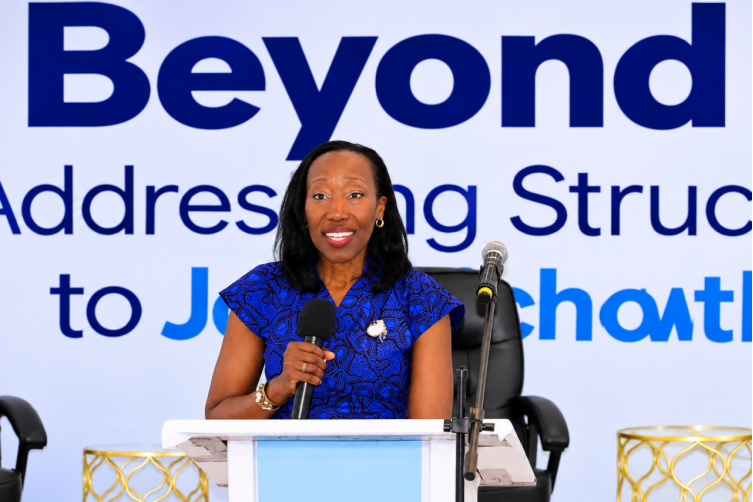
At the launch of the seventh Liberia Economic Update, World Bank Country Manager Georgia Wallen described this as the “paradox at the heart of this report”: the economy is growing, yet more people are struggling to meet basic needs.
Delivering the report, she began with the good news: Real GDP growth rose to an estimated 5.1 percent in 2025, up from 4 percent the year before. Inflation was contained, and the fiscal deficit narrowed to 2.1 percent of GDP.
Madam Wallen credited the government’s and the Central Bank’s “disciplined macroeconomic management,” which she said “deserves recognition.”
The economy has also held up against external shocks. Conflict and disruptions at maritime choke points have unsettled global energy markets and pushed up fuel prices, affecting import-dependent countries like Liberia in early 2026.
Policymakers, she noted, are moving swiftly to contain the risks while maintaining prudent policies.
Even so, extreme poverty is estimated to have climbed from 34.6 percent to 36.1 percent over the past two years. Wallen said this reflects the nature of recent growth, which has come largely from mining, a capital-intensive sector that generates few jobs and offers limited opportunities for local businesses.
According to the report, agriculture, manufacturing and small-scale services, where most Liberians earn their living, have lagged. It states that about 78 percent of workers are in vulnerable informal employment, while nine in ten firms are small or micro enterprises.
“What will it take?” Wallen asked, pointing to farmers facing high transport costs, traders running generators because electricity is unreliable, and entrepreneurs struggling with taxes.
This edition focuses on state-owned enterprises (SOEs), which provide electricity, water, port and fuel services. These services shape business costs and determine whether households have light at night. They also carry significant fiscal risks for the national budget.
The report finds that policymakers cannot see the full portfolio. Many entities do not submit financial reports, while most existing audits are delayed. Wallen called the creation of the State-Owned Enterprises Authority of Liberia (SEAL) “a significant and positive step.”
SOEs alone do not explain the jobs challenge, she indicated, but better information and accountability are practical starting points. Most recommended steps can be taken under existing law.
The report also highlights two trade-offs. The government achieved fiscal consolidation partly by cutting capital spending, which fell from 8.5 percent of GDP. The World Bank Country Chief warned that this approach has limits, since roads, electricity and other infrastructure are essential to Liberia’s growth.
And with iron ore and rubber accounting for more than 90 percent of exports, public finances remain exposed whenever global prices weaken.
Macroeconomic stability is the central foundation, she furthered, and “now is the time to use that foundation to take off.”
The choices ahead, she asserted, concern the quality of public investment, services and information as much as the quantity of growth. Government cannot do it alone; the private sector, civil society and development partners all have a role.
Presenting Chapter Two, “Beyond Growth: Addressing Structural Constraints to Job-Rich Growth in Liberia,” World Bank Senior Public Sector Specialist Bonnie Ann Siroris reveals that the government lacks the reliable information needed to assess SOE performance, fiscal exposure and value for money.
“Oversight covers less than half of the operational portfolio. Over six years, financial information was submitted for only 83 of 276 potential entity-years, while 25 of the 46 entities operating through 2025 never submitted a single return. Reporting standards also vary.”
Although the PFM Act requires International Financial Reporting Standards, entities use a mix of IFRS, public sector standards and U.S. GAAP, while some have no defined accounting basis. That, Siroris told the gathering, can make aggregated figures “very misleading.”
Audits tell a similar story. Seventeen operational entities have completed at least one audit since FY19, and 29 more are underway. Only four audits across all SOEs received unqualified opinions, while all 10 available compliance audits were adverse. Where figures could be compared, 40 percent differed by more than 5 percent between audit reports and Bureau of State Enterprises or SEAL data. The General Auditing Commission has pledged to clear its backlog by June 2028.
The SEAL Act was signed in February 2026, and the former Bureau of State Enterprises is transitioning into the new body.
But oversight is only part of the solution, Siroris noted, because boards must also fulfill their responsibilities.
A 2023 sample showed uneven attendance, and there is no portfolio-wide data on directors’ qualifications, interests or compensation. She recommended a director register, conflict-of-interest declarations, board induction and basic governance records.
The 19 reporting entities show an adjusted surplus of about $28 million for FY24, but three account for roughly $47.4 million of that total. The other 16 posted a combined deficit of about $19.4 million. The largest surplus, at NASSCORP’s core, reflects pension and investment accumulation, not distributable profit.
Those results include $15.1 million in government subsidies and $16.7 million in grants from development partners. Without them, the portfolio would record a loss of about $2.7 million.
At the end of 2025, the 19 entities reported about $815.4 million in liabilities. SOE loans on-lent or guaranteed by the government stood at about $423.3 million, with the Liberia Electricity Corporation (LEC) accounting for roughly 77 percent. Even these figures are incomplete, as there is no reconciled account of arrears, unpaid government bills, supplier claims or court judgments.
LEC’s own revenue rose substantially between FY22 and FY24, but its earnings were positive only when grant income was included, much of it non-cash. It received adverse audit opinions through FY23 and is owed about $34 million, roughly $30.8 million of which is owed by government bodies.
Siroris cautioned against interpreting a subsidy as evidence of poor performance, since it may finance a legitimate public service obligation.
By the end of FY27, the report calls for classifying the portfolio, creating verified entity and director registers, introducing a common reporting template and directing audit resources to the five highest-risk entities. By June 2028, it wants the government’s full fiscal relationship with LEC, the National Port Authority and the Liberia Petroleum Refining Company reconciled.
“Stronger SOE governance will not automatically reduce electricity costs, improve services, or create jobs,” Siroris said. Instead, it creates the conditions to identify underperformance, diagnose its causes, assign corrective action and track results.
The real task, she said, is not whether every SOE turns a profit, but whether the government, the legislature and the public can determine what each entity costs, delivers and risks, and whether the portfolio offers value for money.
Support Independent Journalism
Your support helps FrontPage Africa continue delivering independent, credible, and impactful journalism. Every contribution strengthens our ability to investigate, inform, and hold power accountable while keeping quality journalism accessible to our readers.
Support our journalism or subscribe to receive the latest FrontPage Africa stories and updates.