The United Nations has urged its member states to renew their commitment to cooperation, peace, development and human rights, as Liberia, once host to one of the organization’s largest peacekeeping operations, prepares to take the presidency of the UN Security Council in December.
By Patience M. Jones/ [email protected]
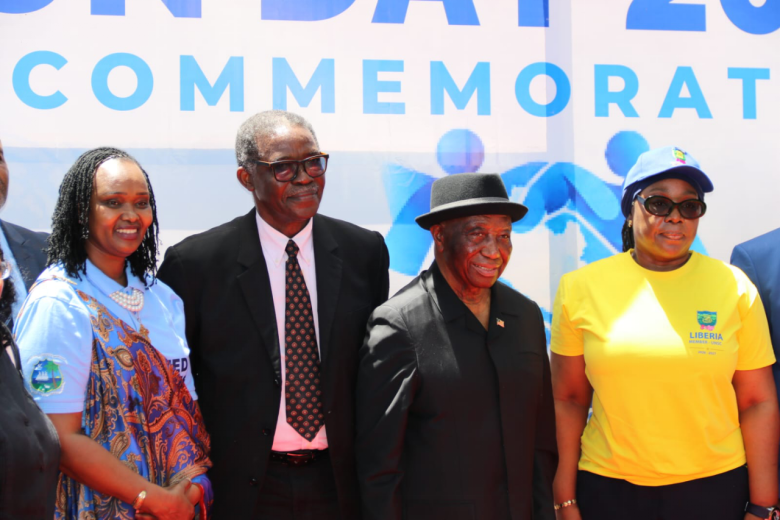
The appeal was made Monday, October 26 at Liberia’s observance of UN Day 2026 at the Ministry of Foreign Affairs on Capitol Hill, Monrovia.
The event was held under the theme: “Liberia on the UN Security Council: From Sustaining Peace at Home to Advancing Peace and Security Globally.”
President Joseph Nyuma Boakai Sr., Foreign Minister Sara Beysolow Nyanti and UN Resident Coordinator Christine N. Umutoni attended alongside diplomats, civil society representatives, academics and young people.
Delivering the message of UN Secretary-General António Guterres, UN RC Umutoni said the organization remains indispensable in addressing the world’s interconnected challenges.
She noted that its 81-year history shows the value of settling disputes through diplomacy and international law, protecting human rights, delivering humanitarian aid and advancing gender equality.
She cautioned that armed conflicts, humanitarian crises and inequality are growing, while emerging technologies are advancing faster than governments’ capacity to regulate them.
“Now more than ever, let us stand firm in our resolve to uphold the United Nations Charter and international law,” the message stated. It called for dialogue over division, cooperation over confrontation and solidarity over fear.
Umutoni said Liberia’s election to the Council demonstrates the worth of international partnership and the enduring relevance of multilateralism.
She also paid tribute to the Youth Advisory Panel and Model United Nations and revealed that this was her final UN Day in Liberia, with about three months remaining in her assignment.
In special remarks, President Boakai thanked the UN personnel and partners who helped end Liberia’s war, describing the organization’s contribution as “immeasurable.”
He also credited the international community with supporting successive peaceful elections and democratic transfers of power.
The President announced that Liberia will hold the Council’s rotating presidency in December, calling it a defining moment for the country’s diplomacy.
According to Minister Nyanti, maritime security will be Liberia’s signature initiative, and the President is expected to chair a high-level debate on the subject on December 3, 2026.
“For the first time in our history, Liberia secured a majority vote in the General Assembly for a full two-year term as a non-permanent member of the Security Council,” President Boakai said.
He pledged to approach the role with humility, drawing on Liberia’s experience of war and reconciliation.
He acknowledged that the presidency comes at a time when the UN faces questions about its effectiveness and relevance. Artificial intelligence, climate change, irregular migration, deepening inequality and the frustrations of young people, he said, are challenges no country can resolve alone.
He called for a UN that is responsive to developing countries and gives vulnerable nations a meaningful voice.
In her theme address, Minister Nyanti described Liberia’s election as the culmination of decades of diplomatic engagement and national sacrifice.
She said Liberia received 181 of 187 votes in June 2025 for a non-permanent seat for 2026–2027 and took its place on January 1, 2026. Liberia is the last of the four African founding signatories of the UN Charter to be elected to the Council.
Liberia was among the 50 founding members that signed the Charter in 1945. Minister Nyanti set the current term apart from 1961, when Liberia and Ireland shared a contested seat after a prolonged voting deadlock, each serving one year.
She also recalled Liberia’s opposition to apartheid and the 1969 election of Angie Brooks as president of the UN General Assembly.
Liberia’s standing at the Council is closely linked to its own recovery.
During the 14-year civil conflict, the UN worked with ECOWAS, the African Union and other partners on peace efforts and humanitarian assistance.
After the Comprehensive Peace Agreement was signed in Accra in August 2003, the Security Council established the United Nations Mission in Liberia (UNMIL) through Resolution 1509.
At its peak, UNMIL deployed about 15,000 military personnel, more than 1,000 police officers and civilian staff. The mission closed in March 2018, when responsibility for security passed fully to Liberian authorities.
Minister Nyanti highlighted Liberia’s expanded diplomatic relations, including the reopening of an embassy that had been closed for 35 years, visa-extension initiatives and representation in regional judicial institutions.
She announced that Liberia will launch what she called Africa’s first gender-responsive feminist foreign policy on November 17, 2026.
Activities planned around the presidency include a diplomatic briefing, a Peace and Reconciliation Museum, a war memorial, a maritime safety and security event, a Model UN Security Council debate for young people, and a compendium of Liberia’s peace agreements compiled by Foreign Service Institute students.
A billboard unveiled at the Ministry recognized the administration’s foreign policy achievements, and Minister Nyanti called Boakai Liberia’s “Foreign Policy Legacy President.”
The President credited the collective work of the Foreign Ministry, the Ministry of State and Liberia’s diplomatic missions.
Both Umutoni and Boakai stressed the importance of teaching young Liberians about their country’s diplomatic history. A parallel celebration was held at the One UN Hub in Zwedru, Grand Gedeh County.
For the UN, the significance of Liberia’s presidency will be judged less by the historic nature of its election than by what the country contributes to peace, security and human rights during its month at the helm.
Support Independent Journalism
Your support helps FrontPage Africa continue delivering independent, credible, and impactful journalism. Every contribution strengthens our ability to investigate, inform, and hold power accountable while keeping quality journalism accessible to our readers.
Support our journalism or subscribe to receive the latest FrontPage Africa stories and updates.