MONROVIA — The Liberia Institute of Statistics and Geo-Information Services (LISGIS) and the Economic Community of West African States (ECOWAS) have called for stronger leadership, institutional capacity-building, and the integration of artificial intelligence (AI) into statistical systems across West Africa to improve data production and support evidence-based policymaking.
By Francis G. Boayue
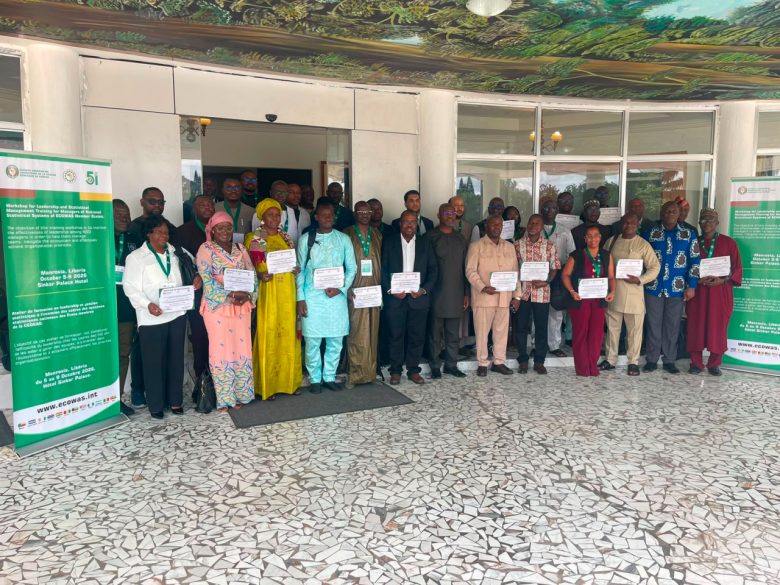
The call was made during the closing ceremony of a five-day leadership and statistical management training for heads and senior managers of national statistical institutions across the sub-region held over the weekend in Monrovia, Liberia.
Speaking at the ceremony, LISGIS Director General Richard Fatorma Ngafuan described Liberia’s hosting of the training as a significant milestone, noting that it was the first statistical leadership training of its kind held in the country.
Ngafuan thanked the ECOWAS Commission for the opportunity and expressed hope that Liberia would continue hosting similar regional programs aimed at strengthening statistical institutions and professional collaboration among member states.
He emphasized that developing effective statistical systems requires more than technical expertise, arguing that institutional leaders must also acquire the management and leadership skills necessary to improve performance and service delivery.
Referencing futurist Alvin Toffler, Ngafuan stressed the importance of continuous learning and adaptation in a rapidly changing world.
He said the training provided participants with an opportunity to strengthen their understanding of institutional governance, leadership, and the effective management of national statistical agencies.
According to Ngafuan, statistical institutions must also improve how they communicate data and research findings to policymakers, public officials, and ordinary citizens who may not understand technical statistical terminology.
He said the ability to translate complex statistical information into accessible language is essential to ensuring that data informs public policy and contributes to national development.
The LISGIS Director General also urged statisticians across West Africa to embrace artificial intelligence and explore its potential to accelerate data production and improve the timeliness of official statistics.
Ngafuan observed that technological developments are transforming the way information is collected, processed, analyzed, and communicated, making it necessary for statistical institutions to strengthen their technological capabilities.
He encouraged participants to consider developing AI-powered tools and agents that could support statistical production and ensure that timely, reliable data is available for policy formulation and development planning.
“Statisticians in West Africa should not be talking about slowing down,” Ngafuan said, emphasizing the need to accelerate institutional capacity-building in response to technological advancements.
He added that participants should share the knowledge gained during the training with colleagues and staff in their respective countries to promote institutional improvements and strengthen regional statistical systems.
Ngafuan also highlighted the diversity of West Africa, noting that despite differences in language, geography, and national circumstances, countries share a common interest in improving the quality and usefulness of official statistics.
He concluded by thanking the ECOWAS Commission and LISGIS staff for their collaboration in organizing the training, describing the program as a successful step toward strengthening statistical leadership in the region.
Meanwhile, Samson Bel-Aube Nougbodobove, Director of Research and Statistics at the ECOWAS Commission, emphasized the distinction between leadership and management, urging participants to apply the skills acquired during the training and extend the learning experience to other officials within their institutions.
He said ECOWAS intends to share leadership training materials with participating countries to enable them to organize similar programs for technical directors and other senior officials responsible for economic statistics, social statistics, coordination, and related areas.
Nougbodobove described the training as the commission’s first leadership program specifically organized for directors general of national statistical institutions.
He indicated that the initiative could be expanded to reach other levels of statistical management and technical personnel across the region.
On artificial intelligence, the ECOWAS official said the commission wants West African statistical institutions to participate actively in discussions about how emerging technologies can improve the production and management of official statistics.
He disclosed that the commission would engage relevant officials to explore the establishment of a small working group focused on artificial intelligence and its application to statistical systems.
According to Nougbodobove, the proposed initiative could help member states develop a common regional approach to AI adoption while encouraging countries to share their experiences and expertise.
He cited the potential for countries making progress in AI applications to share knowledge with other member states, reducing dependence on external expertise and strengthening regional cooperation.
Rather than relying primarily on study visits outside the continent, he encouraged countries to learn from one another by exchanging technical knowledge and practical experiences within West Africa.
Nougbodobove also urged participants to strengthen confidence in ECOWAS as a regional institution and contribute proposals that could improve statistical development across member states.
He stressed that the commission exists to serve its member countries and that stronger cooperation among national statistical agencies is necessary to advance regional development.
He further acknowledged concerns about institutional challenges and the cancellation of scheduled activities, saying the commission was committed to improving implementation and ensuring that resources allocated to training and workshops produce meaningful results.
The ECOWAS official encouraged national statistical institutions to strengthen their capabilities and work toward making West Africa a leading region in statistical development on the African continent.
The five-day training brought together senior statistical officials from across West Africa to discuss leadership, institutional management, capacity-building, and emerging technologies.
The program was intended to strengthen the ability of statistical institutions to produce and communicate reliable data that can inform policymaking, improve governance, and support socioeconomic development across the ECOWAS region.
Support Independent Journalism
Your support helps FrontPage Africa continue delivering independent, credible, and impactful journalism. Every contribution strengthens our ability to investigate, inform, and hold power accountable while keeping quality journalism accessible to our readers.
Support our journalism or subscribe to receive the latest FrontPage Africa stories and updates.