https://www.facebook.com/share/r/18HSumSW1Y/
https://www.facebook.com/share/r/1DMWyZBLWS/
https://www.facebook.com/share/r/19UDhpys3U/
Austin S. Fallah: Ask not, “What can Liberia give me?” But “What can I contribute to Liberia?” Paraphrased from former US President John F. Kennedy, who spoke the famous words, “Ask not what your country can do for you—ask what you can do for your country,” during his Inaugural Address on January 20, 1961.
By: Austin S Fallah: A True Son of the Planet Earth Soil: [email protected]
President Joseph Nyuma Boakai, Sr.: “Meaningful youth participation requires more than listening to concerns.”
President Joseph Nyuma Boakai: “We are investing in you—through improved education, teacher training, digital skills, job creation, and strong institutions.”
Former President George Manneh Weah: “The President said he strongly believes that young people are capable of conquering the world if given a place to stand.”
Former President George Manneh Weah: “A true revolutionary is someone who guides and leads people in a peaceful state of mind.”
Former President George Manneh Weah: “Education delayed should not be education denied.”
Former President Ellen Johnson Sirleaf — to young people: “Be what you want to be; stay the course and don’t be distracted by challenges.”
Former President Ellen Johnson Sirleaf: “The youth of Liberia are our future.”
Dr. Togba-Nah Tipoteh: “The government, the World Bank, and the IMF are still making the gross mistake of saying that Liberia is experiencing progress because the economic growth rate per capita or per person is rising.”
Dr. Henry Boima Fahnbulleh, Jr.:
“Love the people, serve the people, respect the people, and be committed to their welfare.”
Political Advisor Samuel Kofi Woods: Reflecting on his own youth activism. Hon. Woods explained that he began at age eleven through initiatives centered on “clean-up campaigns and empowerment.””
Cllr. Samuel Kofi Woods: “Youth should not merely inherit Liberia’s problems; they must acquire the knowledge, civic responsibility, and peacebuilding skills necessary to transform them.”
Dr. Jarso Maley Jallah — Minister of Education: “Our children are not just the future; they are the present.”
Dr. Jarso Maley Jallah: “This is your moment. Embrace it with courage, curiosity, and commitment. Dream boldly. Learn diligently.”
Hon. Cornelia W. Kruah — Minister of Youth and Sports: “You are not the future of this country. You are the current, the present. You are Liberia.”
Hon. Cornelia W. Kruah: “Whatever Liberia becomes in the next 20 years, it becomes because of the decisions that we make.”
Hon. Bill McGill Jones: “We are solution finders. We are decision-makers, and we are deciding the destiny of our fate.”
Cllr. Jeror Cole Bangalu — former Minister of Youth and Sports
“I urge all Liberian youth to seize the opportunity.”
Hon. D. Zeogar Wilson — Former Minister of Youth & Sports: “I am telling you to tell them to say no to violence and yes to peace.”
Hon. Lenn Eugene Nagbe — Former Minister of Youth & Sports: “Urged young Liberians to pursue technical and vocational education rather than viewing government employment as the only avenue to economic advancement”
Prof. P. L. O. Lumumba: “Moving forward is perilous, moving backward is cowardice, and standing still is suicidal.”
Lee Kuan Yew, former leader of Singapore: “My definition of an educated man is a man who never stops learning and wants to learn.”
Goh Chok Tong: “A young population is a huge asset provided it is properly trained.”
Tharman Shanmugaratnam: “We have to encourage our students to take more intellectual risk.”
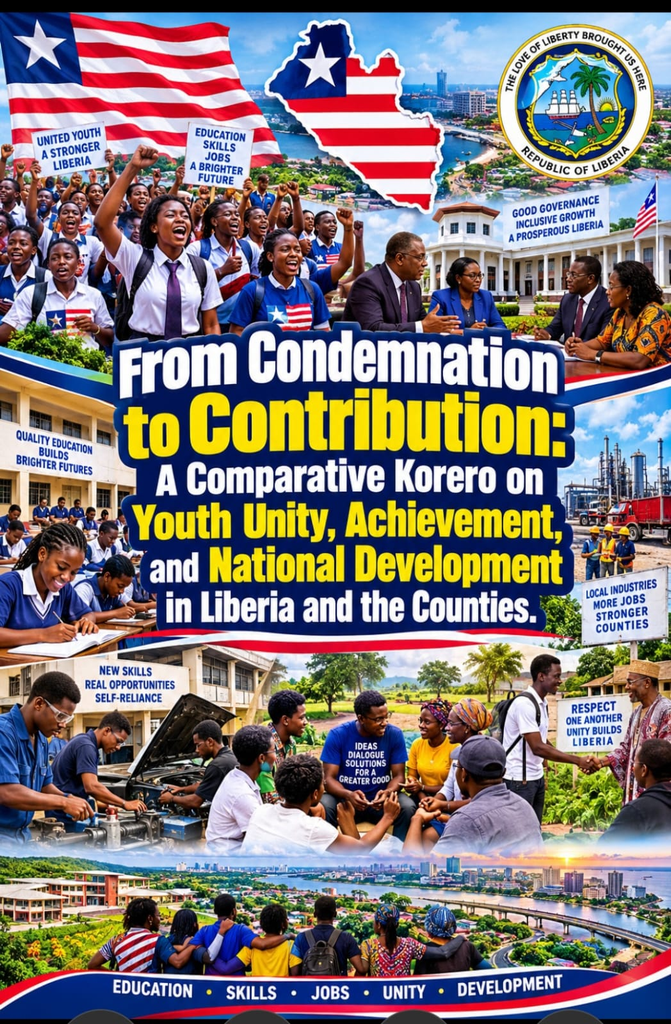
From the writings on the intellectual walls of Hon. Edward Wesee and Hon. Alexander Torbor Kun: Our motherland Liberia will not be built by any government alone. It can only be built when educated, disciplined, united people, visionaries, and courageous young Liberians decide that their counties, communities, and nation are worth serving.”
Liberia’s future will be determined not only by government policies, international partnerships, or natural resources but also by the attitudes and actions of its young people.
In Liberia and throughout the diaspora, young Liberians possess remarkable energy, intelligence, creativity, and ambition.
They are students, entrepreneurs, health professionals, engineers, artists, public servants, activists, athletes, researchers, and community leaders.
Yet too often, their achievements are met not with encouragement, constructive criticism, or national pride but with suspicion, gossip, political labeling, personal attacks, and discouragement.
This culture of unnecessary condemnation has become a quiet obstacle to national progress.
Young people must learn to celebrate one another when someone succeeds.
Hailing another person’s achievement does not mean pretending that the person is perfect, ignoring wrongdoing, or abandoning accountability.
Rather, it means recognizing that individual progress can contribute to collective progress.
When a young Liberian earns a scholarship, starts a successful business, develops a medical innovation, receives a professional appointment, publishes research, writes a book, creates jobs, or represents the country positively abroad, that achievement should be viewed as a national asset.
In comparison with many societies that actively promote and support their young achievers, Liberia’s culture of criticism and social division often weakens the very people who could help move the nation forward.
One of the most important differences between developing societies that make consistent progress and societies that remain trapped in cycles of disappointment is how they respond to achievement.
In many countries, people understand that national development requires an ecosystem of encouragement.
This does not mean that those countries are free from jealousy, political conflict, or social inequality.
Every nation has critics, rivalries, and disagreements.
However, successful societies generally create room for talented recognizing achievements, innovation, and public service.
They understand that when a citizen succeeds, the country gains a model, a mentor, a possible employer, a taxpayer, a donor, or a source of inspiration for the next generation.
For example, countries such as the United States, India, South Korea, Rwanda, Nigeria, and Ghana have produced young entrepreneurs, technology leaders, scientists, physicians, and innovators whose work contributes to both national and international development.
In the United States, successful entrepreneurs are often cited as examples of creativity and risk-taking, even when their businesses face criticism or regulation.
In India, networks of educated professionals, investors, diaspora communities, and institutions that value innovation have supported the growth of technology companies.
South Korea transformed itself from a war-torn and impoverished country into a global leader in technology, manufacturing, entertainment, and education partly because it invested heavily in human capital and developed a national culture that valued advancement.
Liberia can not simply copy these countries’ systems because every nation has its own history, resources, and political realities.
However, Liberia can learn from the principle behind their success: development requires recognizing talent, rewarding productivity, and building institutions that let capable citizens contribute.
A country does not become prosperous because its citizens constantly insult one another online and on social media.
It does not produce scientists by mocking students who are trying to learn.
It does not build industries by tearing down entrepreneurs before their businesses have the opportunity to grow.
It does not create a strong health sector by ridiculing doctors, nurses, pharmacists, researchers, and public health workers who are attempting to serve under difficult conditions.
Destructive criticism is especially visible on social media. Social media has many positive uses.
It allows young people to communicate across counties and continents, promote businesses, share educational opportunities, discuss public issues, organize charitable projects, and hold leaders accountable.
It can also give ordinary citizens a voice. For Liberians in the diaspora, social media provides an important bridge to home.
It lets them stay connected to family members, local events, elections, cultural conversations, and community needs.
However, social media can also become a marketplace of humiliation.
A young person who announces a new business, academic achievement, professional appointment, or community project may quickly become the target of negative comments.
Instead of asking how to support the project, some people look for reasons to discredit the individual.
Instead of celebrating a graduation, promotion, or award, critics may question the person’s background, political affiliation, family connections, or private life.
Sometimes, the criticism is based on real concerns, but often it is not.
It becomes rhetorical, repetitive, and personal, rather than factual or productive.
This behavior has serious consequences. First, it discourages initiative.
A young person who sees others attacked for trying to succeed may decide that it is safer to remain silent, hide accomplishments, or avoid public service altogether.
Second, it creates division among people who should be cooperating. Rather than sharing knowledge, forming partnerships, or mentoring younger people, individuals become guarded and suspicious.
Third, it sends the message that failure is unacceptable and that success is dangerous. A nation can not develop under such conditions.
Innovation requires risk, and risk sometimes produces failure. If every failed business idea or imperfect project becomes a reason for public ridicule, fewer people will be willing to try again.
Liberia needs a culture that distinguishes between constructive criticism and destructive condemnation.
Constructive criticism is necessary in a democracy.
Citizens have the right and responsibility to question public officials, challenge weak policies, expose corruption, demand transparency, and advocate for justice. Political engagement is not the problem.
In fact, political engagement is essential because government decisions affect education, employment, roads, health care, security, agriculture, and the national budget.
Young people should participate in politics by voting, organizing, constructively debating, and holding leaders accountable.
Yet political engagement must lead to tangible results.
Endless insults, rumors, partisan hostility, and condemnation do not build roads, provide jobs, improve schools, or cure diseases.
A person may write hundreds of angry posts about national problems and still contribute nothing practical to solving them.
Real political participation requires more than emotional speeches and online arguments.
It requires research, policy ideas, community organizing, monitoring public spending, supporting qualified candidates, and demanding measurable outcomes from elected leaders.
This distinction is important because criticism without solutions can become another form of national stagnation.
It is easy to say everything is wrong; it is harder to identify what should be done, who should do it, how to fund it, and how to measure progress.
Young Liberians should, therefore, move from a culture of reaction to a culture of contribution.
Instead of only asking, “Who has failed?” they should also ask, “What can we build to help?”
Instead of only asking, “Who should be blamed?” they should ask, “What skills, resources, and partnerships are needed to improve this situation?”
The comparison with other nations becomes clearer when considering professional achievement.
Many countries proudly recognize their citizens who become millionaires, billionaires, business owners, medical directors, engineers, professors, athletes, inventors, and researchers.
These individuals are not always admired without criticism, nor should they be. Wealth and professional success must come with ethical responsibility.
But the larger point remains: societies benefit when successful people are encouraged to invest, mentor, employ, and innovate.
I remember engaging with two individuals on a social media platform, when I said I supervised and reviewed an organization’s $1.5 billion budget expenditure.
The first thing they said was that it was ” da lie.”
On the same social media platform, some individuals could attest, but they chose to let them chew their own pepper of ignorance.
What those two did not(don’t know) is that I have worked and continue to work in the United States in County, State and Federal Government levels at a financial supervisory level, where I supervised the financial expenditure of a largest state government county and department of employees; in state government as an Internal Auditor; and in the federal government in a sensitive department.
In a county government security apparatus where the federal government awarded me a certificate for contribution to national security.
Those two individuals ill-informed, rhetorical, plenty good-for-nothing, empty criticism, without knowing the facts and condemnation is what I am talking about.
Liberia should likewise be proud when its citizens excel.
A Liberian entrepreneur who creates jobs should be encouraged to expand responsibly.
A Liberian doctor or medical director working to improve health care should be recognized.
A researcher working on infectious diseases, maternal health, agriculture, climate resilience, or education should receive support.
A young person in the diaspora who has gained professional experience should be welcomed as a possible partner in national development rather than treated only as an outsider.
A student who receives an international scholarship should be celebrated because that success can inspire hundreds of others.
The Liberian diaspora has a particularly important role.
Liberians abroad often have access to professional networks, advanced training, financial opportunities, and exposure to institutions that may be stronger or more efficient than those at home.
They can contribute through investment, mentorship, remittances, scholarships, medical missions, technology training, business partnerships, and advocacy.
At the same time, diaspora members should avoid assuming they understand every local challenge better than people living in Liberia.
National development requires mutual respect between Liberians at home and Liberians abroad.
Those in the diaspora may bring resources and experience, while those at home bring direct knowledge of local needs, cultural realities, and daily conditions.
A healthier relationship between these groups would benefit the country.
Rather than competing over who is “more Liberian,” “which party is better,” young people at home and abroad should cooperate around shared goals.
Diaspora professionals can mentor students in Liberia through virtual programs.
Local entrepreneurs can partner with diaspora investors.
Medical professionals abroad can support training initiatives for clinics and hospitals.
Technology workers can help create digital platforms for education, agriculture, commerce, and public information.
Artists and cultural leaders can promote Liberia’s history and identity internationally.
These are practical ways in which unity can become more than a slogan.
The idea of recognizing achievement also applies to political opponents.
In polarized political environments, supporters often see praising someone from another party as a sign of weakness or betrayal.
Yet mature democracies require citizens and leaders to acknowledge good actions, even when they disagree strongly on other issues.
Political rivals can oppose one another’s policies while still recognizing a useful idea, a public service achievement, or a moment of national leadership.
In American politics, as in politics elsewhere, leaders from opposing parties have at times offered limited praise when an opponent took an action they considered beneficial.
Such moments do not erase deep disagreements, but they show that public life does not have to be driven entirely by hatred.
Liberia needs more of this maturity. If a government administration builds a needed road, improves a hospital, expands school access, or negotiates a beneficial agreement, citizens should be able to recognize that accomplishment while still demanding accountability in other areas.
Likewise, if an opposition leader presents a serious, workable policy proposal, the government should consider it rather than reject it simply because it came from a rival.
National progress should be more important than political ego.
Of course, unity must not become an excuse for silence.
Liberia’s history includes civil conflict, corruption, inequality, and institutional weakness.
These issues can not be solved by telling citizens to be positive all the time.
People have legitimate frustrations, and many young people criticize because they care deeply about the country’s future.
The goal, therefore, should not be blind praise. The goal should be responsible citizenship.
Responsible citizens criticize with evidence, speak with respect, propose alternatives, and remain willing to cooperate for the common good.
They do not spread rumors simply for attention. They do not destroy another person’s reputation without proof. They do not treat every achievement as a threat.
Ultimately, Liberia’s young people must decide what kind of national culture they want to create.
They can continue a pattern in which every success is questioned, every ambition is mocked, and every public discussion becomes an argument.
Or they can build a culture of encouragement, accountability, discipline, and cooperation.
The second path is more difficult because it requires humility.
It requires people to celebrate another person’s success even when they are still struggling themselves.
It requires political opponents to acknowledge facts. It requires social media users to think before posting. It requires successful Liberians to give back rather than merely seek applause.
But this is the path that can move Liberia forward. A nation rises when its people learn to see possibility in one another.
Young Liberians, whether in Monrovia, Gbarnga, Buchanan, Voinjama, Harper, Foya, California, Zwedru, Greenville, Bong Mines, Zorzor, Sanniqueleh, Suakoko, Tapitah, River Gee, River Cess, Kpadamai, Gbanga, Firestone, Cotton Tree, Dolo’s Town, Buchana, Tubmanburg, Gbapolu, Robertsport, Minneapolis, Free Town, Guinea, Abuja, Lome, Chicago, New York, Philadelphia, Paris, Netherlands, Germany, India, Singapore, London, Atlanta, Accra, or anywhere else in the world, should understand that their achievements are connected.
When one succeeds, others can learn. When one creates, others can benefit. When one leads responsibly, others can follow.
Liberia does not need more empty condemnation.
It needs young people who can transform criticism into action, competition into collaboration, and individual achievement into national development.
Support Independent Journalism
Your support helps FrontPage Africa continue delivering independent, credible, and impactful journalism. Every contribution strengthens our ability to investigate, inform, and hold power accountable while keeping quality journalism accessible to our readers.
Support our journalism or subscribe to receive the latest FrontPage Africa stories and updates.