
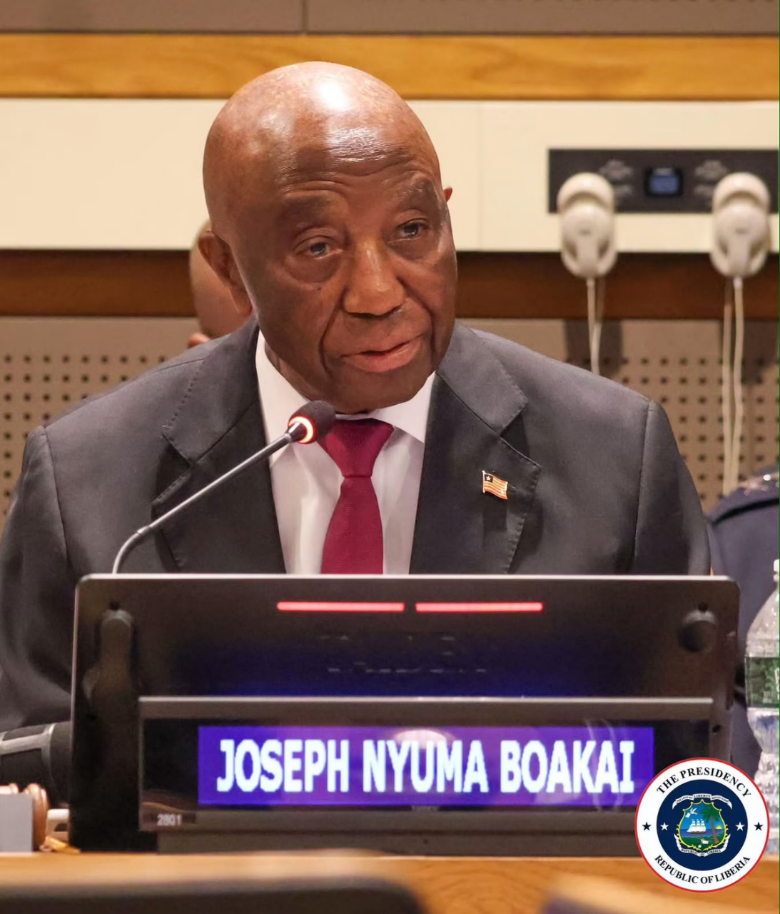
New York, USA — President Joseph Nyuma Boakai has launched Liberia’s Third National Action Plan on Women, Peace and Security (NAP III), reaffirming his administration’s commitment to expanding women’s participation in peacebuilding, governance and national security.
By J.H. Webster Clayeh, [email protected]
President Boakai made the declaration Monday, September 21, at a High-Level Event on Women, Peace and Security held at the United Nations Headquarters in New York.
Speaking before diplomats, international partners and representatives of women’s organizations, President Boakai said Liberia’s experience demonstrates that women are not simply participants in peace processes but key architects of peace.
“We have a saying in Liberia, that, ‘Men make the big decisions while women make the small decisions. But it is the women who decide which decisions are big and which decisions are small,’” President Boakai said.
He also extended greetings to women participating in the event from Monrovia, including women gathered at the Peace Hut in Fish Market. The President said the history of Liberia’s civil war cannot be told without recognizing the courage and determination of Liberian women, who played a critical role in bringing an end to the conflict.
“The story of the end of Liberia’s civil war cannot be told without recognizing the courage and determination of Liberian women,” he said.
According to President Boakai, Liberia’s peace was not achieved solely through negotiations at the peace table in Accra, but was also driven by women who mobilized in markets, churches, mosques, streets and communities across Monrovia.
“Our war did not end only at the negotiating table in Accra. Peace was driven from the markets, churches, mosques, streets, and communities of Monrovia, where women refused to be silent and refused to leave until leaders listened,” he said.
He cited the contributions of the Women in Peacebuilding Network, the Liberian Mass Action for Peace, market women, and Muslim and Christian women who mobilized across religious, ethnic and political divisions.
“They were not invited to the peace processes; they made themselves impossible to exclude,” Boakai declared.
NAP III Builds on Previous Plans
President Boakai recalled that Liberia became the first post-conflict country in the world to adopt a National Action Plan for the implementation of United Nations Security Council Resolution 1325 on Women, Peace and Security.
He said Liberia subsequently implemented a second National Action Plan and has now introduced its third iteration.
“Since then, we have implemented a second NAP, and today we present the third iteration of that commitment: NAP III,” he said.
The President acknowledged that Liberia encountered challenges and made mistakes during the implementation of previous plans, saying those experiences informed the development of the new action plan.
“Because of those experiences, NAP III is our answer not only to what worked but also to what did not,” he said.
The new plan, according to President Boakai, is organized around five areas of action and aligned with his administration’s ARREST Agenda for Inclusive Development.
The five areas are prevention; protection and access to justice; participation; relief, recovery and resilience; and coordination, accountability and financing.
Focus on Prevention and Justice
On prevention, President Boakai said Liberia would focus on addressing the underlying causes of conflict rather than merely responding to its consequences.
“Prevention means investing in social cohesion, addressing inequality, challenging harmful norms, strengthening early-warning mechanisms, and ensuring that women are at the center of efforts to prevent violence before it escalates,” he said.
On protection and access to justice, President Boakai pointed to Executive Order 131 of 2024, which established the Office to operationalize the War and Economic Crimes Court.
He said transitional justice remains essential for women who survived conflict-related violence. “For women who survived conflict-related violence, transitional justice is essential to accountability and closure,” he said.
President Boakai also credited women advocates and civil society organizations for their role in advancing statutes that prioritize gender-sensitive justice through the establishment of the Office of the War and Economic Crimes Court.
He said the framework addresses conflict-related sexual violence and gender-based atrocities committed during Liberia’s civil wars. Boakai Seeks Greater Female Representation in Armed Forces
On participation, President Boakai said sustainable peace cannot be achieved if women remain victims of conflict while being excluded from decision-making.
“Peace cannot be sustainable when women are present as victims but absent from decision-making,” he said.
The President said his administration is committed to increasing women’s representation in elected and appointed positions and ensuring their meaningful participation in peace and security decision-making.
He also highlighted efforts to increase female participation in the Armed Forces of Liberia.
In February 2026, the AFL, in partnership with UN Women Liberia, launched a two-year Elsie Initiative Fund project aimed at removing institutional barriers, strengthening the recruitment and retention of women, and expanding opportunities for women to serve in leadership and United Nations peacekeeping roles, where applicable.
“Our immediate ambition is to reach 15 percent female representation in the Armed Forces by 2028, while contributing to our broader national goal of 40 percent by 2030,” Boakai said.
He added that Liberia, as a non-permanent member of the United Nations Security Council, must demonstrate domestically the same commitment it advocates internationally. “Now, we must ensure they have the opportunity, authority, and institutional support to lead,” he said.
New Threats to Peace
President Boakai said NAP III also recognizes that threats to peace and security extend beyond Liberia’s past civil wars.
He cited climate pressures, democratic reversals, violent extremism, transnational crime, displacement, economic insecurity and other forms of violence as emerging challenges with significant implications for women and girls.
“For women and girls, these challenges can further deepen existing vulnerabilities and inequalities,” he said.
Boakai said the new action plan is therefore designed not only to address the legacy of Liberia’s civil war but also present and future threats.
“Our approach to recovery must go beyond rebuilding infrastructure. It must also rebuild livelihoods, restore dignity, strengthen institutions, and ensure that women and girls are not left behind,” he said.
Liberia’s Security Council Presidency
The President said Liberia’s current position on the United Nations Security Council presents an opportunity for the country to make Women, Peace and Security a signature priority.
Liberia, he noted, spent fourteen years on the UN Security Council agenda before becoming a member of the Council and preparing to assume its presidency in December.
“This moment is significant for another reason. Liberia’s journey from being on the UN Security Council agenda for fourteen years to now sitting at the Council table and assuming its Presidency in December presents an important opportunity for the country to make Women, Peace and Security a signature priority,” he said.
Boakai said Liberia intends to draw on its own peacebuilding experience, particularly the Peace Hut model, as part of its contribution to the global Women, Peace and Security agenda.
“Drawing on Liberia’s peacebuilding experience and women’s leadership through initiatives such as Peace Huts, Liberia offers evidence of localization, with the Peace Hut model as our contribution to the global Women, Peace and Security toolkit,” he said.
He also pointed to challenges facing the West African sub-region, including democratic reversals, transnational crime, insecurity and contested borders.
Liberia, he said, will advocate for preventive diplomacy and locally led solutions before crises escalate into conflicts requiring reactive intervention.
‘A Seat Is an Opportunity, Not an Achievement’
President Boakai recalled Liberia’s commitment, when seeking a seat on the Security Council, to bring the voices of women and young people into
the chamber, particularly those involved in peacebuilding within their communities.
“As a member of the Security Council, we intend to arrive at the annual Women, Peace and Security Open Debate having done at home what we ask of others internationally,” he said.
He stressed that Liberia’s presence on the Council should be measured by what the country does with the opportunity.
“A seat is an opportunity, not an achievement. What we do with it is the achievement,” Boakai declared.
According to the President, NAP III represents the domestic component of that commitment at a time when financing for peacebuilding is declining globally.
He said Liberia recognizes that it cannot implement the plan alone and will seek support from international partners, while emphasizing that the country must demonstrate political ownership. “We have learned an important lesson that a plan that depends entirely on the priorities of others is not truly a national plan,” he said.
“While we recognize that Liberia cannot do this alone, and seek support to implement the NAP III, we are committed to demonstrating the highest level of political will to own it,” he added.
‘Women Changed the Course of Our Nation’
President Boakai said Liberia’s ultimate responsibility is to ensure that future generations inherit not only the memory of the peace fought for by women but also the institutions, opportunities and freedoms needed to sustain that peace.
“Our task now is to ensure that the next generation inherits not only the memory of the peace women fought for, but also the institutions, opportunities, and freedoms that make that peace enduring,” he said.
He thanked Liberia’s international partners for supporting the country and recognizing the role of Liberian women in building and sustaining peace.
Addressing women gathered at the Fish Market Peace Hut, President Boakai said their contribution had permanently shaped Liberia’s history. “To the mothers at the Fish Market who joined us today, your courage changed the course of our nation. Today, we carry that courage forward,” he said.
He said NAP III represents a commitment to creating a Liberia where women and girls can live safely, participate fully in national affairs and exercise leadership. “That is the promise of this Third National Action Plan—to build a Liberia where every woman and girl can live safely, participate fully, lead with dignity, and help shape our country’s future,” President Boakai said.
He subsequently formally launched Liberia’s Third National Action Plan on Women, Peace and Security.
Support Independent Journalism
Your support helps FrontPage Africa continue delivering independent, credible, and impactful journalism. Every contribution strengthens our ability to investigate, inform, and hold power accountable while keeping quality journalism accessible to our readers.
Support our journalism or subscribe to receive the latest FrontPage Africa stories and updates.