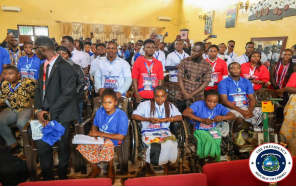
For the third time since taking office, President Joseph Nyuma Boakai convened a national youth town hall, giving young Liberians an opportunity to tell the president directly what they want from his administration and how they believe the country should be governed.
With a population of roughly 5.8 million, Liberia is one of Africa’s youngest nations. Estimates indicate that more than two-thirds of Liberians are under the age of 35. In that context, a youth town hall is more than a symbolic political event; it is an important platform for engaging the demographic that will shape the country’s future.
This year’s gathering was organized by the President’s Youth Advisory Council, which emerged from recommendations made during an earlier youth town hall. Speaking on behalf of the council, Chairperson Mandela Gbollie presented what he described as a “Youth Manifesto” — a forward-looking vision outlining young Liberians’ aspirations for national development.
One of the manifesto’s most notable proposals was a call for the government to make artificial intelligence a national priority. The recommendation reflects a shift in how many young Liberians view development: not simply in terms of today’s challenges, but through the lens of emerging technologies that will define tomorrow’s economy.
“Liberia was left behind during previous industrial revolutions, and we risk falling behind again if we fail to prepare for the AI revolution,” Gbollie told journalists.
His warning is difficult to dismiss. Artificial intelligence is already reshaping industries worldwide, from improving transportation systems and weather forecasting to increasing agricultural productivity, enhancing healthcare, expanding educational access and accelerating scientific research. Countries across Europe, Asia and the Americas are investing heavily in AI education, research and innovation as drivers of future economic growth.
The Youth Manifesto urges Liberia to pursue a similar path by developing AI education frameworks, establishing digital innovation and fabrication laboratories, and creating opportunities for young people to acquire the skills needed to compete in an increasingly technology-driven global economy.
President Boakai did not dismiss the proposal. During his address in Buchanan, he acknowledged AI’s growing role in transforming agriculture and other sectors of the economy. He also referenced efforts to expose Liberian higher education leaders to countries, including Ethiopia, where artificial intelligence is increasingly being integrated into education and development initiatives.
At the same time, Boakai emphasized that technological advancement must produce tangible benefits for ordinary Liberians. He argued that AI should be applied to improve agriculture, transportation, commerce and other productive sectors capable of driving sustainable economic growth rather than serving as a technological trend without practical value.
For now, the town hall’s greatest achievements lie in its organization and in the quality of the ideas presented to the president. The more consequential test, however, begins after the applause fades.
The administration’s willingness to embrace artificial intelligence as part of its youth agenda now raises expectations that concrete policies will follow. As Liberia marks 179 years since its declaration of independence, young people will be watching closely to see whether the government’s public endorsement of AI translates into investments, institutions and opportunities capable of preparing the next generation for a rapidly changing world.
Support Independent Journalism
Your support helps FrontPage Africa continue delivering independent, credible, and impactful journalism. Every contribution strengthens our ability to investigate, inform, and hold power accountable while keeping quality journalism accessible to our readers.
Support our journalism or subscribe to receive the latest FrontPage Africa stories and updates.