PORT HARCOURT, Nigeria — Former Liberian President George Manneh Weah has delivered a forceful warning against the erosion of democratic institutions in Africa, cautioning that leaders who come to power through elections can still become authoritarian if they undermine the judiciary, weaken legislatures and suppress institutional checks on executive power.
By Gerald C. Koinyeneh, [email protected]
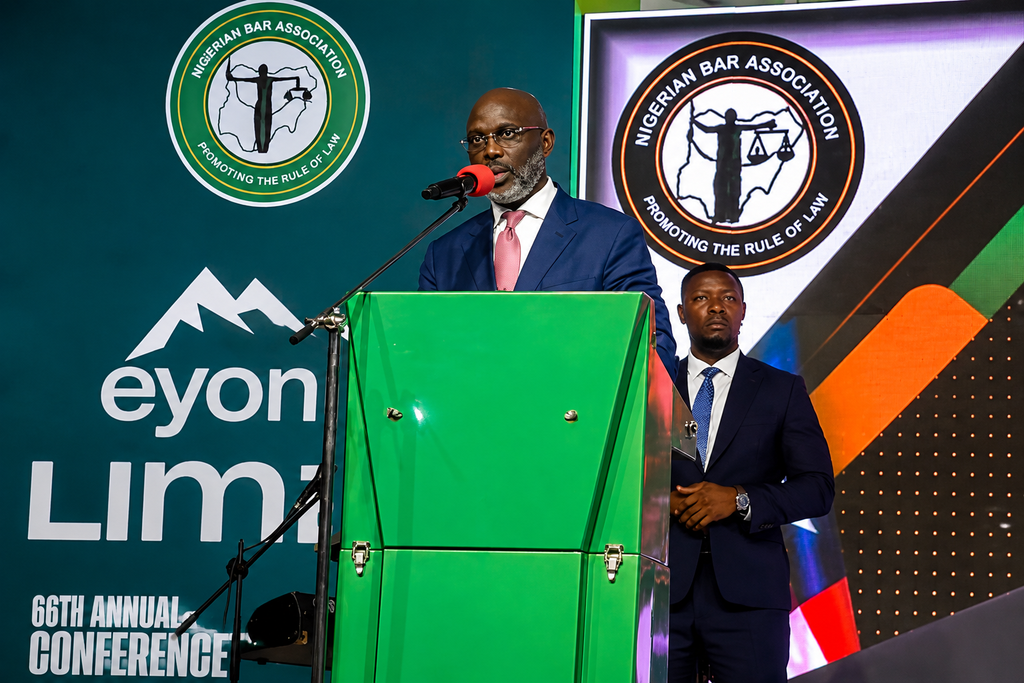
Weah made the remarks Sunday, August 23, while delivering the keynote address at the 66th Annual General Conference of the Nigerian Bar Association (NBA) in Port Harcourt, Rivers State, under the theme “Beyond Limits.”
Addressing lawyers, judges, government officials and other dignitaries, the former Liberian leader argued that democracy does not begin and end with elections, stressing that strong institutions are essential to preserving democratic governance.
“Democracy does not survive on the strength of elections alone,” Weah said. “Elections are the doorway into democracy, not the house itself.”
He said independent courts, a principled legal profession and effective legislative oversight are among the institutions that sustain democratic systems after elections have ended.
‘A Tyrant With a Certificate of Return Is Still a Tyrant’
Weah delivered one of the strongest portions of his address when he warned that the threat to democracy does not come only from military coups or defeated candidates refusing to concede elections.
He said democratically elected leaders can gradually undermine the same institutions that brought them to power.
“The danger is not only that soldiers might seize power in the night, or that a defeated candidate might refuse to leave office,” he said.
“It is also that a leader who arrives in office through a free and fair election can, over time and often gradually, begin to govern like the very dictators the ballot was meant to guard against.”
According to Weah, such leaders may attempt to influence the judiciary, pressure legislatures and turn institutions designed to provide checks and balances into instruments of executive power.
“A tyrant with a certificate of return is still a tyrant,” he declared.
He warned that democracy must be tested continuously after elections by examining how political power treats courts, legislatures, journalists and ordinary citizens.
Weah Calls for Strong Institutions
Weah referenced a statement by outgoing NBA President Mazi Afam Osigwe that “democracy cannot survive on strong men. It survives on strong institutions.”
He said the principle should be displayed prominently in African parliaments and courtrooms.
“The rule of law is not an abstract phrase for law school lecture halls,” Weah said. “It is the practical guarantee that a citizen’s rights do not depend on who is in office or what favor they can secure.”
He argued that the rule of law must provide equal protection to ordinary citizens, including journalists, traders and students, regardless of their social or political status.
“When that guarantee weakens, everything else in a nation weakens with it: investment, security, public trust, and peace itself,” he said.
Warning Against Judicial Interference
The former Liberian president also cautioned against executive interference in the judiciary, citing what he described as examples across the region involving manipulation of judicial budgets, questionable appointments, pressure on judges and the creation of special courts for political purposes.
He also referenced the wave of military takeovers that has affected several African countries since 2020.
While condemning coups, Weah argued that governments operating under democratic labels must also guard against institutional erosion.
He called on the Nigerian Bar Association to remain vigilant in defending judicial independence and citizens’ rights.
“This is why I say to you: the Nigerian Bar Association is not merely a professional association negotiating welfare for its members,” he said.
“You are a standing sentinel of this Republic’s democracy.”
According to Weah, when the legal profession remains silent, courts become more vulnerable to political capture, while a united and principled Bar can deter executive interference.
Weah Revisits 2023 Concession
The former president also used the address to revisit his decision to concede Liberia’s 2023 presidential runoff election to current President Joseph Nyuma Boakai.
Weah said he congratulated Boakai while the vote count was still underway after preliminary results indicated that his opponent was leading.
He said some people around him had advised waiting until the final results were formally certified before conceding.
“I chose to concede while the counting was still underway, because I have always believed, and still believe, that the will of the people must stand above the ambition of any one man in a democratic setting,” Weah said.
He argued that electoral disputes and the failure to respect democratic principles can have serious consequences for national peace and security.
Weah said the NBA’s recognition of his 2023 concession was particularly meaningful because it demonstrated the importance of placing national peace and the people’s will above personal political ambition.
“If a small nation like mine can insist on that standard for itself, then surely this continent…can insist on standards beyond the limits others have too often assumed for us,” he said.
From Monrovia’s Ghetto to the Presidency
Weah also drew heavily on his personal journey, linking his rise from the Gibraltar community in Monrovia to the broader theme of overcoming limitations.
The former football star recalled growing up largely under the care of his grandmother in circumstances where few people expected him to reach the highest levels of international football or become president of Liberia.
“I did not accept them—not out of arrogance, but because the limits placed on us by man are not the same as the limits placed on us by God,” he said.
Weah became the first and remains the only African male footballer to win the Ballon d’Or, following a celebrated international football career before entering politics.
He later became a senator and was elected president of Liberia in 2017, serving from 2018 to 2024.
Beyond ‘Brain Drain’
Turning to Africa’s development, Weah said the continent’s greatest limitations are not a lack of talent or intelligence, but inadequate infrastructure and insufficient political and institutional organization to harness African expertise.
He called for a shift in thinking about the African diaspora—from viewing migration primarily as “brain drain” to developing systems that encourage “brain circulation.”
Weah argued that African professionals living and working abroad can contribute significantly to national development if governments establish mechanisms that enable them to share their expertise without requiring them to abandon opportunities overseas permanently.
He cited African diaspora remittances as evidence of the enormous economic contribution already being made from abroad.
“Imagine that same energy formally invited into legal reform and judicial modernization, as a deliberate national strategy,” he said.
Five Values for Breaking Limits
Weah said Africa’s effort to overcome its challenges must be anchored in five values: discipline, hard work, respect, perseverance and spiritual strength.
He drew parallels between football and the legal profession, saying talent without discipline is insufficient for success.
In the legal profession, he said, intellectual brilliance must be matched by discipline, ethics and commitment to justice.
He similarly described hard work as essential to overcoming corruption, weak infrastructure and institutional inertia.
Respect, he said, must extend to the dignity of every human being, national constitutions and independent institutions.
Perseverance, he added, is necessary because individuals and nations will inevitably face setbacks.
“Perseverance is the internal voice that says, ‘I will rise again,’” Weah said.
He also stressed the importance of spiritual strength, arguing that leadership should be viewed as temporary stewardship rather than permanent ownership of power.
‘Africa Must Stand Up for Democracy’
In closing, Weah called on African lawyers and institutions to defend justice, equality, accountability and free elections.
He urged the Nigerian Bar and legal professionals across the continent to remain independent and protect the rights of people regardless of wealth, political influence or social status.
“The law must never be an instrument of chaos. It must never become a weapon of war,” he said.
“It must remain what it was always meant to be: an instrument of remedy, of peace, of unity, and of accountability.”
Weah concluded by calling on Africa to stand for the rule of law, fairness, impartiality, gender equality, human dignity, peace, democracy and free and fair elections.
“Africa must continue in peaceful coexistence, and we must all stand up for the rule of law,” he said.
The address comes as Weah remains active on the African and international stage following his presidency. He has also signaled his intention to seek the Liberian presidency again in 2029, setting the stage for his continued political relevance ahead of Liberia’s next presidential election.
Support Independent Journalism
Your support helps FrontPage Africa continue delivering independent, credible, and impactful journalism. Every contribution strengthens our ability to investigate, inform, and hold power accountable while keeping quality journalism accessible to our readers.
Support our journalism or subscribe to receive the latest FrontPage Africa stories and updates.