Education is a vital foundation for societal progress, equipping citizens with the skills to break poverty cycles and drive economic growth.
President Joseph Boakai: “Education is the only key to the transformation society needs… ensure that your degrees are not just about the knowledge acquired but how well you use it to impact society and bring about collective change.”
“You want an educated Liberia, a Liberia that can feed herself, and stop depending on foreign aid.”
Former President and Nobel Peace Prize Recipient Ellen Johnson Sirleaf: “Access to quality education is the social justice issue of our time.”
“As more men become more educated and women get educated, the value system has to be more enhanced, and the respect for human dignity and human life is made better.”
Nelson Mandela (former President of South Africa and Nobel Peace Prize Laureate): “Education is the most powerful weapon which you can use to change the world.”
“No country can really develop unless its citizens are educated.
“Kofi Annan (former UN Secretary-General and Nobel Peace Prize Laureate): “Knowledge is power. Information is liberating. Education is the premise of progress, in every society, in every family.”
“Education is a human right with immense power to transform. On its foundation rest the cornerstones of freedom, democracy, and sustainable human development.”
Julius Nyerere (former President of Tanzania): “The education provided must therefore encourage the development in each citizen of three things: an inquiring mind, and ability to learn from what others do, and reject or adapt it to his own needs; and a basic confidence in his own position as a free and equal member of the society.”
By: Austin S Fallah – A True Son of the Planet Earth Soil: [email protected].
In today’s rapidly evolving world, education stands as an indomitable pillar of societal development.
It equips individuals with knowledge, critical thinking skills, innovation, and the capacity to navigate complex challenges.
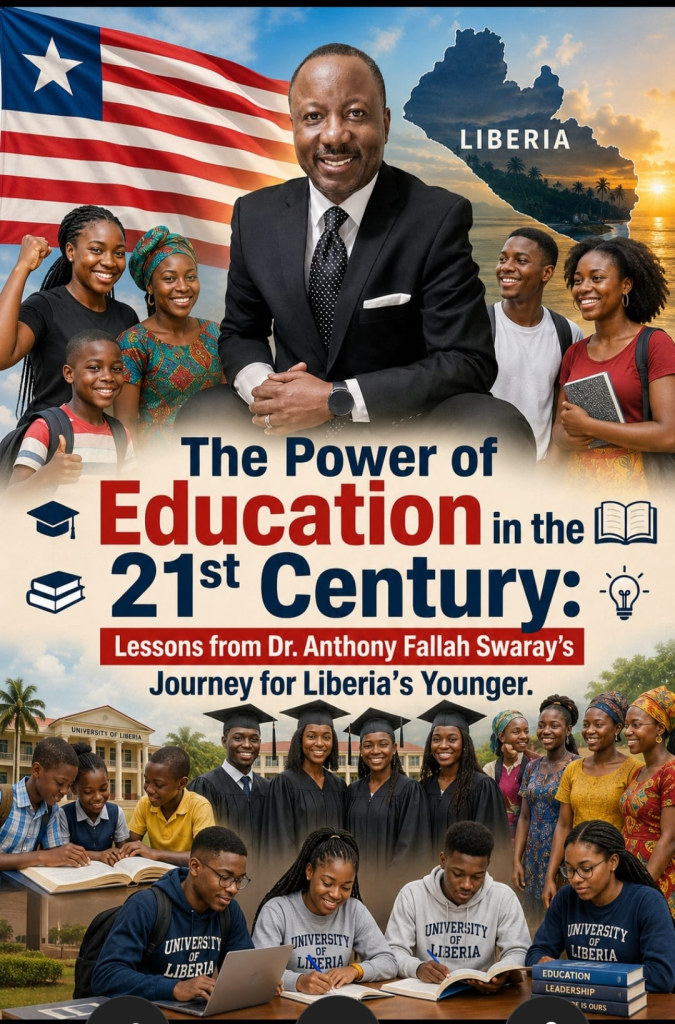
Nowhere is this more evident than in the inspiring journey of Dr. Anthony Fallah Swaray, an academician, intellectual, author, philanthropist, and devoted family man, happily married to Mrs. Precious Yah Swaray, and together they are blessed with three wonderful children: Swaretta, Anthony Jr., and Benjamin.
Born in Yekepah, Nimba County, Liberia, Dr. Swaray’s life story resonates with the narrative of resilience and the transformative power of education.
His extensive academic achievements, coupled with a steadfast commitment to uplifting Liberia’s younger generation, demonstrate that education is not just a pathway to personal advancement; it is essential to national development and social progress.
A Humble Beginning: The Importance of Early Education:
Dr. Swaray’s journey began in the modest setting of the Area B School in Yekepa, Nimba County, where he first discovered the joys of learning.
Then it continued at the Booker Washington Institute in Kakata, Margibi County.
The significance of early education can not be overstated; it is the foundation upon which all future knowledge is built.
Early experiences at school shape a child’s perception of education and instill values such as discipline, hard work, and curiosity.
For Dr. Swaray, these formative years served as a launching pad, inspiring him to reach higher and seek greater knowledge amid a nation recovering from civil strife.
Education in Liberia has historically faced numerous challenges, including inadequate infrastructure, lack of resources, and social instability.
Despite these obstacles, Dr. Swaray’s early schooling fostered a love of learning and intellectual inquiry.
It exemplifies the vital role of grassroots education initiatives in transforming lives, particularly in developing countries.
For the younger generation in Liberia and across the globe, Dr. Swaray’s story serves as a compelling reminder that every child deserves access to quality education.
Pursuit of Higher Academic Excellence:
From graduating high school in 1989 to enrolling at the University of Liberia, Dr. Swaray’s pursuit of higher education highlights a quest for knowledge that transcends personal ambition.
Earning a bachelor’s degree in Accounting with a minor in Economics from Liberia’s best higher education institution, the University of Liberia, he was equipped with foundational skills that would later serve him well in both academic and professional arenas.
This initial step into higher education laid the groundwork for subsequent academic achievements, two master’s degrees in Business Administration and Project Management from the esteemed Catholic Saint Mary’s University of Minnesota, as well as a master’s in Health Informatics from the College of St. Scholastica in the Midwest of the United States of America.
Dr. Swaray’s devotion to lifelong learning is pivotal in the 21st century when change is the only constant.
The modern job market demands that individuals continually update their skills and knowledge to remain professionally relevant.
His journey embodies the idea that education is not merely a series of academic credentials; it is a lifelong commitment to growth and improvement.
As students witness the varied educational paths taken by successful figures like Dr. Swaray, they are more likely to embrace lifelong learning, thereby cultivating a generation that prioritizes education as a means to innovate, lead, and effect change.
Educational Leadership and the Role of Mentorship:
Dr. Swaray’s ascent to earning a Doctor of Education in Leadership reflects his passion not only for engaging with education but also for leading within it.
This dimension of his journey emphasizes the importance of educational leadership in shaping future classrooms and curricula.
Skilled leaders inspire passion for learning and foster environments that nurture inquiry and creativity among their students.
In Liberia, where educational infrastructure faces daunting challenges, effective leadership is essential to drive reforms and improve learning outcomes.
Furthermore, Dr. Swaray has embraced the role of mentor, guiding future doctoral students and the younger generation in Liberia and the United States.
Mentorship is an invaluable factor in education; it enriches the learning experience and cultivates future leaders.
Mentors help students navigate their academic paths, providing insights, encouragement, and inspiration when faced with challenges.
For doctoral candidates and students in Liberia, having a mentor like Dr. Swaray can make a significant difference, opening doors to opportunities, widening networks, and instilling the belief that they can achieve their dreams.
Dr. Swaray’s commitment to mentorship also underscores a broader societal responsibility: educated individuals must give back to their communities.
The cycle of education is strengthened when knowledge is shared, and this reciprocation contributes positively to the development of society.
This is particularly important in a country like Liberia, where many were deprived of educational resources during years of conflict.
By instilling hope and providing guidance, mentors like Dr. Swaray can help reshape the nation’s future.
Social Impact through Philanthropy:
In addition to his academic pursuits, Dr. Swaray exemplifies philanthropy, effectively bridging education and social responsibility.
His philanthropic efforts demonstrate an understanding that education is a collective endeavor, and improving the educational landscape in Liberia requires the support of those who have succeeded.
Philanthropy in education can take many forms, including scholarships, funding for educational programs, and support for local schools and teachers.
Dr. Swaray’s outreach uplifts individuals from underprivileged backgrounds, enabling talented and ambitious young people to pursue their academic goals without being hindered by financial barriers.
By creating educational opportunities, he empowers Liberia’s youth to break the cycle of poverty and hardship.
This serves as a call to action for others in the educated class to recognize their potential impact.
Every contribution to education can lead to far-reaching benefits, strengthening society’s social fabric.
Resilience and Faith: An Inspirational Framework:
Throughout Dr. Swaray’s journey, his guiding biblical quote, “I can do all things through Christ who strengthens me,” encapsulates the spiritual fortitude that has propelled him, reinforcing the crucial relationship between faith and resilience.
In the 21st century, where challenges and uncertainties abound, education can not exist in a vacuum; it often intersects with one’s beliefs and motivations.
Many students may face circumstances that threaten to deter them from educational pursuits.
In reflecting on Dr. Swaray’s journey, they can draw strength from the understanding that faith can provide the resilience needed to overcome obstacles.
Additionally, instilling values such as perseverance, integrity, and a commitment to lifelong learning prepares students for the complexities of adult life.
In a time where mental health struggles among students are rising, equipping them with coping mechanisms rooted in resilience can foster healthier relationships with education and its challenges.
The Lasting Legacy of Dr. Anthony Fallah Swaray:
Ultimately, Dr. Anthony Fallah Swaray’s journey illuminates the profound power of education in shaping the destinies of individuals and nations.
Through his relentless pursuit of knowledge, commitment to mentorship, philanthropic endeavors, and unwavering faith, he provides a template for success that resonates with the younger generation in Liberia and beyond.
In the 21st century, characterized by rapid technological advancements, global connectivity, and sociopolitical volatility, his message is clear: education is not just a privilege; it is a right and a responsibility.
The future of Liberia’s youth hinges on their access to quality education, mentorship, and the courage to persevere against all odds.
For aspiring students and leaders, Dr. Swaray embodies the essence of using education as a tool not only for personal success but also for the betterment of society.
By embracing this lesson, individuals can transform challenges into opportunities and ultimately contribute to a brighter future for Liberia and the world at large.
Support Independent Journalism
Your support helps FrontPage Africa continue delivering independent, credible, and impactful journalism. Every contribution strengthens our ability to investigate, inform, and hold power accountable while keeping quality journalism accessible to our readers.
Support our journalism or subscribe to receive the latest FrontPage Africa stories and updates.