MONROVIA – The Liberia Revenue Authority (LRA) has launched Liberia’s second National Time Release Study (TRS), unveiling a comprehensive package of customs modernization and trade facilitation reforms aimed at reducing cargo clearance times, lowering the cost of doing business and enhancing the country’s competitiveness as a regional trade and investment destination.
By Francis G. Boayue
The report, launched Monday, July 13 at the Liberia Chamber of Commerce in Monrovia, found that imported cargo currently takes an average of 12 days, 19 hours and 42 minutes to move from vessel arrival to final exit through the Freeport of Monrovia, Liberia’s main gateway for international trade.
Speaking during the launch, LRA Commissioner General and Chief Executive Officer, James Dorbor Jallah, described the study as more than a technical assessment, calling it a reflection of Liberia’s commitment to confronting long-standing trade bottlenecks through evidence-based reforms.
“Today is more than a presentation of a document. It is a statement about who we are as a nation—a people unafraid to measure ourselves honestly, confront our challenges, and solve our own problems with determination and with the support of our true friends,” Commissioner General Jallah said.
He noted that the Freeport of Monrovia handles more than 90 percent of Liberia’s international trade, making efficient cargo movement essential to national economic growth.
“Every container that passes through its gates carries the goods that stock our markets, the imports that power our industries, and the revenues that fund our schools, hospitals, and roads. When cargo moves faster, Liberia moves faster,” he stated.
The study examined 670 import declarations, exceeding its original sampling target and making it Liberia’s most comprehensive cargo clearance assessment to date.
Conducted using the World Customs Organization’s Time Release Study methodology, the assessment tracked every stage of cargo clearance—from vessel arrival through customs processing to final release—while engaging customs authorities, shipping lines, APM Terminals, commercial banks, customs brokers, transporters, and other government agencies.
According to the report, joint customs inspections with partner agencies take less than one hour on average, while exit gate processing averages just 34 minutes.
However, the study found that the most significant delays occur before and after customs inspections due to late submission of cargo manifests, manual delivery order systems, fragmented institutional procedures and paper-based payment confirmation processes.
“The delays do not lie in the diligence of our officers at the point of examination. They lie in the spaces between institutions—in late manifests, manual delivery orders, and payment confirmations that still travel by paper,” Commissioner General Jallah explained.
To address those bottlenecks, the LRA announced several reforms already underway.
Among them is the construction of a modern Destination Inspection Facility at the Freeport of Monrovia that will house customs and other major border agencies under one roof. The facility will utilize non
intrusive inspection technology to facilitate joint inspections, reduce duplication, and significantly shorten cargo processing time.
The Authority is also upgrading its ASYCUDA World customs management platform with technical support from the United Nations Conference on Trade and Development (UNCTAD). Once completed, the upgraded system will electronically integrate customs operations with commercial banks, the Central Bank of Liberia, and the Liberia Integrated Tax Administration System (LITAS), enabling real-time confirmation of import duty payments.
“When an importer pays duty at a bank, confirmation will reach customs electronically and in real time—not by paper receipt carried across town,” Jallah said.
He added that the modernization program includes expanding ASYCUDA connectivity to customs business offices nationwide and laying the foundation for Liberia’s long-awaited National Electronic Single Window, which will allow traders to process documentation through a single digital platform.
Commissioner General Jallah said the reforms are aligned with the LRA Corporate Strategic Plan (2025–2029) and President Joseph Nyuma Boakai’s ARREST Agenda for Inclusive Development.
While reaffirming the Authority’s commitment to reform, he stressed that improving trade facilitation requires coordinated action from all institutions involved in cargo clearance.
“The Liberia Revenue Authority cannot do this alone. The clearance of a container is a relay race, and a relay is only as fast as every runner and every handover,” he said, urging shipping lines, terminal operators, customs brokers, importers and government agencies to strengthen collaboration and fully embrace digital processes.
Representing Commerce and Industry Minister Magdalene Dagoseh, Deputy Minister for Commerce and Trade Raymond Reeves described the study as a landmark achievement that will guide Liberia’s future trade reforms.
“Today’s launch is about far more than a report. It is about our collective commitment to transforming the way we do business and trade in Liberia,”Mr. Reeves said.
He noted that the findings provide credible evidence on delays affecting trade while identifying reforms necessary to reduce business costs, improve the investment climate, and strengthen Liberia’s competitiveness.
As Chair of the National Trade Facilitation Committee, Mr. Reeves said the Ministry of Commerce remains committed to implementing the report’s recommendations.
“Trade facilitation is no longer optional. It is a strategic imperative if Liberia is to become a competitive destination for trade, investment, industrialization and job creation,” he added.
Mr. Reeves disclosed that government is simultaneously implementing complementary reforms, including a Trade Information Portal, automated import and export permit systems, online business registration, and the National Electronic Single Window.
He said these initiatives will improve transparency, reduce administrative burdens, and strengthen Liberia’s compliance with the African Continental Free Trade Area (AfCFTA), the ECOWAS Trade Liberalization Scheme and the World Trade Organization Trade Facilitation Agreement.
Presenting the study’s technical findings, Assistant Commissioner for Policy and Technical Affairs, Atty. William L. Buku, speaking on behalf of Assistant Commissioner for Customs-Port Operations Edwin F. Kendema, said the study commenced in September 2025 following the establishment of a multi-sector Technical Working Group comprising government agencies, customs brokers, shipping companies, transporters, terminal operators and other stakeholders.
Atty. Buku said more than 90 days were devoted to data collection, validation, analysis, and report preparation with technical support from the World Customs Organization.
Meanwhile, National Trade Facilitation Committee Secretariat Coordinator Leamon P. Gluaseay said the report should serve as a national blueprint for reform rather than simply another technical publication.
Although the current study adopted a broader methodology than Liberia’s first Time Release Study conducted during the COVID-19 pandemic, she noted that average cargo clearance time has declined from 12 days, 22 hours and 8 minutes to 12 days, 19 hours and 42 minutes—a reduction of 2 hours and 26 minutes.
She identified mandatory electronic submission of cargo manifests before vessel arrival, electronic terminal delivery orders, digitized trade documentation, enhanced data sharing, integrated banking and customs systems, and accelerated implementation of the National Single Window as priority reforms.
“The true value of this report will not be measured by the quality of its analysis, but by the effectiveness of its implementation. Reports do not transform economies. Implementation does,” Madam Gluaseay said.
Also speaking, Commissioner of Customs Saamoi underscored the need to balance trade facilitation with national security, emphasizing that customs authorities must ensure the efficient movement of legitimate trade while preventing illicit goods from entering the country.
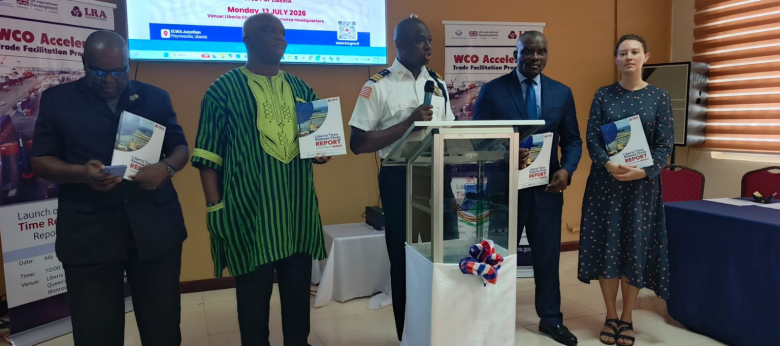
The launch concluded with the official unveiling of the National Time Release Study report, as government officials, development partners and private sector representatives pledged to work together to implement its recommendations.
Support Independent Journalism
Your support helps FrontPage Africa continue delivering independent, credible, and impactful journalism. Every contribution strengthens our ability to investigate, inform, and hold power accountable while keeping quality journalism accessible to our readers.
Support our journalism or subscribe to receive the latest FrontPage Africa stories and updates.