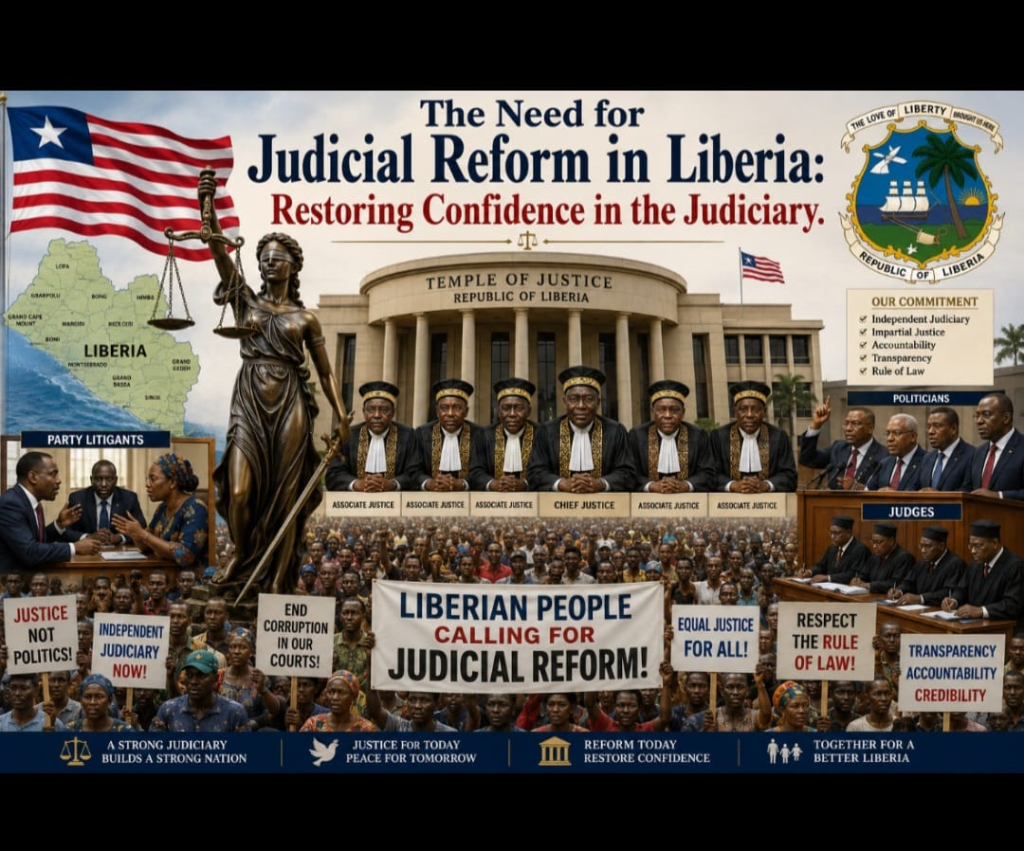
The need for judicial reform in Liberia highlights the critical link between impartial justice and national progress, emphasizing that the rule of law is the foundation of peace, economic growth, and restored public trust in state institutions.
By: Austin S Fallah – A True Son of the Planet Earth Soil: [email protected].
Liberia: Chief Justice Gbeisay Warns Judicial Workers Against Turning Courts into Money-Making Enterprises. Source: https://frontpageafricaonline.com/liberia-chief-justice-gbeisay-warns-judicial-workers-against-turning-courts-into-money-making-enterprises/
Liberia: ‘The Judiciary Is the Most Corrupt Sector’, Associate Justice Kaba Discloses. Source: https://allafrica.com/stories/202111120255.html
President Joseph Nyuma Boakai: The Judiciary stands as the ultimate guardian of liberty and fairness,” Boakai declared. “It is here that every Liberian, rich or poor, educated or uneducated, must find protection and justice.”
President Joseph Nyuma Boakai: “A nation cannot advance where laws are ignored or where the weak have no recourse. The time for ‘You know who I am’ is over. Now is the time for trust and integrity. Our collective effort to reform and strengthen the judiciary is part of building a Liberia that is just, peaceful, and prosperous.”
President Boakai: “The ruin of a nation begins in the homes of its people… This wisdom reminds us that justice, integrity, and order must begin at the heart of our institutions. If our courts are strong, our nation will flourish. If they are weak, the foundation of our democracy will not endure.”
Chief Justice Yamie Quiqui Gbeisay: Emphasizing the transition to a new era of legal excellence and transparency, he stated that the judiciary’s capacity for reform is the benchmark for the nation’s progress, pledging accountability and improved efficiency within the courts.
Leymah Gbowee (Nobel Peace Prize Laureate, Liberia): “You can’t have peace without justice, and you can’t have justice without accountability.”
Cllr. Tiawan S. Gongloe (Prominent Liberian Human Rights Lawyer): Known for his uncompromising stance on judicial independence, he has long advocated that “the robe of a judge must never be used as a cloak for political obedience or personal corruption,” viewing judicial reform as an absolute prerequisite for democratic survival in Liberia.
Nelson Mandela (Former President of South Africa): “For to be free is not merely to cast off one’s chains, but to live in a way that respects and enhances the freedom of others.” (Often cited by Liberian jurists to stress that a reformed judiciary is the ultimate protector of citizen liberties).
Sandra Day O’Connor (Former Associate Justice of the U.S. Supreme Court): “The independence of the judiciary is not an end in itself; it is the guarantee of a fair and impartial process, which is the cornerstone of public confidence.”
Martin Luther King Jr. (Civil Rights Leader): “Injustice anywhere is a threat to justice everywhere.” (Frequently invoked by Liberian civil society to campaign for equal access to justice, regardless of socio-economic or political status).
Kofi Annan (Former UN Secretary-General): “The rule of law is not a luxury; it is the essential foundation for both peace and economic development.”
Liberia, a nation that has faced decades of civil strife, social unrest, and political instability, finds itself at a critical juncture.
As the country continues to rebuild its institutions, the judiciary has emerged as a focal point of concern.
Chief Justice Yamie Quiqui Gbeisay’s admonition to judicial workers against turning courts into money-making enterprises, paired with Associate Justice Yusuf D. Kaba’s alarming characterization of the judiciary as corrupt, underscores the urgent need for comprehensive judicial reform in Liberia.
A judiciary perceived as corrupt not only undermines the rule of law but also erodes public trust, an essential element for any democratic society.
This disquisition analyzes the current state of the Liberian judiciary, identifies the challenges it faces, and outlines the necessity of reform under the administration of President Joseph Nyuma Boakai Sr. and Vice President Jeremiah Kpan Koung.
The phrase “where there is smoke, there is fire” aptly describes the situation within Liberia’s judiciary.
Justice Kaba, by labeling the judiciary the “Black Cow” of the government, encapsulates the widespread perception of systemic corruption and inefficiency that plagues the courts.
The term “Black Cow” evokes an entity that hinders progress and drains resources, much like the judiciary’s current inability to uphold justice impartially.
Justice Kaba’s bold statements are not mere hyperbole; they reflect the sentiments expressed by the public, who have grown increasingly disillusioned with a system that appears to favor the wealthy and powerful over the destitute and marginalized.
This perceived bias threatens to create a bifurcated society in which access to justice becomes contingent on financial means, thereby perpetuating inequality.
One of the foremost challenges facing the judiciary is the pervasive culture of corruption among judicial actors.
There exists a misguided perception among some judges and clerks that the courtroom can serve as a conduit for personal enrichment.
This mindset not only violates ethical standards but also directly contravenes the principles of justice that demand fairness, transparency, and accountability.
If judicial officers prioritize profit over principle, it creates a vicious cycle in which citizens are coerced into bribing officials to obtain justice, thereby further entrenching corruption in the system.
Moreover, weak enforcement of existing laws and regulations exacerbates corruption within the judiciary.
Liberia’s legal framework is robust on paper, but limited resources, political will, and accountability have hampered effective enforcement.
Judicial reform must, therefore, extend beyond mere rhetoric to practical measures that enforce ethical standards and punish corrupt practices.
This may include established judicial whistleblower protections, mandatory asset declarations for judges, and transparent mechanisms for reporting and investigating misconduct.
Through these measures, the judiciary can restore its integrity and demonstrate a steadfast commitment to justice as a public service, rather than a commercial enterprise.
Restoring confidence in Liberia’s judiciary also requires addressing the chronic backlog of cases that hampers timely justice delivery.
Many citizens find themselves entangled in protracted legal battles, waiting years for resolutions that should be available within months.
This backlog not only delays justice but also contributes to public frustration and distrust.
The Supreme Court, under the leadership of Chief Justice Gbeisay, must prioritize case management reforms that enhance efficiency.
This includes leveraging technology to digitize case filings and streamline court processes, thus enabling judicial actors to focus on adjudicating rather than administrative burdens.
Furthermore, public engagement and education are critical components of judicial reform.
Citizens must be informed about their legal rights and the judicial processes available to them.
This awareness empowers individuals to seek justice and hold judicial actors accountable for their conduct.
The reform agenda should incorporate community outreach initiatives, educational campaigns, and legal aid services, particularly for disadvantaged populations who often lack the necessary resources to navigate the complexities of the legal system.
The administration of President Joseph Nyuma Boakai Sr. and Vice President Jeremiah Kpan Koung represents an opportunity for systemic change in Liberia’s judiciary, particularly amid ongoing calls for reform.
However, the political leadership must demonstrate a genuine commitment to transforming the judiciary into a fair and impartial institution.
This can be achieved through legislative changes that enhance judicial independence, strengthen oversight mechanisms, and ensure that judicial appointments are made on merit rather than political affiliation.
By fostering an environment in which judges are insulated from external pressures, the government can promote loyalty to the Constitution and the rule of law over partisan interests.
Furthermore, international collaboration and support can play a vital role in Liberia’s judicial reform efforts.
Countries that have navigated similar challenges can offer valuable insights and best practices.
Capacity building initiatives, training programs for judicial staff, and partnerships with international organizations can facilitate knowledge exchange and strengthen institutional frameworks.
By leveraging external expertise, Liberia can accelerate its judicial reform agenda and rebuild a system that upholds the tenets of justice.
The stakes of judicial reform extend beyond technical adjustments; they touch on the very fabric of Liberian society.
Justice is not merely an abstract principle but a social imperative that can restore faith in governance, promote social cohesion, and foster economic development.
When citizens believe that the judiciary serves as a fair arbiter of disputes, they are more likely to invest in their communities and participate in democratic processes.
Conversely, a tainted judiciary breeds apathy and disenchantment, which could spur further crises in a nation still healing from the wounds of conflict.
The writings and warnings issued by Chief Justice Gbeisay and Associate Justice Kaba are not mere lamentations but rallying cries for urgent reform.
The integrity of Liberia’s judiciary rests on the current administration’s ability to confront the roots of corruption, inefficiency, and inequality within the system.
By prioritizing judicial reform as a hallmark of governance, President Boakai and Vice President Koung can lay the groundwork for a judiciary that serves all citizens impartially.
Through collaborative efforts, both domestic and international, Liberia stands at the precipice of a transformative journey towards a justice system marked by fairness, equity, and restored public confidence.
The time to act is now; Liberia’s future hinges on the integrity of its judiciary.
Support Independent Journalism
Your support helps FrontPage Africa continue delivering independent, credible, and impactful journalism. Every contribution strengthens our ability to investigate, inform, and hold power accountable while keeping quality journalism accessible to our readers.
Support our journalism or subscribe to receive the latest FrontPage Africa stories and updates.