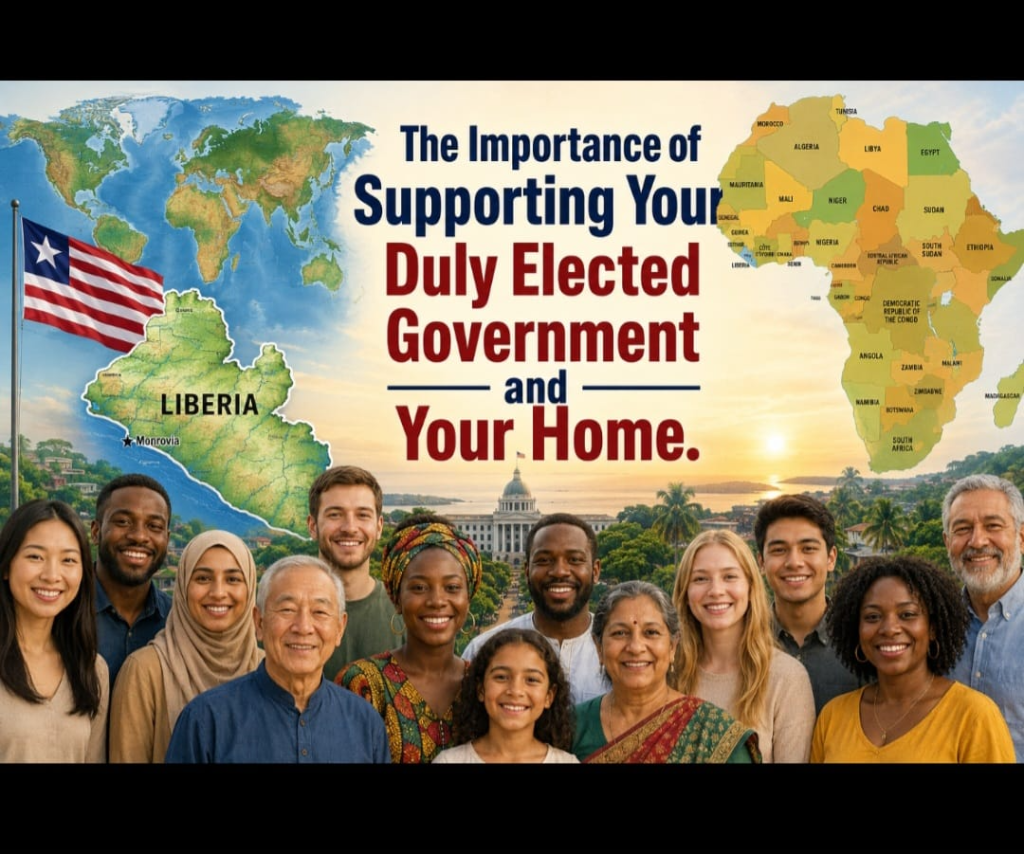
Supporting your duly elected government and home is a universal civic duty. It fosters national unity, protects democratic institutions, and preserves the foundation of community and peace.
” Liberia belongs to all of us. Her promise is our shared inheritance. Her progress is our common responsibility. Let us THINK LIBERIA, LOVE LIBERIA, and BUILD LIBERIA.” — President Joseph Nyuma Boakai Sr.
“The youth of today should be the scriptwriters of their own destiny and feature yourselves as stars that showed the way towards a brighter future.” —Former President of South Africa Nelson Mandela.
“Leadership means service for and not domination over others. Genuine leaders serve the cause of the people and do not expect the cause to serve them.” —Former ANC President Dr. A.B. Xuma.
“Patriotism is supporting your country all the time and your government when it deserves it.” — Mzilikazi wa Afrika.
” Ask not what your country can do for you — ask what you can do for your country.” — Former US President John F. Kennedy.
“Patriotism means to stand by the country. It does not mean to stand by the president or any other public official.” — Former US President Theodore Roosevelt.
“Patriotism is when love of your own people comes first; nationalism, when hate for people other than your own comes first.” — Former President of France Charles de Gaulle.
By: Austin S Fallah – A True Son of the Planet Earth Soil. [email protected].
In a rapidly globalizing world, it is easy for individuals to adopt a cosmopolitan mindset, believing that progress and success can be found anywhere but home.
Here lies a powerful sentiment expressed by the legendary Nigerian musician Prince Nico M’barga, who reminds us of the essential truth that no matter how far we travel or how high we ascend in life, it is our homes—our villages—that deeply shape who we are.
Mr.M’barga’s assertion, “If you tour the whole world, don’t be left aside; the last place where you go, go that you, whether good or bad, home be home,” resonates profoundly, particularly for the youth-young people of Liberia.
It serves as a call to recognize the importance of one’s roots, support one’s community, and uphold the legitimacy of the government that represents these interests.
Such sentiments echo throughout history and philosophy, reminding us of the intrinsic value of community, loyalty, and respect for those who elevate us.
Philosopher Niccolò Machiavelli, for example, emphasized the importance of virtue in leadership and the responsibilities of citizens to support their rulers and institutions.
He posed that understanding the nature of politics is essential for a stable society, and that leaders must earn the loyalty of their subjects as much as subjects must appreciate their leaders.
Thus, the notion of reciprocal support forms the bedrock of societal well-being.
Home is often seen as a safe harbor amid the stormy seas of life’s challenges.
It is not just a physical space but a repository of shared experiences and collective memories.
Our communities provide the foundational tapestry of our identities, shaping our values and our worldviews.
Supporting your government means ensuring the stability and growth of this sanctuary.
When citizens actively engage with and support their duly elected officials, they contribute to a robust and functioning democracy.
History has shown us the catastrophic consequences of political apathy and disillusionment.
For Liberians, whose history has been marred by civil strife and political turbulence, the importance of supporting a legitimate government cannot be emphasized enough.
The idea of loyalty to one’s community and government can be traced back through the words of the ancient philosophers.
Aristotle famously stated, “He who is unable to live in society, or who has no need because he is self-sufficient, must either be a beast or a god.”
Aristotle believed that humans are social beings whose identities are shaped by their interactions with others.
Therefore, rising above individualism to foster community ties is crucial for our collective stability and prosperity.
Supporting a duly elected government is, in essence, a reflection of your commitment to each other as citizens.
It recognizes that the actions of your leaders have direct repercussions on your communities/nation, for better or for worse.
Mr. M’barga also highlighted an essential aspect of humility: “Don’t be proud because you have, it comes from God Almighty.”
This assertion has significant implications in our daily lives, particularly for successful individuals who may forget their roots.
Philosophers like Friedrich Nietzsche emphasized the importance of self-awareness. Nietzsche warned against the hubris that often accompanies success, arguing that one must not become disconnected from one’s origin, lest one lose sight of what truly matters.
In your pursuit of ambition, you must not only recognize your achievements but also the collective effort that made those achievements possible.
This involves acknowledging the contributions of family, friends, mentors, and even our local community, whose support plays a vital role in our journeys.
In support of human connection, Plato explored the concept of the ‘ideals’ in “The Republic.”
He asserted that a society in which individuals prioritize the greater good over personal gain would be more just.
This echoes the importance of supporting one’s home and government, as working towards communal prosperity better positions society as a whole to thrive.
This principle remains painfully relevant today, particularly in contexts where individuals have their sights solely fixed on personal gain.
In Liberia’s case, unity among its people, especially young people, is crucial to rebuilding a nation still navigating the aftermath of conflict and instability.
Disillusionment with government is not uncommon, especially among younger people who have often been sidelined in the political arena.
However, active participation and constructive engagement can turn this tide.
Supporting a duly elected government means making a conscious choice to participate in the democratic process, voicing concerns when necessary, and helping form a government that represents the diverse interests of its constituents.
Resistance to authority can certainly be justified in various contexts, particularly when leaders misuse their power.
However, it is essential to differentiate between constructive opposition and outright rejection of the governance system, especially in fragile democracies like Liberia’s.
By nurturing a spirit of cooperation rather than antagonism, humanity (Liberians) should foster broader systemic changes that can lead to tangible improvements in our governance.
Machiavelli captured the essence of virtuous leadership, asserting that a ruler must engage with their subjects and earn their respect.
This relationship is reciprocal; just as the governed are driven to support their leaders, leaders must also respect the voices of the people.
The symbiotic relationship is critical in establishing a government that is truly representative and responsive to its citizens.
When citizens work together to support their leaders, they foster a culture of accountability and transparency, paving the way for a more effective governance structure.
As air-breathing human beings confront the realities of civic life, the idea that “no condition is permanent” transcends mere statements.
It serves as a reminder that humans are constantly evolving, both as individuals and as part of a larger collective.
Your homes, the places that have formed your personalities, are where your journeys began.
Thus, loyalty to not only your home but also to the structures that govern it encapsulates a broader understanding of civic duty and humanity.
Meanwhile, we must grapple with the pitfalls of pride and superiority that can arise when individuals find themselves in positions of advantage.
Imagine a successful entrepreneur who forgets their hometown or the struggles of their upbringing.
Nietzsche cautioned that losing this connection can disempower those who provided support along the way.
Rising through the ranks must involve empowering others rather than viewing them as stepping stones or backgrounds to our success stories.
Prince Nico M’barga’s messages resonate deeply with your shared humanity and the importance of community.
Supporting one’s home and the duly elected government remain imperatives for building a future reflective of your collective aspirations.
By valuing our roots and honoring those who have assisted in your journeys, we forge a stronger connection to your community-nation.
Through the teachings of philosophers from Machiavelli to Aristotle, humans recognize the imperative of fostering unity, loyalty, and responsibility, understanding that a thriving society is built on shared support and mutual respect.
And as you navigate the complexities of your modern landscape, let’s heed the call to remember your past and embrace your role as active participants in shaping both your government and your homes.
After all, your home is where your heart lies, guiding everyone through life’s currents toward a brighter future together.
Support Independent Journalism
Your support helps FrontPage Africa continue delivering independent, credible, and impactful journalism. Every contribution strengthens our ability to investigate, inform, and hold power accountable while keeping quality journalism accessible to our readers.
Support our journalism or subscribe to receive the latest FrontPage Africa stories and updates.