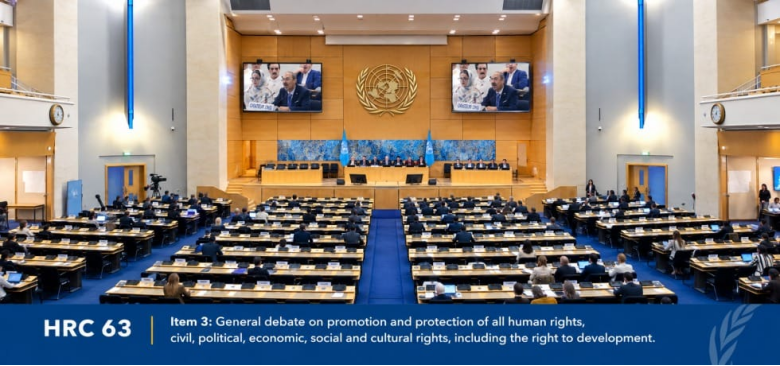
GENEVA — CAP Freedom of Conscience has raised concerns over the pretrial detention and treatment of Lee Man-hee, the 95-year-old founder and leader of the Shincheonji Church of Jesus, during the 63rd session of the United Nations Human Rights Council.
The organization delivered an oral statement on September 18, 2026, during the Council’s General Debate under Item 3, which focuses on the promotion and protection of all human rights.
In its statement, CAP Freedom of Conscience highlighted the case of Lee, who is currently being held at the Seoul Detention Center in the Republic of Korea in connection with what the organization described as non-violent charges.
The organization expressed concern over what it characterized as a politically motivated and discriminatory investigation targeting a religious minority. It also raised concerns about Lee’s detention conditions, particularly his confinement without air conditioning during what it described as Seoul’s severe summer heatwave.
According to CAP Freedom of Conscience, Lee’s age and the absence of an apparent flight risk should have been considered in determining whether pretrial detention was necessary.
The organization argued that his detention and treatment raise questions about South Korea’s obligations under international human rights law, including provisions of the International Covenant on Civil and Political Rights (ICCPR).
It cited Article 9 of the ICCPR, which protects individuals against arbitrary detention and requires detention to meet standards of necessity and proportionality. The group also referenced Article 10, which requires persons deprived of their liberty to be treated humanely and with respect for their dignity.
CAP Freedom of Conscience further cited the United Nations Standard Minimum Rules for the Treatment of Prisoners, known as the Nelson Mandela Rules, particularly provisions concerning access to healthcare, as well as the Tokyo Rules, which promote alternatives to imprisonment and emphasize that pretrial detention should be used only as a measure of last resort.
The organization also invoked Article 18 of the ICCPR, which protects freedom of thought, conscience and religion or belief, arguing that religious freedom concerns are relevant to Lee’s case.
CAP Freedom of Conscience called on the Human Rights Council to urge the South Korean government to comply with its international obligations.
Among its recommendations, the organization urged authorities to consider alternatives to pretrial detention, facilitate an independent medical assessment of Lee’s condition and ensure that proceedings against him are conducted fairly and impartially.
Lee, who founded the Shincheonji Church of Jesus, is a prominent and controversial religious figure in South Korea. His detention has drawn attention from organizations that describe themselves as advocates for freedom of religion and conscience.
CAP Freedom of Conscience’s intervention at the Human Rights Council places the case within a broader international debate over pretrial detention, treatment of elderly detainees and the protection of freedom of religion or belief.
Support Independent Journalism
Your support helps FrontPage Africa continue delivering independent, credible, and impactful journalism. Every contribution strengthens our ability to investigate, inform, and hold power accountable while keeping quality journalism accessible to our readers.
Support our journalism or subscribe to receive the latest FrontPage Africa stories and updates.