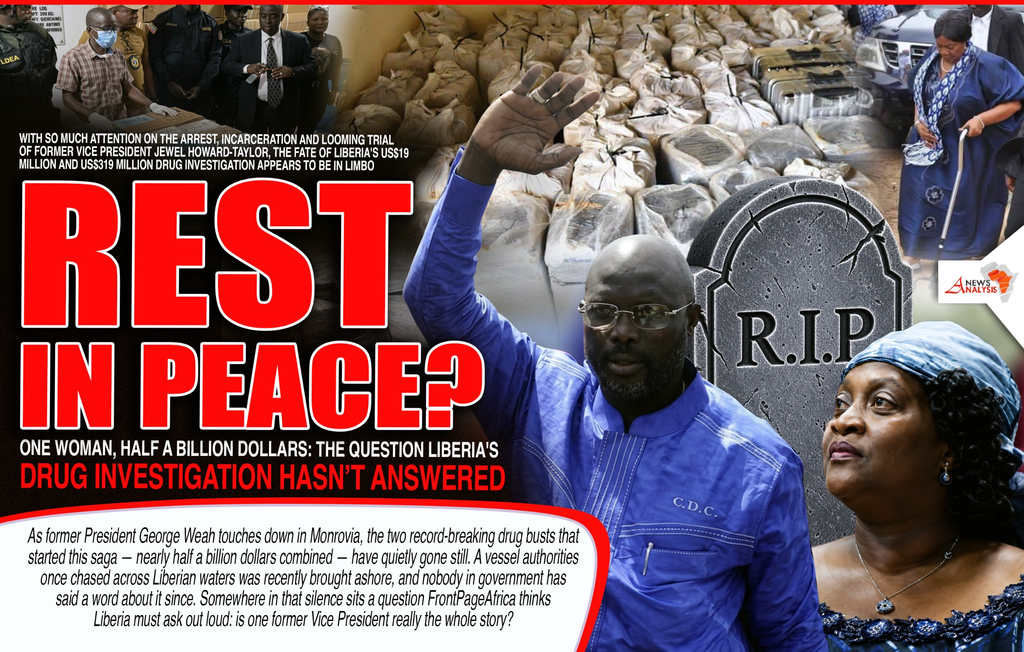
As former President George Weah touches down in Monrovia, the two record-breaking drug busts that started this saga — nearly half a billion dollars combined — have quietly gone still. A vessel authorities once chased across Liberian waters was recently brought ashore, and nobody in government has said a word about it since. Somewhere in that silence sits a question this newspaper thinks Liberia must ask out loud: is one former Vice President really the whole story?
By Rodney D. Sieh | [email protected]
Monrovia — As former President George Manneh Weah touches down in Monrovia Wednesday, the fate of his former Vice President, Jewel Howard-Taylor, lingers in a state of uncertainty, as the ruling Unity Party-led government worked through an audio recording and what it calls mountains of evidence tying the former First Lady to a litany of charges in the ongoing investigation into cartel-driven drug trafficking in Liberia. Weah’s arrival, months after he pledged from abroad to return home and “rally the CDC along with all well-meaning Liberians” against what he called a politically motivated prosecution, adds a charged political backdrop to a week already centered on his former running mate’s fate.
But there is a version of this story Liberians could be forgiven for believing, if all they did was follow the headlines of the last two weeks: that a former Vice President ran a cocaine empire more or less by herself, that she has been caught, and that the case is now simply a matter of scheduling hearings and arguing over a recorded phone call. It is a tidy version of events. It also happens to leave out most of what happened this summer, and nearly everyone else who was standing in the room when it did.
A Summer That Started with Two Busts, Not One
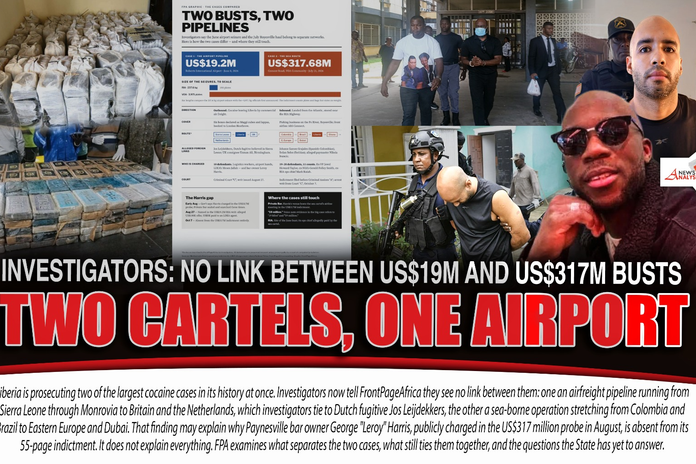
Long before anyone in Liberia was arguing about a Dubai hotel meeting or a foundation called Jewel Star Fish, the story began with customs officers and a number nobody wanted to believe: US$19.2 million in cocaine, seized at Roberts International Airport in June. It should have been the year’s biggest story on its own. Instead, it was a preview. Weeks later, authorities raided a stash house in Paynesville and pulled out somewhere between US$317 million and US$319 million in narcotics — an estimated 238 kilograms to nearly 4 metric tons, the largest seizure in Liberia’s history, and enough to make the June bust look, in hindsight, like a warning shot nobody heeded in time.
Add the two figures together, and Liberia is sitting on almost half a billion dollars in drugs that moved through, or nearly through, its ports and airport in the space of a single summer. That is the number that should anchor every conversation about this case. Instead, it has quietly receded behind a single name.
The Ship Nobody Talks About Anymore
Somewhere in between the two seizures sits a vessel that, for a few uncomfortable days in June, became the most-watched ship in West Africa: the IB Atlantic IV, which sat off Liberia’s coast for the better part of a week while the government worked out what to do about it, before slipping away from patrol boats that were, by multiple accounts, too small to catch it. This newspaper has since learned that a vessel matching that description — or one very much like it, caught up in the same broader case — was eventually brought ashore in Liberia. What was aboard it, what has been done with it, and whether anyone has been charged in connection with it has not been made public. A ship that once dominated the national conversation has become, in the span of a few months, a footnote nobody in government seems eager to revisit.
How the Story Narrowed to One Name
The path from those two seizures to a former Vice President in prison runs through a 2022 meeting in Dubai, arranged, prosecutors say, by a middleman named Sheikh Bassirou Kante, who later became a cooperating witness after running into his own legal trouble in the United States. A wiretapped phone call in which Kante told Jewel Howard-Taylor that the “investors” she met in Dubai had sent her a “gift” became, by the government’s own account, the piece of evidence that turned years of quiet financial ties into a formal arrest. She was stopped at Roberts International Airport on August 19, charged five days later with nine felony counts spanning trafficking, importation, conspiracy, money laundering and abuse of office, and has remained in custody since, her preliminary hearing delayed once already and now set to resume in the coming days. It is, by any measure, a serious and detailed case. It is also, notably, the only piece of this entire saga that has moved with anything resembling urgency.
The Arrests So Far: A Short List for Such a Big Number
Set the charge sheet against Jewel Howard-Taylor next to everyone else this investigation has touched, and the list gets uncomfortably short, uncomfortably fast. Beyond Howard-Taylor herself, only two people connected to this saga have been charged and sent toward trial: LDEA officer Moses Jallah and Paynesville bar owner George Harris, both swept up months ago in the early stages of the case. That is the entire list of people Liberia has formally accused of a crime in connection with nearly half a billion dollars in narcotics.
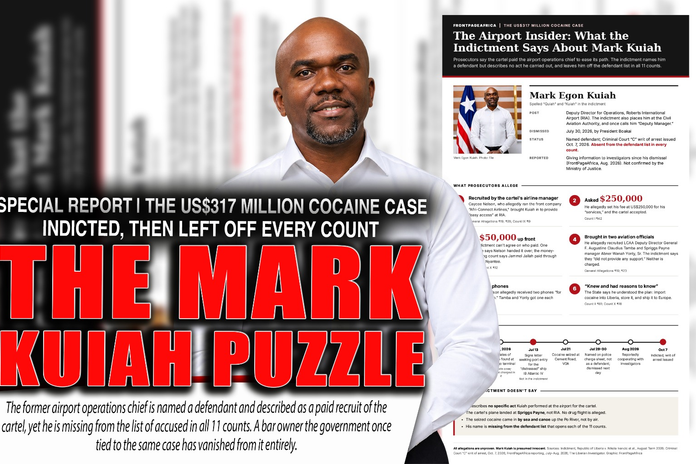
Everyone else occupies some quieter, murkier status. Mark Egon Kuiah, the former operations chief at Roberts International Airport, was named in a writ of arrest back in June and fired from his job in late July — but two months later, he has not been charged with anything a judge could rule on and is reportedly cooperating with investigators rather than facing them. Jonathan Momolu, a security officer at the airport tied to both this year’s case and a 2023 methamphetamine shipment disguised as tea leaves, was questioned once and sent home. Fitzgerald Biago, the Officer-in-Charge of the Liberia Drug Enforcement Agency, recused himself months ago over an unresolved allegation involving vehicles, and that recusal has never been followed by a public resolution one way or the other. Two currently serving Liberia National Police officers, alleged to have physically escorted the drug shipment at the center of the Paynesville case, remain unnamed by the government to this day. Gerald Smith, a former NSA deputy director, was called in for questioning and, as far as the public record shows, nothing more. And the five-person European network this newspaper has identified as the operational core of the entire scheme — Croatians Nikola Ivancic and Mihovil Vrovac, Ukrainian Taras Zadereiko, and a Serbian national and a Spanish national charged earlier in the same case — have all been charged in absentia, and all remain free, spread across Dubai, Ghana and destinations unknown, precisely because a network built to survive the loss of any single member was never going to be dismantled by one arrest in Monrovia.
Is She the Only One Responsible?
Put plainly, because the question deserves a plain answer: no. Nothing in the public record supports the idea that Jewel Howard-Taylor single-handedly moved nearly half a billion dollars in cocaine through Liberia. The government’s own charging documents describe a five-person foreign network with a financier in Dubai, an operator running logistics from Ghana, and a technician structuring the money laundering — a structure that, by design, requires local facilitation at multiple levels to function inside Liberia’s ports, airport and government circles. Names tied to that facilitation — an airport operations chief, an airport security officer, a drug enforcement chief, unnamed police officers — have all surfaced in this newspaper’s reporting over the past two months. Only one of those threads has produced a former official sitting in a prison cell facing trial. The rest have produced recusals, questionings, and silence.
That is not necessarily evidence of a cover-up. Some of it may simply reflect where the evidence is strongest, or where a cooperating witness has made a prosecutor’s job easier. But intent matters less here than pattern, and the pattern is now impossible to miss: the case that moved fastest, hardest and most publicly is also the case attached to the most politically recognizable name. Every other thread — including two seizures worth, combined, more money than the charge against Howard-Taylor alone — has moved slowly enough that most Liberians could be forgiven for forgetting it was ever a separate story.
Where the Silence Is Loudest
Ask the Ministry of Justice today for an update on the broader investigation into the June airport seizure, separate from the Howard-Taylor case, and there is no recent public answer. Ask what happened to the vessel recently brought ashore, and there is no public answer. Ask whether Liberia has made any real progress toward extraditing the five foreign nationals charged in absentia, and there is no public answer beyond a general promise of cooperation with Interpol. Each of these silences might have an innocent, procedural explanation. Together, they describe an investigation whose public face has narrowed to a single defendant, while the machinery that moved nearly half a billion dollars in narcotics through this country continues to operate largely out of view.
President Boakai has pledged “no sacred cows” in this fight, and this newspaper has held him to that standard before. The test of that pledge was never going to be how thoroughly Liberia prosecutes the one defendant whose arrest generated the most headlines. It was always going to be whether the government keeps chasing the money, the network and the local facilitators after the cameras move on to the next hearing date. Right now, on the evidence available to the public, that chase looks like it has largely stopped at one name — and nearly half a billion dollars in drugs says that cannot be where the story ends.
Support Independent Journalism
Your support helps FrontPage Africa continue delivering independent, credible, and impactful journalism. Every contribution strengthens our ability to investigate, inform, and hold power accountable while keeping quality journalism accessible to our readers.
Support our journalism or subscribe to receive the latest FrontPage Africa stories and updates.