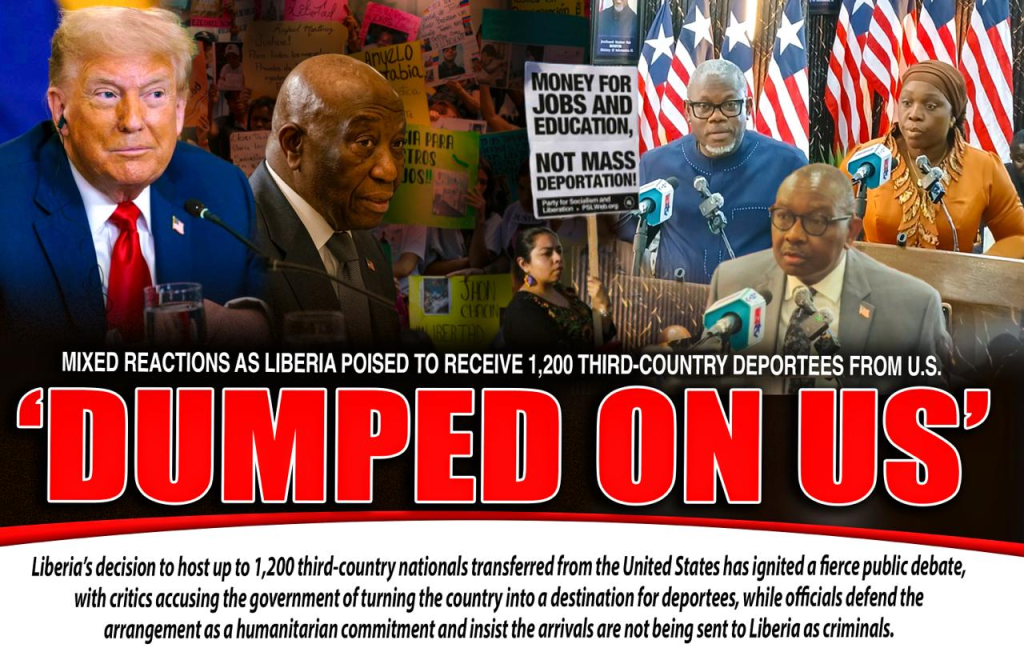
MONROVIA — On Thursday, August 20, the arrival of 20 people at Roberts International Airport will represent far more than another international flight touching down on Liberian soil. It will mark the beginning of an arrangement that could see as many as 1,200 third-country nationals transferred from the United States to Liberia within a year.
By J.H. Webster Clayeh & Selma Lomax, [email protected]
The Liberian government says the people coming are not being sent to Liberia as criminals. Officials describe them as third-country nationals, some of whom may seek asylum or other protection in Liberia, and insist that they are being received as guests rather than prisoners.
Yet outside government circles, the language is considerably less diplomatic. Across social media and among ordinary Liberians, the words “deportees,” “dumping ground,” “security threat” and even “human being dump site” have entered the conversation.
For some Liberians, the arrangement raises questions about whether the government has accepted an enormous responsibility without adequately explaining the terms to the public. For others, it represents an opportunity for Liberia to demonstrate the humanitarian values that have been part of the country’s history.
And for still others, the debate is not about whether Liberia should be compassionate, but whether compassion should come without conditions, restrictions or stronger guarantees. The first 20 arrivals will therefore be watched closely — not only by the government in Monrovia, but by a population demanding answers.
The Agreement Was Made Before Most Liberians Knew About It
The roots of the controversy reach back to September 2025, when Liberia and the United States entered into an Asylum Cooperative Agreement through diplomatic notes.
The agreement was made public in March 2026 and provides a framework for the transfer of third-country nationals to Liberia for asylum, refugee protection or equivalent temporary protection. The agreement also references Liberia’s obligations under international refugee and human-rights instruments, including the 1951 Refugee Convention, its 1967 Protocol and the Convention Against Torture, while incorporating the principle of non-refoulement — the protection against sending a person back to a place where they face persecution or serious harm.
Its emergence was part of a much larger U.S. immigration strategy under President Donald Trump, in which Washington has pursued arrangements with countries willing to receive people who are being removed from the United States but cannot, for various legal or protection reasons, simply be returned to their countries of origin.
Recent reporting indicates that Liberia’s agreement is among a growing number of such arrangements involving countries outside the migrants’ countries of origin. That broader context is important because Liberia is not operating in isolation.
It has entered a global debate over whether powerful countries should be permitted to transfer migrants to countries that are neither their homes nor necessarily places with which they have any previous connection.
Liberia’s History Is Now at the Center of the Argument
The government has chosen history as one of its strongest defenses. Liberia was established in the nineteenth century by freed Black people from the United States and has long been associated with the idea of refuge, return and resettlement.
Over the years, the country has also received refugees fleeing conflicts and persecution in neighboring West African countries.
The Refugee Act of 1993 provides a legal framework for refugee protection in Liberia, while the Liberian government has worked with
the UN Refugee Agency and other partners on refugee assistance and protection.
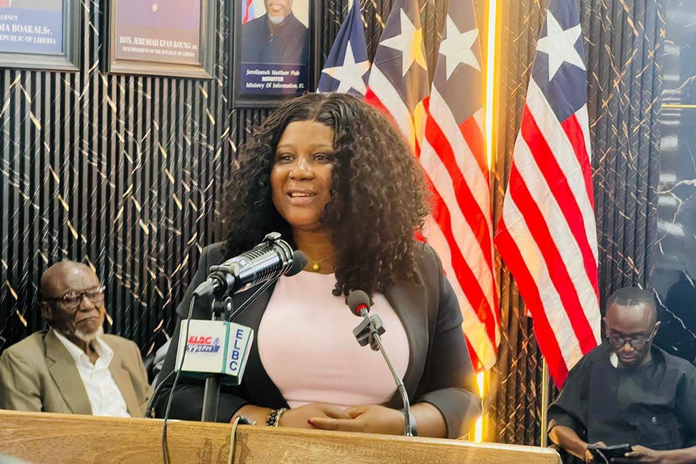
It is against this historical background that Information Minister Jerolinmek Piah has urged Liberians to welcome the incoming people with dignity.
But history, for many citizens, does not settle the matter. The argument being made by critics is that Liberia’s humanitarian tradition should not be interpreted as an open-ended obligation to accept people transferred from another country without first establishing comprehensive safeguards.
The question is not whether Liberia has been hospitable. The question is whether the country can afford to be hospitable without putting its own citizens at risk.
What Exactly Is Liberia Accepting?
That remains one of the most contentious questions. Minister Piah says Liberia intends to accept up to 1,200 people over a one-year period. The people will include nationals of African countries and countries in the Western Hemisphere who have been medically authorized to travel. Some may seek asylum in Liberia. The government says they will be free to leave Liberia whenever they choose and that those who want to remain can seek protection under Liberian law.
But the precise identities and nationalities of the first arrivals have not been publicly disclosed. That information gap has contributed to the suspicion surrounding the agreement.
Recent reporting has also highlighted an important complication surrounding third-country arrangements: some individuals transferred under such policies may have protection orders in the United States preventing their return to their countries of origin because of concerns about persecution or torture. Reuters reported that Liberia’s agreement could involve people who cannot legally be returned directly to their home countries because of such risks.
Justice Minister Cllr. Natu Oswald Tweh has nevertheless acknowledged that many of the individuals have immigration violations or offenses.
He said the United States had already vetted the people and submitted a list to Liberian authorities, who conducted their own vetting before the first group was approved. Tweh also emphasized that Liberia retains the sovereign right to reject anyone it considers unsuitable for entry.
That assurance may provide some comfort, but it also raises another question: What precisely are the criteria Liberia is using to determine who is acceptable?
For Sarah Sahr, the government’s explanation has not erased her concerns. “The US never dumps anything good, en mass, in Liberia,” Sahr wrote in a Facebook post. She compared the current development with Liberia’s historical relationship with the United States, arguing that the arrival of freed slaves in Liberia centuries ago is being repeated in a different form.
Sahr alleged that some people being transferred could have records involving serious offenses, including fraud, rape, child abuse, armed robbery, assault, drug offenses and murder. Her argument goes beyond questioning the agreement itself.
She wants to know why people removed from the United States would be allowed to enter Liberia without what she considers sufficient restrictions. “Why are there no restrictions on their being in Liberia?” she asked. “Why give expelled criminals total freedom like that? We’ve got our own social vices that we are struggling with.”
The government, however, disputes the blanket characterization of the arrivals as criminals. That disagreement over terminology has become central to the controversy. William B. Sando interpreted the arrangement through the lens of President Boakai’s political promises. “From Liberia being a cocaine transfer or transit point to international deportees transfer point under Boakai,” Sando wrote.
He sarcastically described the development as something Liberians had never seen before and then posed a question aimed directly at the administration: “Are these people the investors Boakai promised the Liberian people during the 2023 elections?”
Sando’s comment reflects a broader political frustration among citizens who believe the government should be concentrating on investment, employment and economic development.
For such critics, accepting up to 1,200 third-country nationals raises a question of priorities: Is Liberia taking on an international migration responsibility while still struggling to meet basic needs at home?
Wendell Weah’s concern centers on transparency. “We need to know what agreement between America and Liberia is,” he wrote. He questioned whether Liberia was becoming a destination for deportees from other African countries. “Are they using Liberia as a dumping ground for other African deportees?” he asked.
Weah went further, asking whether Liberia was effectively becoming “a human being dump site” for other countries. His reaction reflects a feeling among some Liberians that the public should not have to rely primarily on government assurances. They want the agreement explained in ordinary language.
They want to know what Liberia receives, what Liberia gives, what rights the incoming individuals have and what responsibilities the government has assumed. James Fully brought the discussion to the practical level. His question was not simply whether the people should be admitted.
He asked what arrangements the Liberian government has made to guarantee their safety, legal status, welfare and possible reintegration once they arrive.
For Edmond Koffa, the controversy begins with a basic question: “Those deportees are they Liberians?” He questioned why people who are not Liberian citizens should be transferred to Liberia. He called on the Information Minister to provide clarity about who exactly the people are and why Liberia is accepting them.
His question highlights the unusual nature of the arrangement. Liberia is not simply receiving its own citizens after deportation. It is agreeing to receive nationals of other countries.
Fomba Kamara believes the government should approach the matter with maximum caution. “This is a very serious matter that needs to be addressed by the government and not to brush it out of hand,” he said.
He argued that the people being transferred should be carefully monitored before being allowed to move freely or obtain employment. His concern is that Liberia should not inherit social problems associated with people who have already experienced difficulties abroad.
Not every Liberian reaction has been hostile. Alieu Kerkulah urged his compatriots to look beyond the politics. “This is bigger than politics; it is about human beings, dignity, and the future of Liberia,” he wrote. Kerkulah said every person has a story and that behind every deportation is a life, a family and a future that has been profoundly affected. He urged Liberia to show compassion while simultaneously protecting its own citizens.
Support Independent Journalism
Your support helps FrontPage Africa continue delivering independent, credible, and impactful journalism. Every contribution strengthens our ability to investigate, inform, and hold power accountable while keeping quality journalism accessible to our readers.
Support our journalism or subscribe to receive the latest FrontPage Africa stories and updates.