MONROVIA — For months, the date August 13 had been viewed by supporters of Justin Oldpa Yeazehn, widely known as “Prophet Key,” as the day the controversial social media commentator would finally leave the Monrovia Central Prison.
By Willie N. Tokpah & Selma Lomax
The date represented the end of a six-month chapter that began with one of the most consequential contempt proceedings involving a Liberian social media personality. Yet, as the anticipated release date arrived, the expectation of freedom collided with a more complicated legal reality.
Prophet Key’s case has entered a stage in which the expiration of his custodial sentence is only one part of the equation. The Supreme Court of Liberia attached additional obligations to its February 13, 2026 decision, and the reported uncertainty surrounding compliance with those obligations has now placed his release in doubt.
What was expected to be a final day behind bars has instead become another chapter in a legal saga that has moved from social media broadcasts to the courtroom, from courtroom proceedings to imprisonment, and now from imprisonment to a debate over what must happen before the prison gates can finally open.
When the Calendar Was Supposed to End the Story
For Prophet Key’s supporters, the six-month sentence appeared straightforward. He was sentenced to 180 days at the Monrovia Central Prison after the Supreme Court found him guilty of criminal contempt. Once the period had elapsed, the natural expectation was that he would be released.
But the February ruling did more than impose a custodial sentence. The Supreme Court ordered Prophet Key to publish an apology to the judiciary and Liberian women in three local newspapers for five consecutive days. He was also required to execute a behavior bond in which he would commit himself to refraining from the conduct that resulted in his conviction.
That distinction has become central to the uncertainty surrounding his release. The issue is not simply whether Prophet Key has physically spent six months in prison. The question is whether the conditions accompanying the Court’s order have been fulfilled in a manner acceptable to the institution that imposed them.
That is why the approach of August 13 did not necessarily bring an automatic conclusion to the case.
The Case Behind the Bars
Prophet Key’s imprisonment was the culmination of a confrontation between an outspoken social media personality and Liberia’s highest court.
Before his incarceration, Prophet Key had become known for an aggressive style of commentary that frequently involved politicians, public officials, prominent personalities, and institutions.
His broadcasts attracted attention because of their directness and often confrontational tone. To his supporters, the style represented fearlessness and a willingness to speak about issues others avoided.
To his critics, however, some of his statements crossed the boundaries of responsible public criticism. The conflict with the judiciary ultimately became the most serious consequence of that approach.
The Supreme Court, sitting in its Full Bench, found Prophet Key guilty of criminal contempt on February 13, 2026, citing statements that it considered vulgar, insulting and abusive. Among the conduct considered by the Court were remarks involving the mother of Chief Justice Yamie Quiqui Gbeisay and allegations of corruption against members of the judiciary that the Court found unsupported by evidence. The decision sent Prophet Key from the world of online commentary into the highly restrictive environment of the Monrovia Central Prison.
When Expression Met the Authority of the Court
The case immediately raised questions beyond the fate of one individual. At its core was a difficult question for a democratic society: how far can an individual go in criticizing public institutions, particularly the judiciary, before criticism becomes punishable conduct?
Prophet Key’s supporters viewed the imprisonment through the lens of freedom of expression and argued that a strong democracy must tolerate harsh criticism, including criticism that may be uncomfortable or offensive.
The Supreme Court, however, approached the matter from the perspective of the authority and integrity of judicial proceedings. The Court acknowledged constitutional protections for freedom of expression but emphasized that those protections are accompanied by responsibilities.
The decision referenced Articles 5, 14 and 15 of Liberia’s 1986 Constitution while addressing the relationship between expression, individual rights, public order and national values.
The result was a sentence that effectively transformed the debate from an argument over what Prophet Key was allowed to say into a legal determination over the consequences of what he had said.
The Apology That Changed the Tone
Inside prison, Prophet Key eventually made a move that signaled a significant shift from the public persona that had brought him before the Supreme Court.
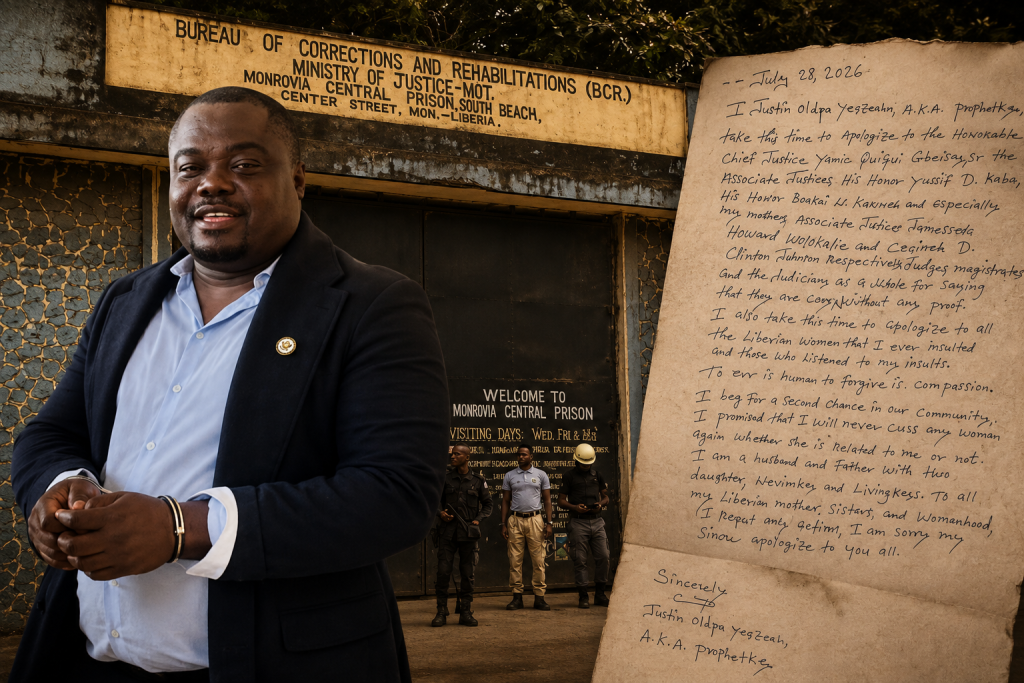
On July 28, he issued a handwritten apology. The document was addressed to Chief Justice Gbeisay, Associate Justices Yussif D. Kaba, Boakai N. Kanneh, Jamesetta H. Wolokolie and Ceaineh D. Clinton Johnson.
He also extended his apology to judges, magistrates and the judiciary generally. Most significantly, he acknowledged having accused members of the judiciary of corruption without proof.
He also apologized to Liberian women for statements he acknowledged were insulting. The apology was significant because it acknowledged the conduct at the center of the contempt proceedings.
It also suggested that Prophet Key understood that returning to freedom required more than simply waiting for the calendar to reach the end of his sentence.
But the apology created another question: Was writing the apology enough? According to the account of his supporters, the answer was no.
The Supreme Court did not reportedly limit its requirement to Prophet Key writing an apology. That meant the apology had to move from a document produced by Prophet Key to a public statement appearing in three local newspapers for five consecutive days.
A handwritten apology could remain a private or limited document. A newspaper publication, by contrast, would place the statement before the broader public and ensure that the acknowledgment of wrongdoing reached an audience beyond the courtroom.
According to a member of the Free Positive Movement, Abu A. Kamara efforts were made to have the requirement fulfilled, but publication schedules and other logistical issues reportedly created difficulties.
Some of the required publications allegedly did not appear within the expected timeframe, raising questions about whether the five-day requirement had been fully satisfied.
That uncertainty has now become one of the most important issues surrounding Prophet Key’s freedom. The Prophet Key case highlights a distinction that is easy to overlook when a person receives a fixed prison sentence. For Prophet Key’s family and supporters, the matter is no longer an abstract debate about legal conditions.
Support Independent Journalism
Your support helps FrontPage Africa continue delivering independent, credible, and impactful journalism. Every contribution strengthens our ability to investigate, inform, and hold power accountable while keeping quality journalism accessible to our readers.
Support our journalism or subscribe to receive the latest FrontPage Africa stories and updates.