MONROVIA – A new water advocacy group has been launched in Liberia, with a call on government to ensure the equitable and affordable provision of safe drinking water to citizens across the country.
By Obediah Johnson
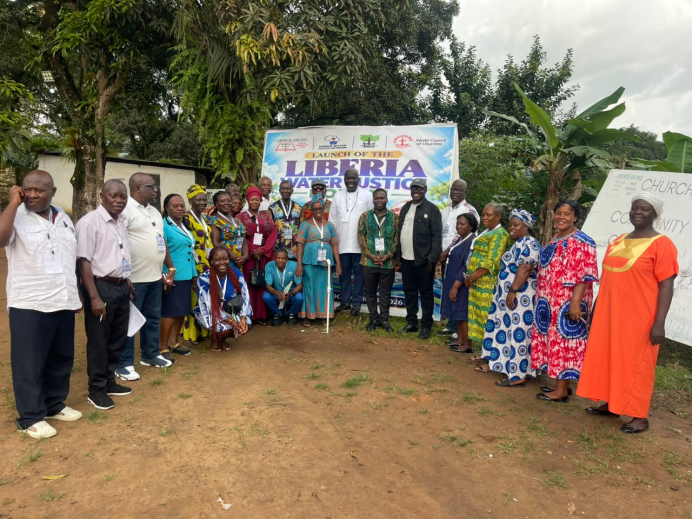
The group named and styled Liberia Water Justice Forum was launched at the climax of a capacity building workshop held at the New Water in the Desert Apostolic Pentecostal Church in Brewerville, outside Monrovia.
The Forum was launched by Church Aid International (CAI, in collaboration with the Fellowship of Christian Councils and Churches in West Africa (FECCIWA) and Africa Water Justice Network based in Togo and Accra, Ghana respectively.
Speaking during the launch, CAI Chairman Bishop Kortu Brown disclosed that the Forum would advocate and ask hard questions surrounding access to water in Liberia.
He said those who would not listen and respond to inquiries being raised by others to address social and other challenges confronting Liberians, should not be leaders here.
“No matter how hard the questions are, we can find solutions to those hard questions. If you are leading people you must be ready to answer the hard questions. All those who are running away from the hard questions should not be leaders because leaders speak to the rock. You must find answers to the hard questions.”
Bishop Brown maintained that church and other religious leaders of the Liberia Council of Churches (LCC) must speak out and ask hard questions to find solutions to societal issues.
“We have to face the hard questions because if Moses does not speak to the rock, the water will not come. The are things that we God servants would like to pray Moses prayed and God said to find solution you have to speak to the rock.”
He said many leaders in Liberia get worrisome when asked the hard questions. He vowed that the church would not relent to continue to advocate for the supply of accessible and affordable safe drinking water to citizens across the country.
Bishop Brown noted that regardless of geographical locations or boundaries, all Liberians, especially women and children, should have access to water.
He called for concession companies operating in Liberia to pay fees for allegedly polluting rivers, creeks and other sources of water in their respective areas of operations.
He stressed that citizens in the leeward areas used the creeks and rivers to fetch water for drinking, cooking and other purposes and as such, these waters should not be polluted by mining companies.
“Where ever the difficulties are, we have to go there and speak. If you don’t know where the problem is, you can never find the solution. It is on this premise that I come to formally launch the Liberia Water Justice Forum.”
For his part, the Secretary General of the Liberia Council of Churches (LCC) Rev. Christopher Toe observed that though water covers a substantial percentage of the land space in Liberia, access to safe drinking water remains a challenge in households across the country.
He pointed out that the launch of the Forum is in promoting pillar six of the global Sustainable Development Goals (SDGs), which amongst other things calls for the provision of clean water and sanitation.
He maintained that with 70% of the human body comprising of water, it (water) should always be a component of every human life.
Rev. Toe emphasized that church leaders have a roll to play towards ensuring that there is justice for water in the Liberian society.
“Water is life, water is dignity. Our land space gets so much water but yet still we don’t have water in our homes or access to water. I think this forum is a justice component of water. God gives us water to make use of it (water) so that it benefits you. There are many a lot of people who are getting rich out of water. In everything we do, the politicians are aware that the Church is the lead.”
He said through advocacy, the church should speak with one voice on the significance of access to water to citizens across the country.
“There is a conversation about the third land. On that third lane we must ensure that water is in all our homes. Anybody who will be on that third lane, you will have to take water as a priority.”
He cautioned against attacks and suppression of the Church by politicians in the country. Also speaking, the acting Secretary General of the Fellowship of Christian Councils and Churches in West Africa (FECCIWA) based in Lome, Togo, Mr. Michael Tettey, observed that access to water remains one of the biggest challenges on the African continent.
He said the idea of the Forum in Liberia was birthed in Benin a a result of expressed interest and willingness of Bishop Brown to drive the initiative.
He disclosed that it took just two months to plan and ensure that the Forum was established in Liberia to advocate justice for access to water in the country.
Mr. Tettey added that access or citizens’ right to affordable water remains critical to support development and social initiative for their well-being. He said Christians should advocate towards the promotion of good sanitation accountability.
Mr. Leonard S. Quartey, Coordinator of Africa Water Justice Network based in Accra, Ghana, commended CAI for leading the initiative. He pointed out that approximately 400million people on the African continent do not have access to safe drinking water.
He said with a very meager population of Liberian population having access to safe drinking water, the launch of the Forum would help raise awareness and advocate for the provision of safe drinking water to citizens.
“We are fighting against a system that wants to normalize the situation (of the lack of safe drinking water). Quartey said various water systems across the African continent should be improved for the betterment of the citizenry.
The capacity building workshop marking the launch of the Forum brought together participants and facilitators from Sierra Leone, Ghana, Togo, Guinea, amongst others.
Support Independent Journalism
Your support helps FrontPage Africa continue delivering independent, credible, and impactful journalism. Every contribution strengthens our ability to investigate, inform, and hold power accountable while keeping quality journalism accessible to our readers.
Support our journalism or subscribe to receive the latest FrontPage Africa stories and updates.