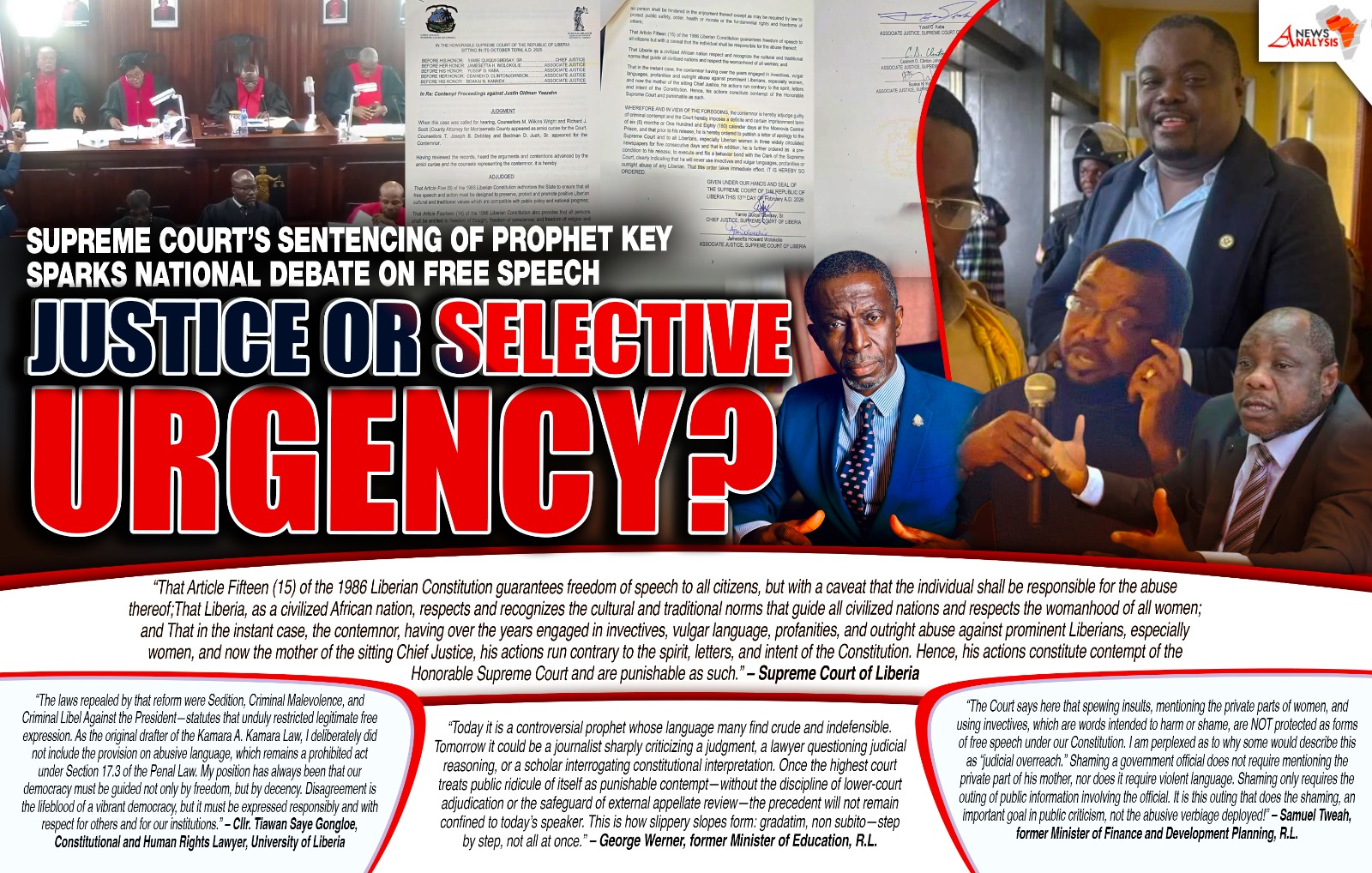
Monrovia – The Supreme Court of Liberia’s decision to sentence controversial social commentator Justin Oldman Yeazehn, widely known as Prophet Key, to six months in prison for criminal contempt has ignited one of the most intense national debates in recent years—pitting constitutional interpretation against concerns about judicial power and equal protection under the law.
By Gerald C. Koinyeneh, [email protected]
Presided over by Chief Justice Yamie Quiqui Gbeisay, Sr., along with Associate Justices Jamesetta Howard Wolokolie, Yussif D. Kaba, Ceaineh D. Clinton Johnson, and Boakai N. Kanneh, the Court ruled that Prophet Key’s repeated use of “invectives, vulgar language, profanities and outright abuse,” particularly targeting the mother of the sitting Chief Justice, constituted contempt of the Supreme Court.
In its judgment, the Court relied heavily on Articles 5, 14, and 15 of the 1986 Constitution, emphasizing that while freedom of speech is guaranteed, it is not absolute and carries responsibility.
The Court declared: “His conduct in spewing out invectives, insults, abuses, and indecent language constitutes a violation of the constitutional right to freedom of expression.”
Beyond the six-month custodial sentence—180 calendar days—the Court imposed additional conditions. Prophet Key must publish a letter of apology to the Supreme Court and to all Liberians, especially Liberian women, in three widely circulated newspapers for five consecutive days; execute and file a behavior bond with the Clerk of the Supreme Court pledging never again to use invectives, vulgar language, profanities, or abusive speech against any Liberian.
The order took immediate effect.
“That Article Fifteen (15) of the 1986 Liberian Constitution guarantees freedom of speech to all citizens, but with a caveat that the individual shall be responsible for the abuse thereof,” the Court declared.
The Justices further emphasized Liberia’s cultural and constitutional values, stating: “That Liberia, as a civilized African nation, respects and recognizes the cultural and traditional norms that guide all civilized nations and respects the womanhood of all women; and that in the instant case, the contemnor, having over the years engaged in invectives, vulgar language, profanities, and outright abuse against prominent Liberians, especially women, and now the mother of the sitting Chief Justice, his actions run contrary to the spirit, letters, and intent of the Constitution. Hence, his actions constitute contempt of the Honorable Supreme Court and are punishable as such.”
Who Is Prophet Key?
Justin Oldman Yeazehn, a social commentator and online personality from Tappita Statutory District, Nimba County, rose to prominence through social media livestreams and commentary that frequently criticized public officials, religious leaders, and prominent citizens. His blunt and often inflammatory style attracted both supporters and critics.
While some followers hailed him as a fearless truth-teller, others accused him of defamation, vulgarity, personal attacks, and ethnic or religious provocation. He has previously been accused of publishing unverified corruption claims and using profane language toward women, though legal action rarely succeeded—except in a case by former Liberian Cultural Ambassador Julie Endee, which was quashed.
When the Supreme Court initiated contempt proceedings against him for verbally attacking the Court and the Chief Justice’s mother, Prophet Key admitted guilt and pleaded for mercy. The Court, however, ruled otherwise.
A Nation Divided
Almost immediately, the ruling sparked sharply divergent reactions from legal scholars, former public officials, journalists, and civil society actors.
Gongloe: Freedom Must Be Guided by Decency
Cllr. Tiawan Saye Gongloe, constitutional and human rights lawyer and lecturer at the University of Liberia, defended the broader principle underlying the ruling.
Referencing his role in drafting the Kamara A. Kamara Press Freedom Law, Gongloe noted that while sedition, criminal malevolence, and criminal libel against the president were repealed to expand democratic space, the prohibition on abusive language was intentionally retained.
“My position has always been that our democracy must be guided not only by freedom, but by decency,” Gongloe stated. “Disagreement is the lifeblood of a vibrant democracy, but it must be expressed responsibly and with respect for others and for our institutions.”
In a lengthy public education commentary, Gongloe stressed that democracy thrives on disagreement—but not on destruction.
He argued that contempt of court is not about protecting judicial ego, but about safeguarding the administration of justice. Citing precedents such as In re Scott & Roberts (1984) and In re Joseph K. Jallah (1987), Gongloe noted that Liberia’s Supreme Court has long held that criticism of judicial reasoning is permissible—but sweeping accusations of corruption or abusive ridicule that undermine public confidence may constitute contempt.
“Freedom in a constitutional democracy is never without responsibility,” he wrote, emphasizing that reckless speech can erode the rule of law itself.
For Gongloe, the issue is not suppression of criticism but the preservation of constitutional balance between liberty and responsibility.
Tweah: A Refinement of Free Speech
Former Finance Minister Samuel Tweah echoed similar sentiments, arguing that the Court did not strip Prophet Key of free speech rights but clarified their limits.
“The Court says here that spewing insults, mentioning the private parts of women, and using invectives… are NOT protected as forms of free speech under our Constitution,” Tweah wrote.
He rejected claims of judicial overreach, asserting that effective public criticism does not require vulgarity.
“Shaming a government official does not require mentioning the private part of his mother, nor does it require violent language. Shaming only requires the outing of public information involving the official.”
According to Tweah, the ruling enhances public discourse by directing critics toward substance rather than verbal abuse.
Werner: A Structural Warning
However, former Education Minister George K. Werner offered a sobering caution about the precedent.
“Today it is a controversial prophet whose language many find crude and indefensible,” Werner observed. “Tomorrow it could be a journalist sharply criticizing a judgment, a lawyer questioning judicial reasoning, or a scholar interrogating constitutional interpretation.”
Werner’s concern centers on procedure and institutional design. The Supreme Court initiated the contempt proceedings, adjudicated the matter, and imposed punishment—without the possibility of appeal to a higher domestic authority.
“Once the highest court treats public ridicule of itself as punishable contempt… the precedent will not remain confined to today’s speaker,” Werner warned. “This is how slippery slopes form: gradatim, non subito—step by step, not all at once.”
He warned that when the highest court punishes speech directed at itself, especially with conditions governing future expression, it creates a precedent that could extend beyond today’s controversial defendant.
“Celebration,” Werner cautioned, “is often the most dangerous stage of erosion.”
Washington: Justice at Last—or Selective Urgency?
U.S.-based Liberian journalist Danlette Washington raised perhaps the most emotionally charged question: Why now?
“For years, he publicly insulted and degraded several women, including one of Liberia’s most respected cultural icons and peace ambassadors, Queen Juli Endee,” Washington noted. “She repeatedly sought justice through the courts. Yet, at the time, the system did not appear to move with the same urgency.”
Washington acknowledged that Prophet Key deserved accountability but questioned whether the speed of this case was influenced by the fact that the insult targeted the mother of the sitting Chief Justice.
“So what changed?” she asked. “Was it the offense, or was it who was offended?”
Her remarks have resonated widely, particularly among women’s rights advocates who argue that the justice system must demonstrate equal urgency when ordinary Liberian women are victims of abuse.
‘Constitutional Accountability, Not Absolute Freedom’
The national debate over the High Court’s decision intensified, with Senator Amara Konneh of Gbarpolu County adding his voice to calls for consistency and reform within Liberia’s justice system.
Senator Konneh, Chairman of the Public Accounts Committee of the Liberian Senate and former Minister of Finance and Development Planning under former President Ellen Johnson Sirleaf, described himself as a “non-lawyer” who followed the proceedings with keen interest.
Constitutional Accountability, Not Absolute Freedom
Referencing Article 15 of the 1986 Constitution, Konneh acknowledged that freedom of expression is guaranteed but not without limits.
“Article 15 of the 1986 Liberian Constitution guarantees freedom of expression but also explicitly states that individuals are accountable for misuse,” he said, aligning his position with legal arguments advanced by constitutional lawyer Cllr. Tiawan Saye Gongloe and others.
According to Konneh, the Constitution clearly protects speech while mandating responsibility for abuse, particularly in cases of defamation involving both private citizens and public officials.
‘Would the Court Have Been Just as Quick?’
Like Miss Washington, the Senator raised pointed questions about the speed and circumstances under which the Court acted.
“Now, let us suppose the case that led to ProphetKey’s imprisonment yesterday involved a private citizen or another public official in the Legislative or Executive branches rather than the Chief Justice; would the court have been just as quick to dispense justice?” he asked.
Konneh further questioned whether the judiciary would have demonstrated similar firmness in the face of pressure or interference from influential figures allegedly connected to Prophet Key.
The central issue, he argued, is whether Liberia genuinely upholds its national motto: “Let Justice Be Done to All.”
“Who is protecting private citizens against defamation and insults,” he asked, “which yesterday’s court ruling made clear are not protected by Article 15 without consequences?”
‘Corruption Allegations Must Not Be Ignored’
While condemning the vulgar insults directed at the Chief Justice’s mother, Konneh also insisted that broader allegations raised during the same podcast—particularly claims of corruption within the judiciary—must not be ignored.
“I expect the Supreme Court to address the issue of corruption in our courts,” he stated bluntly. “The reality is, our courts are corrupt.”
Konneh emphasized that the fight against vulgar and defamatory speech must be matched with equal urgency in confronting systemic corruption.
“We must acknowledge this in our debate with the same energy we are applying to the distasteful, vulgar language in ProphetKey’s utterances,” he said. “No cherry-picking!”
‘Sacred Pillar of Democracy’
Representative Musa Bility, who represents Electoral District #7 in Nimba County, also weighed in. In a strongly worded message titled “Letter from Saclepea”, Bility framed the issue as larger than one individual, describing it as a defining moment for justice, decency, and the integrity of Liberia’s highest court.
Bility emphasized that the moment transcends the fate of Prophet Key.
“For me, this moment is not merely about one man,” he wrote. “It is about justice. It is about decency. And more importantly, it is about the place of our Supreme Court in the life of our Republic.”
While acknowledging that no judicial system is without flaws, Bility described Liberia’s Judiciary as the “most sacred institution” of the nation’s democracy. He noted that throughout years of political tension and uncertainty, Liberians have consistently relied on the Supreme Court to resolve disputes peacefully.
“That alone is not a small achievement,” he stated.
Judiciary as Stabilizing Force
At a time when Liberia faces mounting political and governance challenges, Bility argued that the Judiciary has demonstrated greater institutional discipline and transparency than the other branches of government.
“That does not mean the Court is perfect,” he cautioned. “No court anywhere is. But it does mean that it continues to function as the stabilizing pillar of our constitutional order.”
Bility praised what he described as the absence of interference from the Executive and Legislative branches in the Court’s handling of the contempt proceedings, calling such restraint “commendable” and a sign that constitutional boundaries are being respected.
Drawing the Line Between Dissent and Degradation
While affirming that Liberia’s Constitution protects dissent and disagreement with court rulings, Bility drew a sharp distinction between lawful criticism and vulgar attacks.
“We may disagree with the decisions of the Court. In fact, disagreement is healthy,” he wrote. “But there is a profound difference between disagreeing with a ruling and denigrating the institution that delivers justice.”
According to Bility, attacking and vilifying the Judiciary weakens the very system citizens depend upon to safeguard their rights.
“We must be careful not to drag the Judiciary into the same culture of chaos that often defines our politics,” he warned.
Seeking Mercy for Prophet Key
Senator Nya D. Twayen of Nimba County has called for forgiveness and rehabilitation following the Supreme Court’s decision to sentence fellow Nimba native Justin Opa Yeazean, popularly known as Prophet Key, to six months’ imprisonment for criminal contempt.
In a public statement, Senator Twayen described the development as emotionally complex for Nimba County, noting that both the convicted social commentator and the Chief Justice presiding over the Judiciary hail from the same county.
“Well, well, well; after all, this week has been a mixed-feeling week for Nimba,” Twayen said. “One of our own admittedly erred and is facing punishment; one of our elders who presides over the Judiciary has rightfully brought the younger one to check for the good of county and country.”
Twayen framed the situation not as a political confrontation but as a moment of internal accountability within the county — emphasizing respect for both the rule of law and traditional values of correction and rehabilitation.
The Nimba lawmaker announced that he plans to visit Yeazean during his incarceration in the coming weeks. He clarified that the visit would not be an act of pity, but a gesture of responsibility as a representative of all citizens of the county.
“As Senator of Nimba, I represent all citizens: the good, the bad, and even the ugly/beautiful,” he stated. “I will be visiting Yeazean not to have pity on him but to see him go through what he admittedly confessed to doing wrong.”
Twayen also disclosed plans to meet with Mrs. Yeazean to provide support toward her husband’s upkeep and well-being while he serves his sentence.
While acknowledging the seriousness of the offense, Twayen appealed to the Chief Justice, the Supreme Court, and the Liberian public to extend forgiveness.
“We ask the Chief Justice, the Supreme Court, and all Liberians to forgive Yeazean,” he said, adding that Yeazean has admitted wrongdoing and promised “total transformation and transition to normalcy and respect for our culture and tradition.”
The Constitutional Crossroads
At its core, the controversy forces Liberia to confront a defining constitutional question: Where does robust democratic speech end and punishable contempt begin?
Supporters of the ruling argue that democracy cannot survive if public discourse descends into unchecked vulgarity and character assassination. They contend that protecting the dignity of non-public individuals, including relatives of public officials, strengthens democratic culture.
Critics caution that the judiciary must exercise extraordinary restraint when wielding its inherent contempt powers, especially when the speech in question is directed at the Court itself.
For now, the Supreme Court’s ruling stands as binding law—one that may shape the contours of free speech jurisprudence in Liberia for years to come.
Whether history records this moment as a necessary recalibration of democratic decency—or as a troubling expansion of judicial power—may depend on how consistently and impartially the principles articulated in this case are applied going forward.
The Broader Question
At the center of the debate lies a fundamental tension: Where does free speech end and contempt begin?
The Supreme Court has drawn a line—declaring that criticism of public officials is permissible, but abusive language that undermines constitutional values and public confidence in the judiciary is not protected.
Supporters say the ruling restores dignity to public discourse and protects non-public individuals—such as relatives of officials—from defamatory abuse.
Critics warn that concentrated judicial power, especially when exercised without external review, demands extraordinary restraint to preserve public confidence.
For now, the ruling stands as binding law.
Prophet Key begins his six-month sentence under an order that many believe could shape Liberia’s constitutional landscape for years to come.
Whether it ultimately strengthens democratic maturity or chills public expression may depend less on this one case and more on how consistently and prudently the law is applied going forward.
Support Independent Journalism
Your support helps FrontPage Africa continue delivering independent, credible, and impactful journalism. Every contribution strengthens our ability to investigate, inform, and hold power accountable while keeping quality journalism accessible to our readers.
Support our journalism or subscribe to receive the latest FrontPage Africa stories and updates.