Monrovia – Crayton O. Duncan, Senator of Sinoe County and Chair of the Liberian Senate’s Committee on Autonomous Agencies and Commissions, is under fire following remarks defending the right of elected officials to accumulate wealth, even as fresh evidence links him to an alleged illegal forest land lease and potential conflict of interest.
By Obediah Johnson, [email protected]
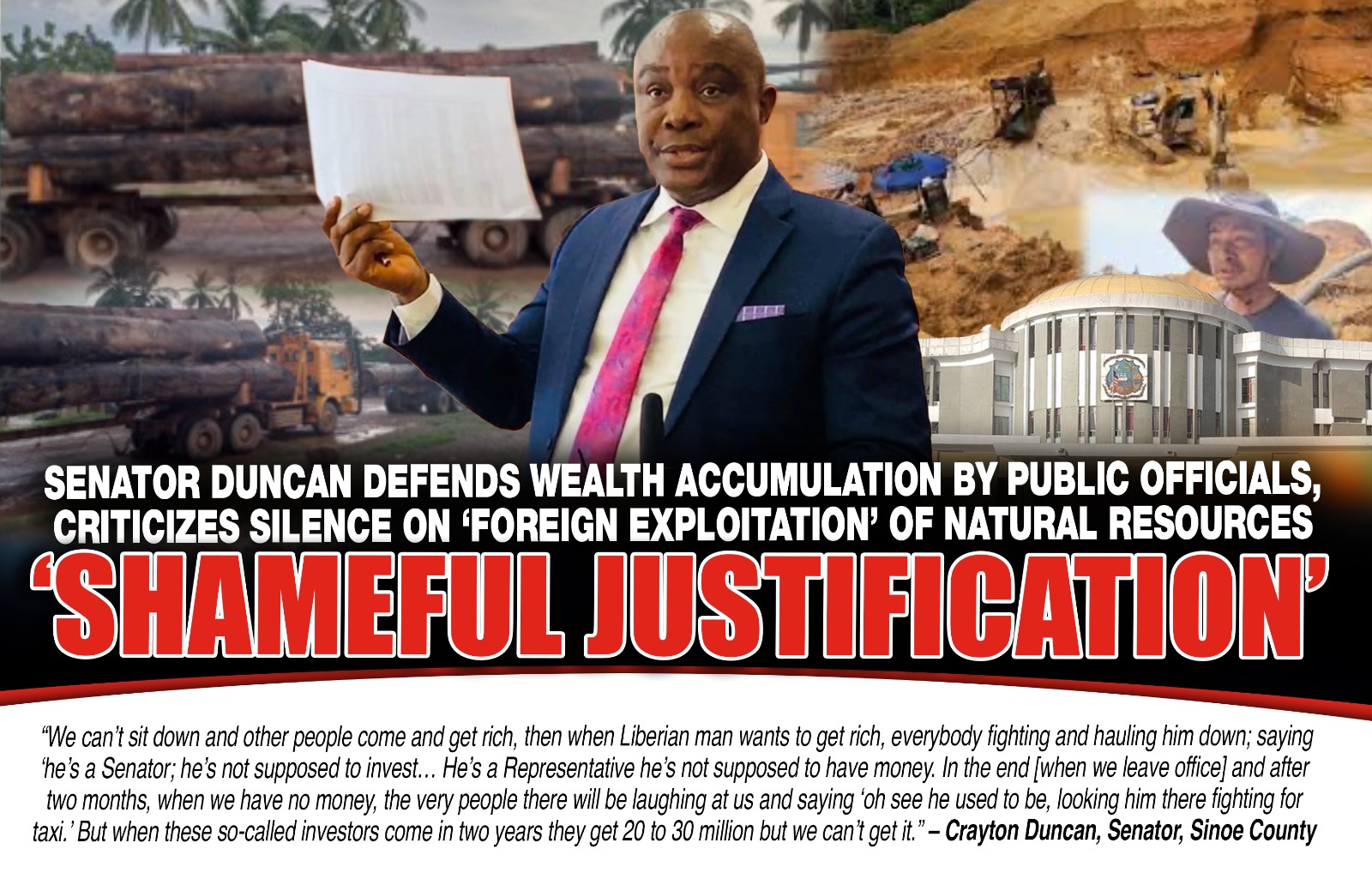
The senator’s statements, made during a recent plenary session of the Senate, were a bold critique of Liberians who question the sudden financial prosperity of their elected representatives. “We can’t sit down and other people come and get rich. Then when Liberian man wants to get rich, everybody fighting and hauling him down,” Duncan said during his remarks.
“He’s a senator; he’s not supposed to invest. He’s a Representative; he’s not supposed to have money. In the end, after two months we have no money, the very people there will be laughing and saying ‘Oh he used to be, look at him there fighting for taxi.’”
Senator Duncan went further to argue that foreign investors are getting significantly wealthier from Liberia’s natural resources than Liberians themselves. “The so-called investments of these people that are coming here — they are not investing — they are exploiting. It is the exploitation of our resources. We cannot barely fix our roads because we don’t have money,” Duncan stated.
“Everything we rely on is the few taxes that we generate, when we know that they [the investors] are supposed to be telling us that those logs should not be cut by a man who just brought US$2 million here and becomes US$20 million richer when he goes by cutting our logs and putting them on the ship.”
But while the senator publicly decries foreign exploitation, critics say he is simultaneously participating in the same practices he condemns — this time as a top executive of a logging company operating in his own county.
A document obtained by Liberia Forest Media Watch reveals a 25-year lease agreement signed between the Bannah community in Sinoe County and a company called Sino Forest Corporation. The deal, notarized on May 3, 2021, grants the company access to 250 acres of community land for logging operations.
What makes the agreement controversial is the presence of Senator Duncan — then serving as District 1 Representative for Sinoe County — listed on the contract not as a witness or facilitator, but as Executive Director of Sino Forest Corporation. The document also includes signatures from local leaders, including the Youth President, Paramount Chief, and Township Commissioner.
This development raises serious legal red flags. Liberia’s Code of Conduct for Public Officials prohibits elected representatives from engaging in business activities that pose a conflict of interest or contradict public policy.
Additionally, the National Forestry Reform Law of 2006 explicitly bars public officials from owning or operating logging companies. Senators Duncan’s involvement in the lease appears to violate both statutes.
Furthermore, under the 2009 Community Rights Law, lawmakers are restricted from making decisions regarding community forests. They may serve on community assemblies in an advisory capacity, but not lead or direct commercial forestry agreements.
According to Richard G. Gleah, Liaison Manager of the Forestry Development Authority, the law is clear. “Even a town chief is not supposed to own a logging company,” Gleah said during an appearance on Forest Hour, a local environmental radio show.
The land lease sparked local outrage in October 2022 when residents of Bannah staged a peaceful protest in Greenville, Sinoe County. The protestors demanded answers from Senator Duncan regarding the purpose of the lease and questioned the involvement of Chinese investors who were reportedly seen conducting logging operations on the land.
“We had no agreement with these Chinese people,” said Ranford Beah, Youth President of the Bannah community and one of the signatories on the lease. “Representative Duncan refused to come and explain to us what was happening.”
Community members expressed concern that the agreement was entered into without adequate consultation, and they feared that Senator Duncan’s dual role as a legislator and corporate executive compromised their rights and future benefits from the land.
In an apparent effort to shift blame away from local actors, Senator Duncan blasted foreign concessionaires for their hiring practices. He alleged that most of these companies hire Liberians only on a temporary, contractual basis in order to avoid long-term employment benefits such as retirement, health care, and paid leave.
“All of these things have been stripped away by these concessions that we bring here and these investors who are in our country. Sometimes I wonder whether they are really investors. The word investor does not apply to them,” Duncan said.
The senator further noted that some logging companies operating in Sinoe County employ as few as eight Liberians, despite the abundance of natural resources. He failed, however, to provide evidence that Sino Forest Corporation — his own company — offers better conditions or greater employment opportunities. “I’m wondering what is the purpose of us having these people in Liberia when they cannot employ our people after three months, according to the law,” he said.
“From that three months, they will sign six months and other six months contracts. Thereafter, more contracts will come and they (Liberians) will work two or three years on that three months contract they signed four years ago.”
Though Senator Duncan positions himself as a nationalist frustrated by foreign exploitation, civil society groups and legal analysts are raising concerns that his statements are an attempt to distract from his own financial entanglements. “In Liberia, many of those elected to public positions see their ascendancy as a means to accumulate wealth,” Duncan himself admitted on the Senate floor. “They see their call to public service as a stepping tool to enrich themselves and improve their living conditions and their respective family members.”
But critics argue that Senator Duncan is describing his own conduct, rather than condemning a systemic problem. “He’s not just part of the problem; he is the embodiment of the loopholes and impunity in our governance system,” said a legal analyst familiar with Liberia’s forestry laws who asked to remain anonymous for fear of reprisal.
The case of Senator Duncan is emerging as a test of political will. Legal experts say the evidence of conflict of interest is overwhelming and demand a formal investigation by the Liberia Anti-Corruption Commission, the General Auditing Commission, and the Public Procurement and Concessions Commission.
Despite widespread media coverage and community protests, Duncan has yet to publicly respond to allegations of violating the forestry reform law and the Code of Conduct. Efforts by this reporter to contact the senator for comment were unsuccessful as of press time.
Senator Duncan’s dual role — as a fierce critic of foreign resource exploitation and an alleged participant in illegal logging ventures — has generated a national debate about integrity, governance, and accountability.
Support Independent Journalism
Your support helps FrontPage Africa continue delivering independent, credible, and impactful journalism. Every contribution strengthens our ability to investigate, inform, and hold power accountable while keeping quality journalism accessible to our readers.
Support our journalism or subscribe to receive the latest FrontPage Africa stories and updates.