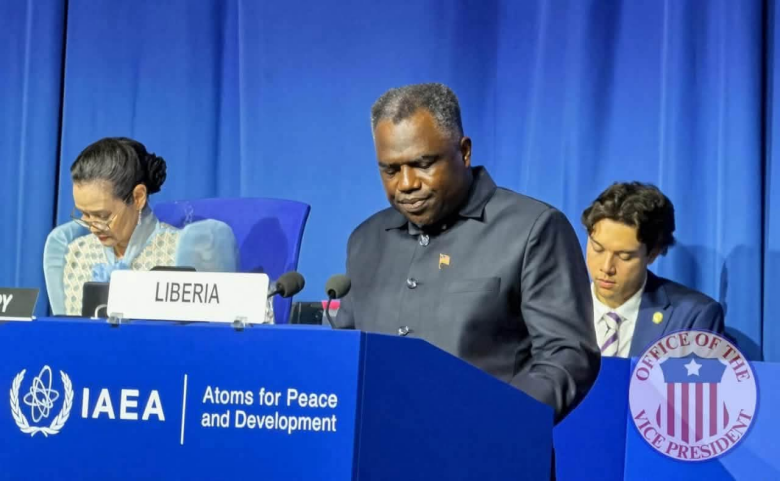
VIENNA, Austria Liberia is seeking at least US$22 million to build and operate its first comprehensive cancer diagnosis and treatment center as the West African nation looks to expand access to life-saving healthcare and deepen cooperation with the International Atomic Energy Agency (IAEA).
By Jaheim T. [email protected]
Addressing the 70th General Conference of the IAEA in Vienna, Vice President Jeremiah Koung said Liberia believes developing countries should have equal access to the benefits of peaceful nuclear science and technology.
He stressed that nuclear technology can play a major role in improving healthcare, food production and climate resilience in countries with limited resources.
“Access to peaceful nuclear technology must not be determined by geography or national income. Its benefits must reach people in countries with the greatest needs,” Vice President Koung said.
Vice President Koung stated that Liberia’s priorities under the government’s ARREST Agenda for Inclusive Development are closely linked to the goals of the IAEA.
He explained that the country wants to move beyond individual projects and build a broader partnership that supports national development across several sectors.
“We seek to elevate our cooperation with the IAEA from isolated technical interventions to a coordinated national development partnership that strengthens health systems, enhances food security, builds climate resilience, and establishes a robust radiation safety infrastructure,” he said.
As Liberia expands the use of radioactive materials for peaceful purposes, the government is also working to strengthen its legal and regulatory framework. Koung said a new nuclear law has been drafted to guide the safe and secure use of nuclear science and technology in the country.
“This law will strengthen radiation protection, the security of radioactive and nuclear sources, and compliance with international safety standards,” he intimated.
Vice President Koung highlighted cancer as one of Liberia’s most pressing public health concerns. He noted that thousands of new cases and deaths are recorded every year, while the country lacks the facilities needed to provide specialized treatment for most patients.
“Cancer is one of the most urgent health challenges facing our nation,” Vice President Koung said.
He said many Liberians who can afford treatment are forced to travel abroad, creating emotional and financial hardship for families. To address the problem, Liberia and the IAEA launched the country’s first cancer diagnosis and treatment center in July 2025.
“President Boakai and IAEA Director General Grossi broke ground on Liberia’s first comprehensive cancer diagnosis and treatment center in July 2025,” Vice President Koung averred.
Vice President Koung said the government is now focused on securing the resources needed to ensure the success of the project. The planned facility will require modern equipment, trained specialists and long-term operational support.
“We are now mobilizing at least US$22 million to construct, equip, and sustainably operate this life-saving facility,” he said.
The Vice President also appealed for continued international support, arguing that countries with the greatest healthcare challenges should benefit from the IAEA’s cancer care initiatives.
“The IAEA’s Rays of Hope must reach countries where cancer patients have the least access to diagnosis and treatment,” Vice Koung said.
Beyond healthcare, Liberia is also using nuclear science to support environmental monitoring and agriculture.
Vice President Koung said the country recently established a functioning radiological laboratory and acquired an elemental analyzer through IAEA support to strengthen public health and environmental protection efforts.
“With IAEA support, we have established a functional radiological laboratory and recently secured, through the IAEA, an elemental analyzer valued at approximately €100,000,” he said.
The Vice President also welcomed the outcomes of the recent Atoms4Food mission to Liberia, which developed a framework for improving crop production, livestock development, nutrition and agricultural value chains.
“Liberia stands ready to implement this plan with urgency and ambition, and we welcome partners to join us in transforming our agricultural landscape,” Vice President Koung said.
Calling for greater support for developing nations, Vice President Koung urged member states to ensure reliable funding for the IAEA’s Technical Cooperation Fund and fair access to training, equipment and scientific expertise.
He said Liberia remained committed to working with international partners to turn scientific cooperation into practical benefits for ordinary citizens.
“We stand ready to work with the IAEA and all partners to translate scientific cooperation into cancer treatment, resilient agriculture, safer communities, the peaceful use of nuclear science, and renewed hope for our people,” Vice President Koung added.
Support Independent Journalism
Your support helps FrontPage Africa continue delivering independent, credible, and impactful journalism. Every contribution strengthens our ability to investigate, inform, and hold power accountable while keeping quality journalism accessible to our readers.
Support our journalism or subscribe to receive the latest FrontPage Africa stories and updates.