Addis Ababa, Ethiopia — President Joseph Boakai has called for comprehensive reform of the United Nations and a unified African position ahead of the election of the next UN Secretary-General, warning that the global body faces systemic challenges that go beyond financial constraints.
By J.H. Webster Clayeh, [email protected]
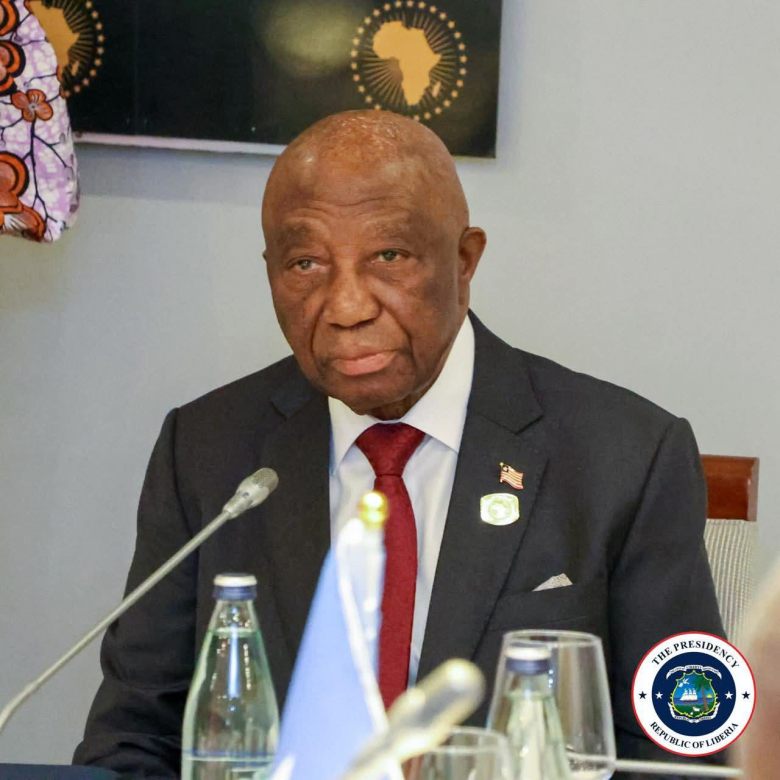
Speaking at a High-Level Breakfast Consultation on the Future of the United Nations and the Election of the Next Secretary-General at the Marriott Hotel Addis Ababa, Boakai said the UN stands “at a crossroads” as it approaches its 80th anniversary.
“For nearly eight decades, the UN has represented our shared hope that cooperation would prevail over conflict,” President Boakai told an audience of African heads of state, government officials, and senior diplomats. “Today, however, we must speak with honesty and clarity.”
President Boakai emphasized Africa’s historic and ongoing role in multilateralism, noting that Liberia was one of only four African countries that were original signatories to the UN Charter in 1945. Though much of Africa was not represented at the founding of the organization, he said the continent has since become central to its peacekeeping, development, humanitarian, and human rights work.
“Africa engages the UN both as a contributor to global solutions and as a region whose experiences continue to test the Organization’s relevance and effectiveness,” he said.
The Liberian leader acknowledged growing global concern that the UN is struggling to respond effectively to prolonged conflicts, rising humanitarian needs, fragile development gains, and declining public trust in multilateral institutions.
He cited reform proposals from various global actors. European countries including France, United Kingdom, Germany, and Japan have called for a more efficient and results-oriented UN system, with stronger oversight and reduced duplication.
Meanwhile, countries such as China and India, alongside the Non-Aligned Movement, have pushed for reforms that better reflect contemporary global realities and amplify the voices of developing nations, with development placed at the center of the UN agenda.
President Boakai also welcomed renewed commitments from the United States to address outstanding financial obligations to the UN, describing adequate funding as essential. However, he cautioned that financial contributions alone would not resolve deeper structural issues.
“The difficulties facing the UN are not only financial. They are systemic,” he said, pointing to concerns about priority-setting, mandate implementation, institutional coordination, and leadership in an increasingly fragmented world.
President Boakai praised the work of the African Union Committee of Ten, known as the C10, for ensuring that African perspectives remain central to discussions on UN reform. He said Africa’s engagement must be strategic, collective, and forward-looking.
As Liberia chairs the African Group in New York this month, President Boakai said the timing of the consultation was critical, coming just months before the selection of the next UN Secretary-General.
Describing the upcoming Secretary-General selection as more than an administrative decision, Boakai said it would shape the credibility and direction of the organization at a time of urgent global need.
He referenced ongoing global debate about whether the position should continue to follow informal regional rotation and whether incumbents seeking a second term may be constrained in pursuing bold reforms.
“The question before us is not whether Africa must adopt every argument, but whether Africa has sufficiently reflected on its own position at this critical moment,” he said.
President Boakai urged African leaders to articulate clearly what qualities they seek in the next UN chief and to speak with unity during the selection process. “Africa must not be a peripheral participant or passive observer in this process,” he said, noting that the continent represents more than a quarter of UN member states and engages the organization across virtually all its pillars.
President Boakai called for reform efforts that address deeper issues of relevance, effectiveness, and trust within the UN system.
“The future of the United Nations will be shaped by those who choose to lead with clarity and courage,” he said. “Africa must be among them, speaking with one voice, guided by shared principles, and committed to a multilateral system that truly serves all nations.”
Support Independent Journalism
Your support helps FrontPage Africa continue delivering independent, credible, and impactful journalism. Every contribution strengthens our ability to investigate, inform, and hold power accountable while keeping quality journalism accessible to our readers.
Support our journalism or subscribe to receive the latest FrontPage Africa stories and updates.