
Monrovia – Unions of motorcyclists and tri-cyclists (popularly called ‘Keke’ in Liberia) under District #10 and the Community Policing section of the Liberia Nation Police (LNP) gathered Saturday, September 15, 2018 to discuss ways to reduce motor accidents in another part of Liberia: Clara Town Community, Bushrod Island, Monrovia.
Report by By Samuel G. Dweh, Contributor
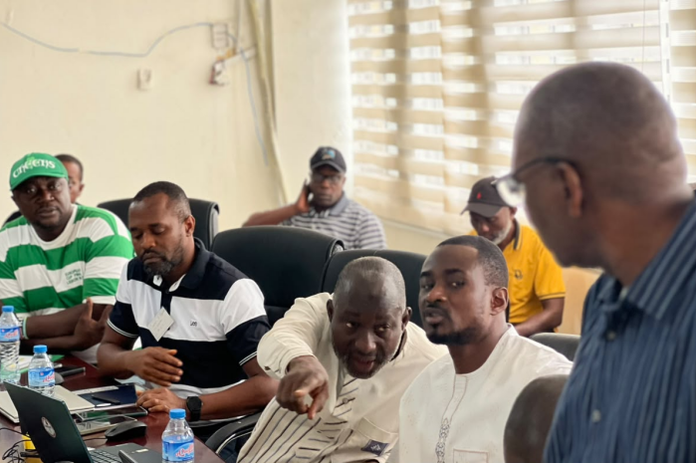
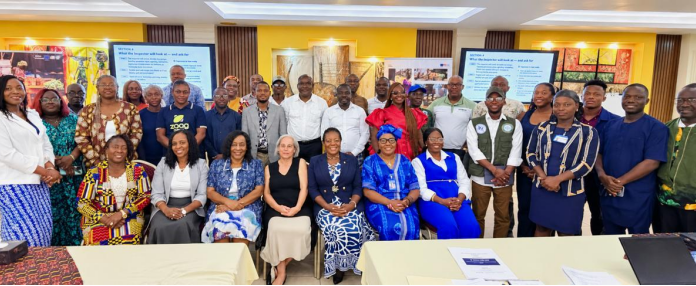
The day was for the launch of a four-week Road Safety Workshop for Motorcyclists and Tri-cyclists (Clara Town’s branch), organized by the Community Services Section of Zone #10 Police Station, in collaboration with the Traffic Section of the LNP.
The venue for the launching program was a private ‘Talking Point’ named “Movement for Intellectual Exchange (MIE)”, located along the main route (Street) into Clara Town.
In his Welcome Remark, the Chairman of Clara Town Community, Mr. McGill Gbessie, stated: “I hope we will listen, because we have (traffic-related) problems in Clara Town here.”
Giving the Overview of the Workshop, the General Commander and the Chief Superintendent of Zone 10 and its Depots (District 3), Mohammed Sambollah, represented by Inspector H. Archie Nyenatoh, said the Workshop was to educate motorcyclists on the factors of accidents and ways to minimize them.
“The factors of accidents are ourselves—the motorcyclists, the parents, the community leaders,” said H. Blanyan Himmie, Deputy Chief Section, Community Services Section (CSS), at the Headquarter of the LNP, who served as the Chief Launcher of the four-week Workshop. “Safety should be first and safety should be last.”
Speaking on “Public Safety and Prevention Tips”, Inspector Vamuyan Dorley, Chief of Traffic, Zone 10 and its Depots, stressed much on “ignorance and attitudes” of the on-bike motorcyclists as major causes of accidents. “Most of them put their bikes in the traffic, without knowledge of the rules of the traffic,” he said.
“I’m going to use a bike to demonstrate what I’m talking about,” Inspector Vamuyan Dorley said to the audience, and then gave order for a commercial motorbike to be brought into the hall.
A Task Force officer of the Motorcycle Union and a Police officer picked a bike among a group of dozens of commercial bikes parked outside of the venue of the program. Most of the owners of the bikes were inside the hall as participants.
Sitting on the bike, he said, “some of the motorcyclists twist their butt like this or raise their legs into the air,” he said, mimicking each of the ‘actions’ by the motorcyclists he was speaking about. “You say you’re playing style on the moving bike, which may take away somebody’s life. Do not bluff. The traffic is not for bluffing.”
His colleague, Officer Saidu S. Massalay (Community Police Officer, LNP), Zone 10, Clara Town, held the microphone to his mouth since his both hands were gripped to the bike’s steering for balance.
During contributions by the audience on the “Public Safety and Prevention Tips”, some participants blamed pedestrians, victims of accidents, on failure obey ‘street-crossing rules’; other participants talked about ‘overloading’ on the bike.
“Before you cross the street, you must look left and right, to see if a bike or a car is coming,” a participant, who identified himself as James, advised pedestrians.
Answering a participant’s question about ‘overloading’, Officer Dorley said the traffic law Liberia allows only two persons on a motorbike, but, due to the prevailing economic constraints in Liberia, some traffic police officers would allow two passengers on a commercial bike.
Speaking on “Drugs and Substance Abuse”, Officer Saidu S. Massalay, Community Police Officer, LNP, mentioned six types of drugs ‘abused’ by motorcyclists, which tragically influence their attitudes on the bike.
He began with the definition of drug—“a substance that has physiological effects on the brain of a person.”
“Drug is not negative,” he said, but noted that taking a drug without a medical doctor is the ‘negative aspect’, which is termed as “drug abuse,” he added.
He said alcohol is a “drug, because it contains intoxicants that affect the brain.”
Drug abuse comes about when a person depends on it to calm any discomforting feeling in his or her body, COP Massalay said.
Some of the types of drugs he mentioned are Depressants, Hallucinogen, Cannabis, Dissociative drugs, Opioids, and Tramadol.
“For the Dissociative drugs, it makes the dependent always feels no other person loves him or her, so he or she goes to live in a solitary places like a graveyard,” COP Massalay said.
“Reckless riding by motorcyclists”, “absence of speed bumps” and “spoiled and parked motorbikes and tri-cycles along the street” in Clara Town community were some of the hotter issues raised by participants during the Remarks segment of day one of the four-week Workshop.
“Controlling our community’s boys riding motorbikes is extremely difficult,” complained Madam Cecelia J. Weah, Superintendent of Clara Town Community.
Madam Hawa Sonpon, Gender Coordinator of District #14, Montserrado County, was full with emotions as she spoke on the attitude of commercial motorcyclists in Clara Town and the rest of the District. “They always respond with violent actions or insults to anybody who comes out to speak to them on reckless riding or accident,” she lashed out.
However, Madam Sonpon gave advice: “When leave your house to find daily bread for your family, be focused, ride responsibly, and obey traffic rules.”
She ended with an appeal to the leadership of Clara Town Community to erect “speed bumps” in the main Street of the Community for over-speeding motorcyclists.
Abraham Sheriff, speaking for the Tri-cycle Union, said: “We hope this Workshop would not be the last.” Representative of the Motorcycle Union repeated the Tri-cycle Union’s spokesperson.
Pitch C. Sengbeh, Secretary General of the Movement for Intellectual Exchange (MIE), venue of the program, gave order to the Clara Town’s leadership to remove all broken-down motorbikes, tricycles and cars parked along the community’s only street. “We, the youth, of this community, are sending a caveat to the leaders and elders of this community: Remove all spoiled motorbikes, tricycles and cars parked and abandoned along the streets of this community now. They are causing problems in the community,” he said.
The Workshop had a ‘religious neutrality’ component. The program’s Emcee, Officer Thomas Kawah, asked for ‘Silence Meditation’ for the ‘Opening Prayer’ segment, instead of prayer by any member of a particular known faith, “because we have many religious beliefs represented here,” he said.
Support Independent Journalism
Your support helps FrontPage Africa continue delivering independent, credible, and impactful journalism. Every contribution strengthens our ability to investigate, inform, and hold power accountable while keeping quality journalism accessible to our readers.
Support our journalism or subscribe to receive the latest FrontPage Africa stories and updates.