Monrovia– Liberia has reaffirmed its strong commitment to climate action and sustainable development with the official launch of its Nationally Determined Contribution (NDC 3.0) and the Natural Capital Atlas of Liberia at the ongoing 30th Conference of the Parties (COP30) in Belém, Brazil.
By Selma Lomax [email protected]
The event took place at the Liberia Pavilion and brought together key government officials, international partners, and local representatives to showcase Liberia’s climate ambition and its vast ecological potential.
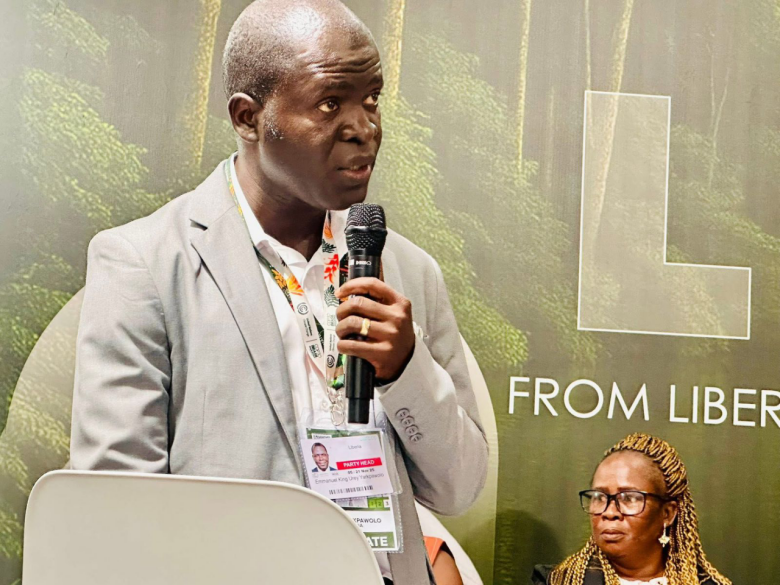
The event was graced by the Executive Director and Chief Executive Officer of the Environmental Protection Agency (EPA) of Liberia, Dr. Emmanuel K. Urey Yarkpawolo, Deputy Minister for Economic Management at the Ministry of Finance and Development Planning, Dehpue Y. Zuo, and Nimba County Superintendent Kou Meapeh Gono. Also in attendance were development partners including the United Nations Development Programme (UNDP) Resident Representative to Liberia, Mr. Aliou Dia, representatives of the Government of Canada, the United Nations Capital Development Fund (UNCDF), and members of the Liberian delegation.
In his keynote address, Dr. Yarkpawolo described the launch as a defining moment in Liberia’s climate journey, marking a new chapter in the country’s efforts to address the climate crisis while fostering inclusive economic growth. He said the NDC 3.0 represents more than a policy document — it is a roadmap for transformation that aligns national development with the goals of the Paris Agreement, President Joseph Boakai Sr.’s ARREST Agenda for Inclusive Development, and the United Nations Sustainable Development Goals.
Dr. Yarkpawolo explained that Liberia’s NDC 3.0 commits the country to reducing 64 percent of its national greenhouse gas emissions by 2035, with 10 percent of the effort financed domestically and the remaining 54 percent dependent on international support.
He highlighted key priorities including renewable energy development, clean cooking solutions to reduce deforestation and improve public health, climate-smart agriculture to ensure food security, sustainable forest and coastal management to protect biodiversity, and nature-based and market-based mechanisms such as the emerging National Carbon Market Policy designed to attract green investments and ensure fair benefit-sharing with local communities.
He emphasized that Liberia’s approach to climate action is inclusive and people-centered, ensuring that farmers, fishers, women, and youth — those most affected by climate impacts — are active participants in shaping sustainable solutions.
According to Dr. Yarkpawolo, Liberia’s ecosystems, including its dense tropical forests, rich river systems, and blue carbon mangroves, remain among the most important in West Africa, serving as both a natural defense against climate change and a foundation for future economic growth. He added that through the NDC 3.0, Liberia seeks to turn its natural capital into a driver of human development, linking science, policy, and finance to create a resilient and prosperous nation.
The EPA Executive Director also unveiled the Natural Capital Atlas of Liberia, describing it as a groundbreaking tool that maps the country’s forests, rivers, wetlands, mangroves, minerals, and biodiversity hotspots with scientific precision. He noted that the Atlas goes beyond documentation to serve as an evidence-based instrument for policy design, investment planning, and sustainable resource management.
The Atlas, he explained, will help identify areas where nature-based solutions can deliver both environmental and economic benefits, while showcasing Liberia’s potential for green investment in forestry, eco-tourism, and carbon markets.
Performing the official unveiling of the Atlas on behalf of the Government of Liberia, Deputy Minister for Economic Management Zuo hailed the launch as a major milestone in Liberia’s climate and development agenda. He stated that the Natural Capital Atlas provides a clear understanding of Liberia’s environmental assets and their spatial distribution, helping the government make informed decisions on land use, investment, and environmental protection. “The Natural Capital Atlas gives Liberia a clearer picture of what we have, where it is located, and how we can sustainably use it,” Zuo said.

“This is not just about protecting forests and biodiversity; it is about building a sustainable economy that benefits all Liberians while supporting global climate action.”
Deputy Minister Zuo reaffirmed the government’s dedication to integrating environmental management into national planning and emphasized that climate resilience, clean energy, and sustainable economic growth remain central pillars of President Boakai’s ARREST Agenda.
He said Liberia’s commitment to the Paris Agreement and the Sustainable Development Goals underscores its determination to tackle climate change as both a national challenge and a global responsibility.
Speaking on behalf of the United Nations Development Programme (UNDP), Resident Representative Aliou Dia commended the Government of Liberia and the EPA for demonstrating strong leadership in advancing climate governance. He described the launch of the NDC 3.0 and the Natural Capital Atlas as a significant achievement that showcases Liberia’s potential to attract international support and investment for sustainable development.
“We are proud to be part of this important work,” Dia said. “This Atlas captures Liberia’s potential — from its coasts to its forests — and shows the world that this country has so much to offer in terms of climate action. What we see here is less than one percent of Liberia’s total natural wealth, but it’s a great start.” He further praised the close collaboration between the EPA, UNDP, and the Ministry of Planning, calling the Atlas “a tangible product of serious commitment at the highest level of government.”
Adding a local perspective, Nimba County Superintendent Kou Meapeh Gono thanked the EPA and UNDP for ensuring that local governments and communities were represented at COP30. She stressed that local communities are on the frontlines of climate change and must be central to national adaptation and mitigation strategies.
“Our people are often the first to feel the impact of climate change,” she said. “We are proud that Nimba, home to the East Nimba Nature Reserve and the new Botanical Garden, is playing its part in conservation and sustainable development.” Superintendent Gono announced that the Nimba Botanical Garden, established with support from the EPA and UNDP following COP29, has completed its first phase, including the cultivation and preservation of medicinal plant species. She appealed for continued international support to expand the initiative and strengthen community-based conservation efforts across Liberia.
In closing, Dr. Yarkpawolo extended appreciation to all development partners, including the Government of Canada, the UNCDF, and the International Focus Magazine, for their contributions to Liberia’s environmental programs and for supporting the successful organization of the Liberia Pavilion at COP30. He reaffirmed that Liberia stands ready to lead in nature-based and market-based climate solutions and to collaborate with responsible investors, innovators, and development institutions.
He said the launch of the NDC 3.0 and the Natural Capital Atlas is a bold declaration that Liberia is open for climate-smart investment and is committed to transforming its natural capital into human capital through innovation, transparency, and shared prosperity.
He called on the international community to stand with Liberia as it works to become a model of climate mitigation and adaptation in Africa. He emphasized that through science-driven and business-oriented approaches, Liberia is poised to demonstrate that climate action and economic growth can advance together.
“Liberia is ready to lead and to show that environmental protection can drive economic opportunity,” he said. “Together, we can make Liberia a beacon of hope for a greener, more resilient, and prosperous Africa.”
Support Independent Journalism
Your support helps FrontPage Africa continue delivering independent, credible, and impactful journalism. Every contribution strengthens our ability to investigate, inform, and hold power accountable while keeping quality journalism accessible to our readers.
Support our journalism or subscribe to receive the latest FrontPage Africa stories and updates.