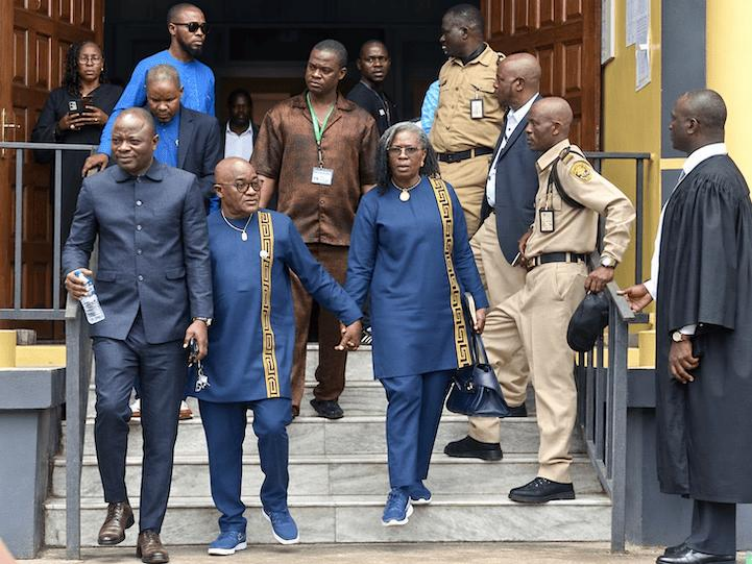
Monrovia-Former Foreign Minister Dee-Maxwell Saah Kemayah and other defendants convicted in the controversial Saudi Rice case are heading into another decisive legal battle, with Criminal Court ‘C’ scheduled to rule Friday on their motion seeking a new trial following the October 9 jury verdicts.
By:Willie N. Tokpah
The ruling, scheduled for 1:00 p.m. on November 13 at the Temple of Justice, could determine whether the guilty verdicts returned against eight of the 13 defendants will stand or whether the court will grant the defense an opportunity to reopen the proceedings.
The development presents a critical moment for Kemayah and his co-defendants, who are challenging the outcome of a prosecution involving 29,412 bags of rice donated by the Kingdom of Saudi Arabia for disaster victims and vulnerable communities in Liberia.
In a November 12 statement, the Asset Recovery and Property Retrieval Taskforce, AREPT, confirmed that Criminal Court ‘C’ will deliver its determination on the defense’s Motion for New Trial, which was heard on November 6.
The court is expected to determine the motion before proceeding to any subsequent sentencing proceedings, as appropriate.
For Kemayah and the other convicted defendants, Friday’s ruling represents an important opportunity to challenge the jury’s findings through the judicial process.
Defense Challenge At The Center Of Friday’s Hearing
The October 9 verdicts produced mixed outcomes in the high-profile case.
Eight defendants were found guilty, and three were acquitted, while the jury could not reach verdicts concerning two others.
Following the verdicts, defense lawyers filed a Motion for New Trial, seeking judicial reconsideration of the outcome.
Although AREPT confirmed that the motion was heard on November 6, its public statement did not disclose the specific grounds advanced by the defense.
Those arguments are central to Friday’s proceedings, as the court must examine whether the defense has established legally sufficient grounds to set aside the jury’s verdicts and order another trial.
A motion for a new trial is an important safeguard in criminal proceedings. It allows the court to consider whether errors or other legally recognized circumstances warrant another examination of the case.
The court’s determination will, therefore, be significant not only to the defendants but also to the integrity of the judicial process.
Kemayah and Others Face Critical Legal Moment
Kemayah, who previously served as Liberia’s Minister of Foreign Affairs, became one of the prominent figures in the prosecution, which attracted national attention because of the humanitarian nature of the Saudi donation and the involvement of former senior government officials.
The case concerns allegations that rice intended for vulnerable Liberians was diverted from its humanitarian purpose.
The prosecution’s allegations, however, must be distinguished from the legal rights of the defendants, who are entitled to challenge the proceedings and seek judicial remedies available under Liberian law.
The defense’s request for a new trial places the court in the position of determining whether the jury’s findings should remain intact or whether further proceedings are legally warranted.

Should the motion be denied, the court may proceed to the appropriate sentencing stage for defendants whose convictions remain in force.
If granted, the ruling could reopen the affected proceedings and create another opportunity for the defense to contest the prosecution’s case.
Friday’s hearing also brings renewed attention to the importance of due process in criminal prosecutions.
While the government has maintained its commitment to accountability and the recovery of public assets, the pursuit of accountability must operate within the protections guaranteed by law.
The defense’s right to challenge a verdict is part of that process, just as the prosecution retains the responsibility to establish its case in accordance with the law.
The three defendants acquitted by the jury are not subject to sentencing on the charges for which they were acquitted.
The two defendants against whom the jury could not reach verdicts also remain subject to separate judicial determination.
In its statement, AREPT reaffirmed its commitment to the rule of law, due process, and accountability in the management of public and humanitarian resources.
The Taskforce said it would continue working with the Ministry of Justice in pursuit of justice and the lawful recovery of public assets.
But for Kemayah and his co-defendants, the immediate concern is the court’s determination of their motion and whether the October verdicts will survive the legal challenge.
As attention turns to Criminal Court ‘C’ on Friday, the proceedings will test the application of judicial safeguards in one of Liberia’s most closely watched corruption-related prosecutions.
For the defendants, the motion represents an opportunity to seek another judicial examination of the case.
For the prosecution, it represents another stage in its effort to sustain the convictions.
Ultimately, the decision rests with the court, which must determine the matter based on the law, the record, and the arguments presented by both sides.
Support Independent Journalism
Your support helps FrontPage Africa continue delivering independent, credible, and impactful journalism. Every contribution strengthens our ability to investigate, inform, and hold power accountable while keeping quality journalism accessible to our readers.
Support our journalism or subscribe to receive the latest FrontPage Africa stories and updates.