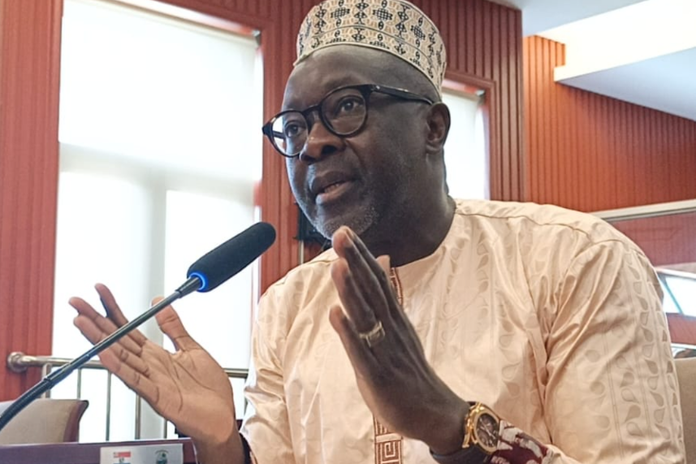

Capitol Hill, Monrovia – The head of the Law Reform Commission, Cllr. Boakai Kanneh has called on the Legislature to repeal the act creating the Code of Conduct (COC) to be replaced with a new one that is applicable.
But the Program Manager at the Governance Commission, Bornor M. Varmah disagreed, stating the law has several unique provisions that are pivotal in the fight against corruption.
The two men made the exchanges on Thursday at a public hearing conducted by the House Standing Committee on Elections and Inauguration aimed at soliciting expert opinions for the passage of a draft act that is seeking the amendment of certain portions of the New Elections Law (1986) of Liberia.
Cllr. Kanneh, in his deliberations warned the law was not applicable in Liberia and it risks continued violations if it is not repealed to be replaced with a clear and workable version.
“The code of Conduct which has a bearing on our elections has to be repealed. That law has to be repealed and rewritten and the reason why I am suggesting this is because from the onset, the concept that led us to writing this was biased.
In March 2014, the 53rd Legislature of Liberia passed a National Code of Conduct for all public officials and employees of the Government of Liberia.
The Legislature’s decision was in line with the Constitution of Liberia which calls for the enactment of basic law to protect the integrity of public service and guard against conflicts of interest among officials holding public office.

The CoC has been hailed by some legal luminaries as an excellent instrument that could be pivotal in fighting graft if it is implemented fully. The law, among other things seeks to cut bribery, nepotism, lobbying and unethical behavior that could give rise to a conflict of interest or undermine the credibility of public policy. However, some of its provisions, particularly ‘Part V’ which focuses on political participation have caused controversies in recent times.
‘Part V’ of the law states that “all officials appointed by the president” are not allowed “to engage in political activities” including- the contesting for elective office, campaigning for a political party or candidate, and using resources and facilities of government to back partisan politics.
It further provides that appointed officials who want to canvass or participate in an election must resign at least two years before elections, and three years in the case of tenured officials.
The clause has been marred by controversies because most people who run for public office in Liberia are active public servants, local government appointees or officials in state-run enterprises and autonomous agencies.
Cllr. Kanneh, citing series of court instances in which the Supreme Court gave ruling, told the Legislative panel during the hearing that the Code of Conduct should be a legal document that is clearly written and interpreted.
Speaking further, he said the Code of Conduct has become so convoluted and difficult to understand that even the National elections Commission had to refer some of the complaints brought before it to the Supreme Court to render judgment.
He warned that if the law is not repeal, it will continue to be violated in every election including the upcoming December 8, 2020 Special senatorial and national referendum.
Mr. Varmah, on the other hand, argued that although certain portions of the law could be amended, calling for its complete dissolution was not the right way as it contains other provisions that are unique in fighting corruption.
Support Independent Journalism
Your support helps FrontPage Africa continue delivering independent, credible, and impactful journalism. Every contribution strengthens our ability to investigate, inform, and hold power accountable while keeping quality journalism accessible to our readers.
Support our journalism or subscribe to receive the latest FrontPage Africa stories and updates.