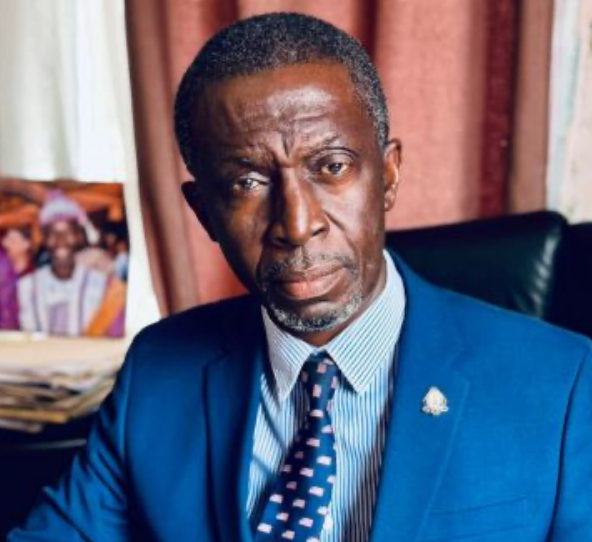
BUCHANAN, Grand Bassa County – Prominent constitutional and human rights lawyer Cllr. Tiawan S. Gongloe has called on Liberian lawmakers to give priority consideration to the establishment of a War and Economic Crimes Court, warning that the country risks undermining the rule of law if it continues to delay accountability for atrocities committed during the civil conflict.
Speaking at a legislative retreat organized by the Office for the Establishment of the War and Economic Crimes Court for Liberia (OWECC) in Buchanan last week, Gongloe delivered a comprehensive presentation on Liberia’s transitional justice and accountability framework, emphasizing that justice for wartime abuses remains an unfinished national obligation.
Addressing members of the House of Representatives and Senate, Gongloe described transitional justice as more than a legal issue, calling it a moral, governance, constitutional, and national imperative that will shape how history judges Liberia’s current generation of leaders.
“The decisions made in this retreat will influence whether Liberia strengthens the rule of law, confronts impunity, promotes reconciliation, attracts international confidence, and leaves a stronger foundation for future generations,” he said.
Accountability Long Overdue
Gongloe traced Liberia’s transitional justice efforts to the 2003 Comprehensive Peace Agreement, which led to the establishment of the Truth and Reconciliation Commission (TRC). He noted that the TRC recommended accountability for individuals bearing the greatest responsibility for serious violations of human rights and international humanitarian law, as well as economic crimes linked to the conflict.
According to him, the central issue facing Liberia today is not whether accountability was recommended but how it should be implemented in a manner that is constitutional, credible, fair, and consistent with international law.
“For more than two decades, victims have waited; families have waited; communities have waited; and history has waited,” Gongloe told lawmakers. “The issue before us is not merely the creation of another court. It is the completion of an unfinished national obligation.”
Calls for Internationally Credible Tribunal
The veteran lawyer stressed that the proposed War and Economic Crimes Court should not be driven by revenge but by justice for victims, accused persons, communities, and future generations.
Drawing lessons from the Special Court for Sierra Leone, he argued that Liberia’s court should focus on individuals bearing the greatest responsibility for war crimes and crimes against humanity, while operating under internationally recognized legal standards and independent judicial mechanisms.
“The Court should not become a vehicle for political scores or selective justice,” Gongloe warned. “Its legitimacy will depend upon its fairness. Its authority will depend upon its independence. Its success will depend upon public confidence.”
He further urged Liberia to seek support from the United Nations, ECOWAS, the African Union, and other international partners to ensure the credibility and effectiveness of the court.
War Crimes Court Before Anti-Corruption Court
While acknowledging the devastating impact of corruption on national development, Gongloe recommended that lawmakers prioritize passage of legislation establishing the War and Economic Crimes Court before considering the proposed National Anti-Corruption Court.
He argued that the war crimes court addresses obligations arising from the peace agreement, the TRC process, and Liberia’s commitments under international humanitarian law.
However, he maintained that an Anti-Corruption Court remains necessary to combat the misuse of public resources and strengthen governance.
“Corruption steals from the poor, weakens institutions, delays development, and undermines confidence in government,” he said.
At the same time, he cautioned that any anti-corruption court must uphold constitutional guarantees, including due process and the presumption of innocence.
Raises Constitutional Questions
One of the most significant issues highlighted by Gongloe was whether appeals from the proposed War and Economic Crimes Court should ultimately be reviewed by Liberia’s Supreme Court or by a specialized appeals chamber, similar to the model used by the Special Court for Sierra Leone.
He described the matter as a fundamental question that lawmakers must address as they determine the character and structure of the tribunal.
“This is not a minor drafting issue. It goes to the heart of the Court’s character,” he said.
Gongloe argued that transitional justice mechanisms are often created to address extraordinary circumstances that fall outside the normal constitutional order and therefore require special legal arrangements.
“The Future of Liberia Depends on Rejecting Impunity”
Throughout his presentation, Gongloe repeatedly stressed that impunity remains one of the greatest threats to democracy, peace, and good governance.
He warned that impunity sends dangerous signals to public officials, warlords, judges, and citizens alike, creating the perception that wrongdoing carries no consequences.
“The opposite of impunity is not revenge. The opposite of impunity is accountability,” he declared.
He concluded by urging lawmakers to enact legislation that strengthens accountability and the rule of law, saying history would judge their actions.
“Let us ensure that when history records this moment, it will say that the Legislature of Liberia chose the rule of law over impunity, accountability over indifference, and justice over expediency,” Gongloe said.
The legislative retreat forms part of ongoing efforts by OWECC to build support for the establishment of both a War and Economic Crimes Court and a National Anti-Corruption Court, key initiatives aimed at addressing Liberia’s longstanding challenges of wartime accountability and corruption.
Support Independent Journalism
Your support helps FrontPage Africa continue delivering independent, credible, and impactful journalism. Every contribution strengthens our ability to investigate, inform, and hold power accountable while keeping quality journalism accessible to our readers.
Support our journalism or subscribe to receive the latest FrontPage Africa stories and updates.