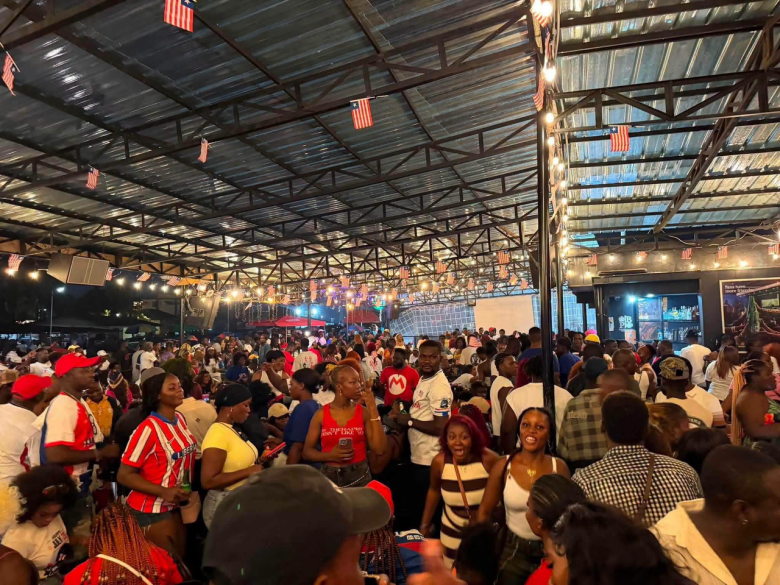
A nightspot closed for a day, its owner facing charges, and a lot of unanswered questions about who else spent their evenings there. If the government treats Private Bar as a single businessman’s problem rather than what it may actually be — a gathering place for a trafficking network operating in plain sight of Liberia’s young people — it will have missed the point of this entire scandal.
PRIVATE BAR ENTERTAINMENT CENTER is, on any ordinary night, exactly what its name promises: music, drinks, a crowd, mostly young. That is precisely what should worry Liberians most about what investigators now say was happening there. This newspaper reported this week that George “Leroy” Harris, the venue’s owner, faces a lengthy list of charges tied to the record $317 million cocaine seizure in Duazon, and that Harris is said to have strong ties to Michael Brown, one of several individuals charged in absentia in the broader case. By multiple accounts, Private Bar was a regular gathering spot for others accused of ties to the same network. Put plainly: a business built around Liberia’s young nightlife scene may have doubled, for some period of time, as a comfortable meeting ground for people allegedly moving hundreds of millions of dollars in cocaine through this country.
IF THAT IS TRUE, EVEN IN PART, the implications reach far beyond Harris’s own legal fate. A courtroom can settle what happens to one man. It cannot, by itself, answer the harder question this case raises: how many young Liberians spent evenings in that room, dancing a few tables away from the people now accused of running a trafficking operation, with no idea what they were standing next to? How many nights did a bar frequented by students, young professionals and Monrovia’s nightlife regulars double as an informal office for a cartel network? Those are not questions a single prosecution answers. They require an investigation into the venue itself — not just the man who owned it.
WE RECOGNIZE THE GOVERNMENT has already moved further than many expected. The closure this week, whatever questions remain about its legal basis, was a real step, and the charges against Harris are serious ones. But a single day’s closure and a management notice promising cooperation are not the same thing as a full accounting of what actually happened inside that building, over what period of time, and how many other establishments across Monrovia may be operating the same way, hiding in plain sight behind loud music and a young crowd that has no reason to suspect what’s really going on around them. Three prior inspections at Private Bar reportedly found no illegal substances on the premises. That should not be read as exoneration. Cartels do not store their product on the dance floor; they use spaces like this one to build relationships, pass information, and move money, precisely because a bar’s ordinary chaos gives them cover. A clean inspection tells you nothing about what was said in a back booth or arranged over a round of drinks.
THIS IS WHERE THE STAKES STOP being abstract. Liberia’s young people are already living through a summer in which cocaine has moved through their country’s main airport in industrial quantities, in which police commanders allegedly escorted the drugs themselves, and in which the institutions meant to protect them have repeatedly turned out to be entangled in the very crisis they were supposed to prevent. If the places where young Liberians go to relax and socialize are also, even occasionally, where trafficking networks conduct their business, then this is no longer only a law-enforcement problem. It is a public health and social problem, one that risks normalizing proximity to organized crime for an entire generation before anyone in government has fully reckoned with how deep it runs. A young person who spends enough nights in rooms where this kind of money and influence moves freely does not need to break a single law to be shaped by what they’ve witnessed.
THE BOAKAI ADMINISTRATION owes the country more than a closed bar and a set of charges against one man. It owes Liberians a genuine investigation into Private Bar’s role in this network — who else was present, how long this arrangement is believed to have run, whether other venues across the city have served the same purpose, and what, if anything, government regulators and licensing bodies knew or should have known before this scandal forced the issue into public view. It also owes young Liberians something less tangible but no less important: an honest public accounting of what happened in a space many of them walked through without a second thought, so that trust in the places they gather is not left to quietly erode along with trust in everything else this scandal has touched. Liberia cannot prosecute its way out of a problem it has not fully investigated. Get to the bottom of Private Bar — all the way to the bottom — before the cost of not knowing falls on people who never should have had to pay it.
Support Independent Journalism
Your support helps FrontPage Africa continue delivering independent, credible, and impactful journalism. Every contribution strengthens our ability to investigate, inform, and hold power accountable while keeping quality journalism accessible to our readers.
Support our journalism or subscribe to receive the latest FrontPage Africa stories and updates.