MARLAY TOWN, District Number Six — The Forestry Development Authority (FDA) has deployed forest rangers and the Liberia National Police officers to Marlay Town in the Boe and Quella Administrative District, Nimba County, following complaints by residents that Burkinabè Nationals have allegedly encroached on community forestland, restricted access to farms and contributed to an unresolved boundary dispute.
By Franklin Doloquee
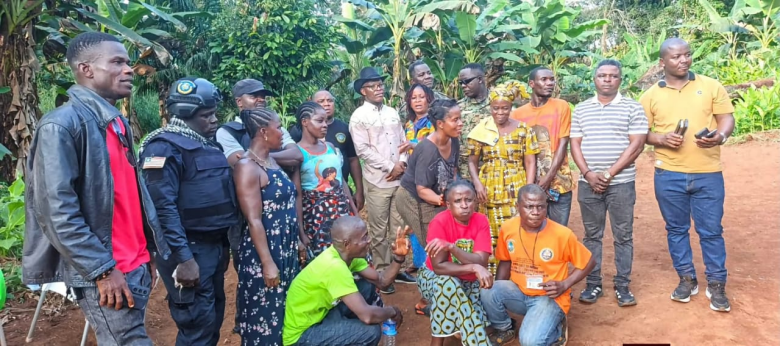
The delegation, which included FDA officials and police personnel, visited the community on Sunday, November 8 after women and other residents said they could no longer freely access farmland and forest areas they have traditionally used.
Authorities said the mission was intended to assess conditions on the ground, listen to residents’ concerns and prepare a report for further government action.
“We came as a response to the cry of the people of Marlay Town,” said Victor W. Kpaiseh, FDA Deputy Director General for Administration and Finance.
“The women said they no longer have access to their farms, and the Burkinabè have taken over their forest. We are here to identify what is happening and determine the appropriate response.”
Security and Environmental Concerns
Kpaiseh described the situation as a potential national-security concern, citing reports that foreign nationals had occupied portions of community forestland.
He warned that uncontrolled forest clearing, unclear land arrangements, and growing tensions over access to farmland could deepen conflict if not addressed promptly.
The FDA said it has deployed three forest rangers and three Liberia National Police officers to Marlay Town.
Their immediate assignment is to investigate reports of forest occupation and destruction, identify those involved and gather information for a formal report. Additional security personnel may be deployed as the investigation progresses.
Officials also expressed concern about deforestation around the disputed area. The FDA said the case reflects broader pressures on Liberia’s forests, where agricultural expansion particularly cocoa cultivation and migration have intensified competition for land, raised concerns about illegal clearing, and threatened community livelihoods.
In southeastern Liberia, reporting has linked the cocoa boom to forest loss and land disputes. Migrant cocoa workers, including Burkinabè and Ivorian nationals, have been recruited by local landholders under sharecropping-style arrangements in which landowners provide land while migrants provide labor and investment.
In Grand Gedeh, the FDA has previously reported that eight of nine authorized community forests were threatened or occupied, with several cases investigated and referred for prosecution.
Residents told the delegation that the boundary between community land and the forest reserve reportedly established in 1952 has become difficult to identify. They said the line has not been regularly maintained or re-demarcated, creating uncertainty over which areas belong to the community and which fall within the protected forest.
Community members called for a fresh demarcation exercise to clearly mark the boundary. The FDA delegation agreed that re-identifying the boundary should be part of the resolution emerging from the meeting.
Residents also raised concerns about land reportedly taken from the community near the reserve. According to one account presented during the meeting, community members had previously sought about 500 meters of land from the reserve for farming, but said land was instead taken from the community side.
The FDA delegation said that specific claim had not been raised during the nearly three-hour town hall, but acknowledged that boundary clarification remained central to resolving the dispute.
To support the process, the FDA plans to use drone technology to help identify and re-demarcate the disputed forest boundary. The agency also said the Liberia Immigration Service has been requested to conduct an enumeration exercise to establish the number of foreign nationals living in the affected communities.
Community Allegations and Response
Some residents accused the Community Forest Management Body of failing to establish clear boundaries between Kpablee and the Boe and Quella districts. They also alleged that some foreign nationals were brought into the forest by local residents under farming arrangements.
However, Boe and Quella Executive Committee Chairman Samuel Dweh denied allegations that local leaders encouraged the presence of foreign farmers.
He maintained that the boundaries were established in consultation with local authorities and the Liberian government. Kpaiseh cautioned residents against giving forestland to foreign nationals under so-called “sixty-forty” farming arrangements, in which one party provides land while another provides labor and investment.
He warned that such arrangements could trigger future land conflicts, particularly where land rights, boundaries and environmental obligations are not clearly documented.
Similar arrangements have been reported in southeastern Liberia, where local landholders provide land to migrant farmers for cocoa production.
Investigations have found that such agreements can lead to forest clearing and disputes over community land governance, especially where formal documentation and oversight are weak.
Residents’ Demands
For residents of Marlay Town, the immediate demands are clear: a properly demarcated boundary, restored access to farmland, and stronger protection of community forests.
Community leaders and women’s representatives said they fear that continued uncertainty could leave them without access to land they have traditionally used for farming.
They warned that uncontrolled forest clearing could undermine livelihoods, water sources, and the local environment. The concerns echo earlier complaints from Marlay Town residents, who have called on the government to investigate alleged unequal enforcement of forest regulations and to provide a lasting solution to the dispute.
The Marlay Town case highlights a growing tension in Liberia between conservation, community land rights, agricultural expansion, and migration. Under Liberia’s Community Rights Law, authorized forest communities may access, manage, use, and benefit from forest resources through Community Forest Management Agreements negotiated with the FDA.
Authorities have also raised concerns about the presence of Burkinabè nationals in southeastern Liberia, particularly in Grand Gedeh and River Gee counties, where many are reportedly engaged in agriculture and mining.
A recently announced registration exercise is intended to document foreign nationals’ identities, locations and immigration status amid concerns over land use, unauthorized economic activity and forest encroachment.
The FDA delegation said the findings from Marlay Town would inform its report and any follow-up action, including possible boundary demarcation, increased ranger deployment, and closer coordination among forestry authorities, police, local leaders and residents. “We have been going across the country,” the FDA official said. “Once the people are crying, the government has to respond in time.”
Community Praise for Kpaiseh
Citizens of Marlay Town praised Victor W. Kpaiseh, a former administrator of the Esther and Jereline Medical Hospital, for what they described as his continued service to the community from his earlier work in student leadership to his current role at the Forestry Development Authority (FDA)
Residents who spoke with FrontPage Africa claimed that Kpaiseh was able to help calm tensions and bring hope to the town. They said his presence, along with the FDA delegation, gave residents confidence that their concerns would be heard and addressed by the government.
Community members said they now await concrete action, including a clear boundary demarcation, protection of farmland and a lasting resolution to the forest dispute.
Support Independent Journalism
Your support helps FrontPage Africa continue delivering independent, credible, and impactful journalism. Every contribution strengthens our ability to investigate, inform, and hold power accountable while keeping quality journalism accessible to our readers.
Support our journalism or subscribe to receive the latest FrontPage Africa stories and updates.