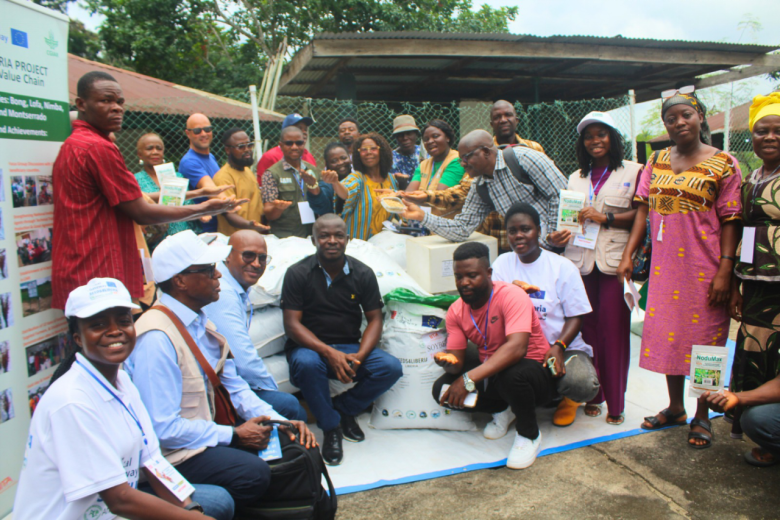
MONROVIA –The European Union-funded Seeds4Liberia Project and partners recently handed over improved seeds, seedlings, fish fingerlings and agricultural machinery to local seed enterprises.
Items handed over included power tillers, lowland and upland rice seeders, rice reapers, hermetic cocoons with ECOWAS monitoring systems, hermetic bags, catfish fry, tilapia fry, mixer machines for fish feed production, a feed pellet mill, hapa net, sechi disks, a scale, foundation seeds, and cuttings.
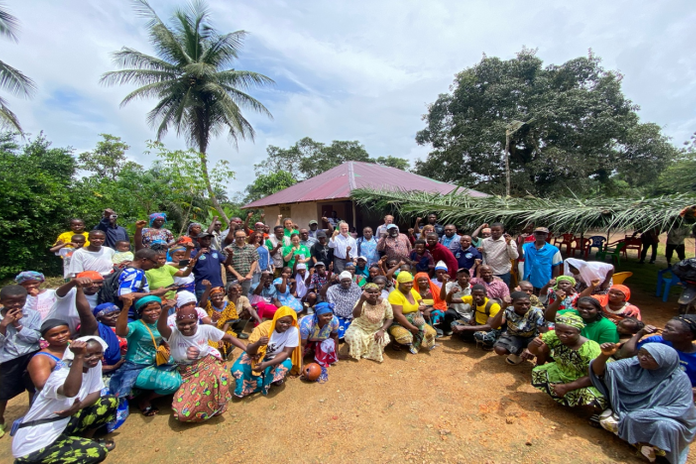
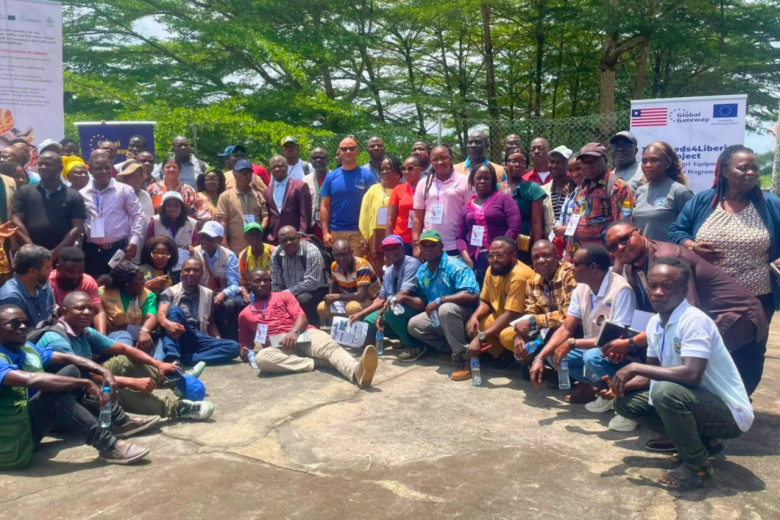
The hand over ceremongy took place last week at the Central Agricultural Research Institute (CARI), with stakeholders calling on farmers to use the inputs responsibly to strengthen Liberia’s food security and agricultural productivity.
Speaking at the event , the project’s National Coordinator /AfricaRice Country Representative to Liberia Moustapha Gaye described the event as more than the distribution of agricultural inputs, saying it reflects the strong partnership between the Government of Liberia, the European Union and the consortium of AfricaRice, the International Institute of Tropical Agriculture (IITA) and WorldFish.
“Today’s event represents much more than the distribution of agricultural inputs,” Gaye said. “It reflects the strong partnership between the Government of Liberia, the European Union and the consortium of AfricaRice, IITA and WorldFish, working together to strengthen Liberia’s agricultural sector and improve the livelihoods of farmers across the country.”
He thanked the European Union for financing the Seeds4Liberia Project, saying the investment is helping strengthen Liberia’s seed systems, improve farmers’ access to quality planting materials, promote sustainable agricultural technologies and create opportunities for increased productivity and food security.
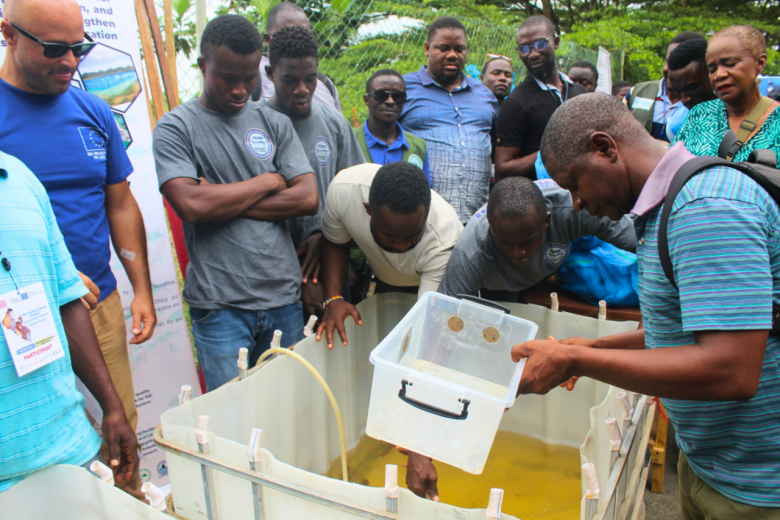
Gaye also acknowledged national partners including, the Ministry of Agriculture, CARI, the Seed Development and Certification Agency (SDCA), the Liberia Agricultural Commodity Regulatory Authority (LACRA), the National Fisheries and Aquaculture Authority (NAFAA), county authorities and other development partners, for supporting the project’s implementation.
He urged beneficiaries to maximize the use of the agricultural inputs distributed under the project.
“The seeds, seedlings, and equipment being handed over today are not an end in themselves. They are tools that will enable farmers, seed enterprises and producer organizations to increase production, improve quality, create businesses and generate income,” Gaye said.
He emphasized that the project’s long-term success will depend on continued collaboration among research institutions, government agencies, the private sector, extension services and farmers to ensure that improved technologies remain sustainable beyond the life of the project.
Also speaking, the European Union Programme Officer for Agriculture Antonio Di Clemente said the Seeds4Liberia Project is intended to build resilient seed systems for rice, cassava, soybean, coffee and fish value chains to strengthen food security and promote economic diversification.
According to Di Clemente, the project seeks to strengthen institutional capacity to produce and regulate high-quality breeder seeds, seedlings and fish while empowering private-sector and community-based enterprises to produce, store and market certified seeds and quality fish fingerlings
He said the initiative has also operationalized the Seed Development and Certification Agency to improve national quality assurance systems, promote high-yielding and climate-resilient crop varieties, provide practical training for farmers and students, and strengthen market linkages through partnerships between seed producers, buyers and financial institutions.
Additionally, the Assistant Minister for Planning and Development at the Ministry of Agriculture, Francis Mulbah, described the ceremony as another demonstration of the Liberian government’s commitment to revitalizing the country’s agricultural sector.
Mulbah reaffirmed the ministry’s commitment to working with development partners to improve agricultural production through the distribution of quality seeds and planting materials.
Also speaking, Farmers Union of Liberia Director Josephine Francis urged farmers’ cooperatives and federations to take ownership of agricultural projects to ensure their long-term sustainability.
“I always tell our farmers and their families to take ownership,” Francis said. “When you take ownership of projects that come to your cooperatives and federations, that is what makes them successful.”
She encouraged farmers to use the improved planting materials responsibly and highlighted the growing economic potential of soybean production, noting that Liberia has an existing market that imports thousands of tons annually.
Francis also praised the introduction of seven improved cassava varieties under the project and urged farmers to learn the characteristics of each variety to maximize yields.
Project organizers commended CARI, under the leadership of Director General Dr. Arthur Bob Karnuah, for hosting the ceremony and serving as a key technical partner in strengthening Liberia’s national seed systems and promoting improved agricultural technologies.
They also recognized the contributions of SDCA, LACRA, NAFAA, IITA, WorldFish and other implementing partners for supporting the initiative.
Beneficiaries, in turn, thanked the Ministry of Agriculture, the European Union and project partners for providing the agricultural inputs and equipment, pledging to use them to improve production and strengthen their livelihoods.
The EU-funded Seeds4Liberia Project is jointly implemented by Africa Rice Center (AfricaRice), the International Institute of Tropical Agriculture (IITA), and WorldFish in collaboration with the Ministry of Agriculture (MoA), the Central Agricultural Research Institute (CARI), the National Fisheries and Aquaculture Authority (NaFAA), the Seed Development and Certification Agency (SDCA), and the Liberia Agricultural Commodity Regulatory Authority (LACRA).
The initiative aims to strengthen food production, improve rural livelihoods and reduce Liberia’s dependence on imported agricultural commodities through improved seed systems, climate-resilient technologies and stronger public-private partnerships.
Support Independent Journalism
Your support helps FrontPage Africa continue delivering independent, credible, and impactful journalism. Every contribution strengthens our ability to investigate, inform, and hold power accountable while keeping quality journalism accessible to our readers.
Support our journalism or subscribe to receive the latest FrontPage Africa stories and updates.