MONROVIA – A new Central Bank of Liberia strategy meant to give Liberians access to credit, savings and insurance, not just mobile money, will depend on reforms to the national identification system, business registration and credit reporting, participants in a review of the draft have said.
Some of those reforms will require legislative approval, judicial reforms, government budgeting and private-sector investment, according to Lillian Best, a former central banker and co-lead of the financial inclusion pillar of the African Women Leaders Network. That puts much of the plan’s success in the hands of institutions other than the CBL.
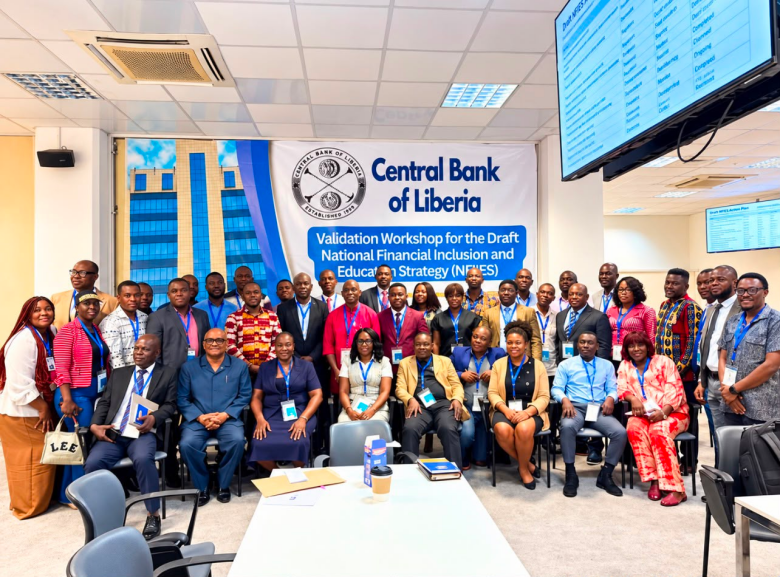
The draft National Financial Inclusion and Education Strategy was reviewed during a two-day validation exercise that brought together representatives of the financial sector and other institutions to identify gaps and recommend changes before the document is finalized. Former CBL Governor Milton Weeks, a consultant on the project, said the draft would be revised as a result.
“Some of the things that we had put in the initial draft, we’ll have to change,” Weeks said.
The strategy is expected to cover five years, although the exact implementation period could depend on when it is formally launched.
Informal Economy at the Center
Weeks said the strategy matters because most of Liberia’s economic activity takes place in the informal sector.
“The majority of the Liberian economy is really in the informal sector,” he said.
He said new financial products and services have not reached most Liberians.
“We keep saying we’re making progress. Yeah, we’re bringing in new products. We’re bringing in new services. But the majority of the people are not benefiting from them,” Weeks said.
He said meaningful financial inclusion should not stop at mobile money accounts but should give Liberians access to loans, savings and insurance as part of a broader financial services system.
Weeks described the plan as a national initiative rather than one belonging only to the Central Bank.
“This is a national strategy,” he said. “This is a national effort that hopefully will have a national impact and be for the betterment of the majority of Liberians.”
He said the hard part would begin once the strategy is completed, and that the CBL would need to help ensure the framework does not remain a document but is carried out in a way that produces tangible benefits.
Education Alongside Access
Atty. Andrew A. Tellewoyan, officer in charge of the CBL’s Development Finance Section, said the views and recommendations submitted during the validation would inform the final document.
Tellewoyan said being able to read and write does not necessarily mean a person can manage money effectively. The draft therefore pairs financial inclusion with financial education, aiming to improve both people’s access to financial services and their ability to use them.
The CBL says the strategy is expected to provide a framework for expanding financial inclusion while bringing together the actors needed to remove barriers to participation in the financial system.
Gaps in ID, Registry and Credit Systems
Best said the exercise was more than a formality.
“It wasn’t just a validation workshop,” she said. “Really, it was intensive, very lively, and we were actively strategizing.”
She said participants identified specific interventions, the institutions that could implement them and the dependencies that must be resolved for the strategy to meet its targets. Among the areas flagged were the National Identification Registry, business registration and credit-reference systems.
Liberia needs a cohesive identification system that can be integrated with commercial banks and other institutions, Best said. She said the business registry should be decentralized to make it easier for businesses to register and enter the formal credit system, and cited technology, coordination, cooperation and liquidity management as other priorities.
Best said financial education should not be left to the Central Bank or commercial banks alone. She called on commercial banks to teach customers and borrowers about loan management, repayment and cash-flow management, and urged that financial literacy be built into the K-12 education system.
She also urged businesses to invest in digital payments and said churches and informal-sector businesses should consider digitizing their transactions, while financial service providers work to build trust among users.
Forex Bureaus Want Digital Roadmap
Nimely Sayeh, president of the National Association of Foreign Exchange Bureaus of Liberia, said the country lags in digital finance and needs a clear roadmap.
“Liberia is way behind when it comes to digital financing,” Sayeh said.
He said participants discussed issues affecting digital financial services, including the role of agents and financial institutions. Sayeh said he would take the financial inclusion message back to the foreign exchange sector and stressed that access to financial services should not depend on a person’s level of education.
He called on the government to expand Liberians’ access to digital financial services, arguing that greater digitalization could boost economic activity.
Support Independent Journalism
Your support helps FrontPage Africa continue delivering independent, credible, and impactful journalism. Every contribution strengthens our ability to investigate, inform, and hold power accountable while keeping quality journalism accessible to our readers.
Support our journalism or subscribe to receive the latest FrontPage Africa stories and updates.