Summary
- Heavier and less predictable rainfall, intensified by climate change, is combining with clogged drains and construction in wetlands to worsen flooding across Monrovia’s low-lying communities.
- Nearly 20,000 families have been affected, displaced, disrupted schooling, lost income, illness and with 7 deaths as floodwater surrounds their homes and remains for days in two counties.
- Residents want blocked waterways reopened, while officials call for stronger forecasting, better drainage, wetland protection and increased disaster-response funding.
By Nemenlah Cyrus Harmon, climate and environment reporter with New Narratives
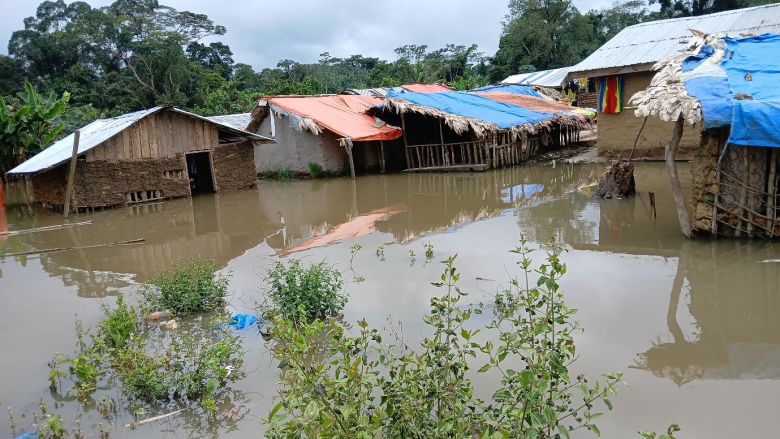
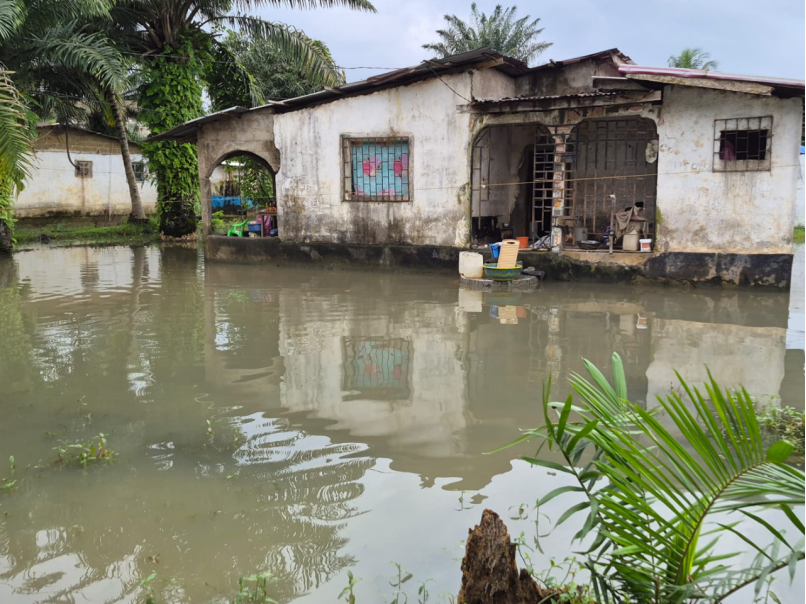
LOFA COMMUNITY, Montserrado County – Paulina Manloh knows the water is coming before she sees it. She has lived in the Lofa community since 2019, long enough to recognize the pattern: rain falls, and within hours the ground around her home disappears beneath brown water.
When the rain is very heavy things get even worse.
“The water can get full until sometime entering the house,” she said, sitting near the swamp that has come to define six months a year of her family’s life. “So now we’re not able to get outside to go look for food or do other activities.”
Across Monrovia, seasonal flooding is becoming a persistent threat to thousands of families. An estimated 5,950 people in Lofa Community alone are affected by flooding, according to the community leader, while families face displacement, disrupted schooling, lost income, illness and death as floodwater surrounds their homes and remains for days. Scientists and government officials say climate change is bringing heavier and less predictable rainfall to a city already struggling with decades of unplanned growth, clogged drains and weak enforcement of environmental laws.
This year Kawi Badio, director for risk and early warning at the National Disaster Management Agency, the body responsible for coordinating disaster preparedness, emergency response and recovery efforts, said 19,986 people have already been affected by flooding across Montserrado, and Grand Cape Mount with seven deaths recorded.
Authorities warn that the crisis will worsen unless the government acts. Anthony Saah Tengbeh, chairperson of the Department of Environmental Studies and Climate Change at the University of Liberia, said flooding in Monrovia and its environs is not caused by climate change alone. He said heavier rainfall is colliding with inadequate drainage, blocked waterways, construction on wetlands and poorly planned urban development, leaving fewer places for floodwater to go.
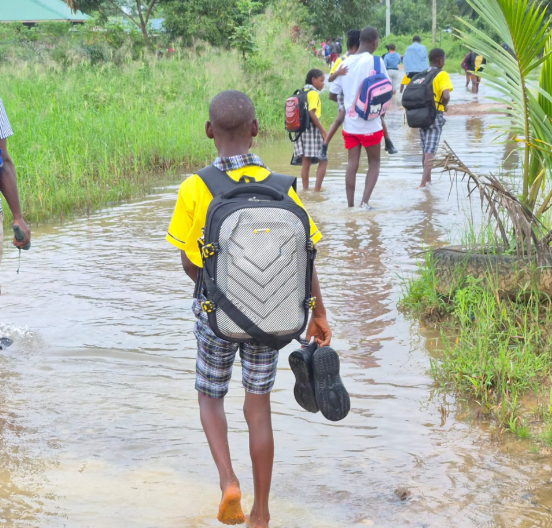
Some families are displaced for a week at a time. Children cannot reach school, and parents cannot reach work. In June, Harris S. Quoiduo, a block leader in the Lofa community estimates that flooding affects about 85 percent of the roughly 7,000 people living across the community’s four blocks. A four-year-old girl drowned after she was swept from a flooded bridge while crossing to find her mother.
“It makes the community feel very, very sad,” he said. “Just imagine your child was not sick, you left the child home just to go and come back, and then you find out the child drowned.”
For Manloh, the consequences are immediate. She has five children, and when the water rises, their world shrinks to whatever dry ground remains. School stops. Errands stop. Sickness moves in. “It can really make me feel bad,” she said. “You struggle for money, pay your children’s school fees, but the water does not allow them to go to school.”
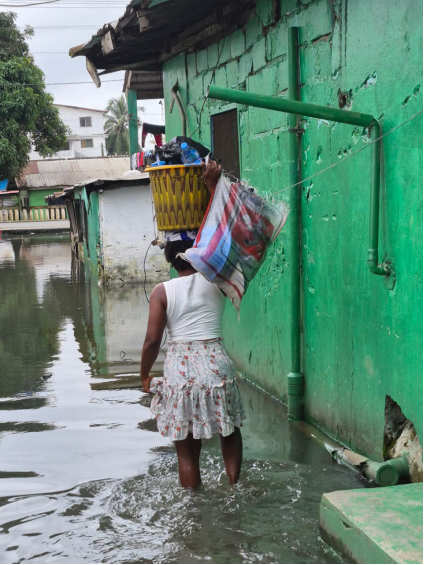
In Monrovia’s 13th Street community in Sinkor, Lansanah Mbawo, a 25-year-old teacher, described in July a newer version of the same problem. Water near his home no longer drains, he said, after a shop was built over what residents believe was the community’s drainage channel.
“We did not use to walk in water,” Mbawo said. “But now it is not really easy.” He said neighbors have fallen ill after wading through stagnant water to reach food, work or family.
Following repeated complaints to the Ministry of Public Works, the structure was eventually demolished.
A City Built on Water
Much of the damage can be traced to where and how Monrovia grew. “Monrovia was built not for the population that dwells in it today,” said Ansu V.S. Dulleh, the agency executive director. The drainage network installed decades ago was designed for a much smaller city.
As informal settlements expanded into wetlands and swamps, homes, shops and roads blocked the natural routes water once used to escape. “You know the water is very jealous,” Dulleh said. “Once the rain comes down, the water will try to find a way to its original inhabitants.” Until the city redesigns its drainage system and stops construction in wetlands, he said, flooding will continue.
Emmanuel Urey Yarkpawolo, executive director of the Environmental Protection Agency, put it more bluntly: “Monrovia is a sinkhole” – low-lying, where water naturally collects. The EPA can issue fines and enforce wetland protections, he said, but a land-starved population continues to push into swamps that flood every rainy season.
Enforcement is also constrained by limited resources.
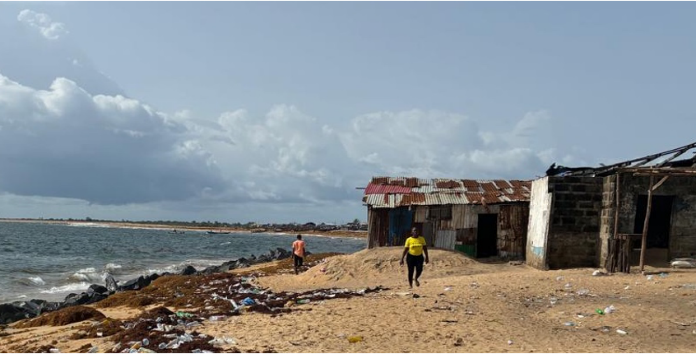
Wetland destruction is part of the worsening flooding situation
Tengbeh said wetlands, (also known as mangroves because of the plants that grow there) act as natural storage areas for excess rainwater. But construction on top of them across the city is reducing their ability to absorb floodwater.
“When we build on the wetland, we build in the swamps, the swamp now will not play its role as a sponge.” Then the consequence: “And that excess water that should be absorbed by the swamp will now go to the dry land and now start to cause problem for us.”
But stopping construction in wetlands remains difficult. The EPA depends on police to carry out eviction orders, Yarkpawolo said, and officers can act only when they have sufficient manpower and logistics.
“Monrovia is overcrowded,” Yarkpawolo said. “The land space in Monrovia is not enough.”
Uncollected trash is also a major issue. With no money to hire heavy equipment, residents have tried to clear the clogged waterways themselves, sometimes with their bare hands and without gloves or boots. Quoiduo said the government should send two or three excavators to reopen the channel.
“That is the most important thing,” he said. “Giving an individual money will not help. They will give the money today, you use it, and the next day you experience the same thing.”
Rainfall Is Becoming Harder to Predict
Residents’ sense that the weather is changing is supported by government forecasters. Albert Momolu Sherman, director of meteorological services at the Ministry of Transport, said Liberia’s historical data shows rainfall becoming more intense even as its timing grows less predictable.
“What we used to experience previously, we do not have now,” Sherman said. “It is like two to three days of rainfall falling in a few hours.” Liberia’s drainage systems were not engineered for that intensity, he said.
Tengbeh said researchers at the University of Liberia are studying whether Liberia’s traditional understanding of two seasons still accurately reflects changing weather patterns.
He holds the view that Liberia has more than three seasons, “all we need to do is to take into consideration the climatic condition over a number of years and have consistent data to determine what is happening in our country.”
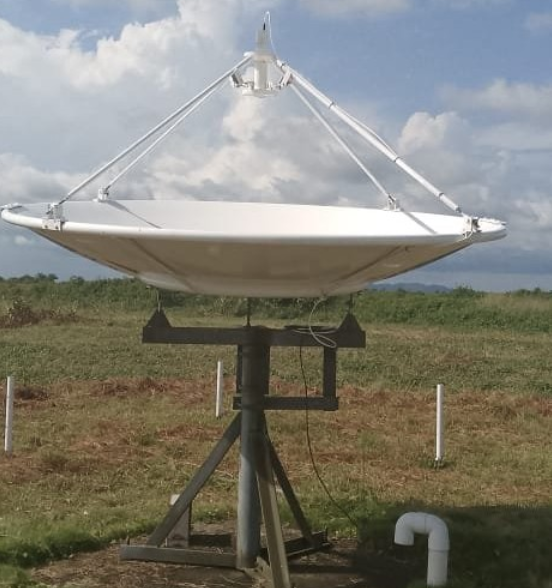
The country also lacks the computing capacity to model storms independently. Forecasters instead rely largely on international satellite data supplied through the African Union and European Union. That gives them about two or three days’ warning before a major storm.
That is enough time to issue an alert, Sherman said, but not enough to constitute a complete national early-warning system. He said the deeper problem is institutional. Liberia does not have a fully resourced national service. Responsibility for weather-related work is scattered across several ministries.
FrontPage Africa/New Narratives documented suspected corruption and a lack of capacity under the Weah administration that led to four-year delays in the US$10 million Climate Information System project, which was funded by international donors and intended to warn communities about hazardous weather.
The Boakai administration began the work to move the project forward, but it has faced obstacles. “That project also has its activities to make sure that the met service and the hydrological service go autonomous. We still have yet to see that project kicking off fully,” said Sherman.
Living With Standing Water
Still, the broader frustration remains: forecasts are issued, ministries meet and officials visit, but the same low-lying neighborhoods flood year after year. The disaster agency, created in 2016, coordinates the national response but relies on a small, mostly volunteer workforce.
Dulleh said only 30 to 40 volunteers serve nationwide, and the agency’s budget is too small for the scale of the problem. He is pressing the World Bank to help establish a national disaster trust fund.
Flooding is only one of the hazards the agency is tracking. This year, windstorms have also torn roofs from homes in Gbarpolu, Bomi, Bong and Nimba counties. When floodwater does not recede, Dulleh said, disease often follows, creating additional demands for health workers, food assistance and relocation support. “We cannot continue to go in a cycle,” he said. “Every time there is flooding, we move there.”
Residents Want Waterways Clear, Not Money
Residents living with the water say they are not asking first for relief packages or temporary compensation. They want blocked waterways reopened before the next storm.
“When they open the waterway, it will help us,” Manloh said. Residents repeatedly clear the channel near Lofa, she said, only to see it blocked again by new construction. “I want the government to help us open the waterway,” she said. “The main problem is the waterway.”
The worst may not be over. Dulleh said the seasonal forecast points to especially heavy rainfall through September, with Montserrado, Bomi and Lofa counties among the most exposed. Flash flooding has already affected West Point, Clara Town and Doe Community in Monrovia.
No deaths had been confirmed in those communities this season, he said, but families had been displaced and officials were preparing for disease outbreaks linked to standing water.
This story was a collaboration with New Narratives as part of the Investigating Liberia Project. Funding was provided by the Swedish International Development Cooperation Agency. The funders had no say in the story’s content.
Support Independent Journalism
Your support helps FrontPage Africa continue delivering independent, credible, and impactful journalism. Every contribution strengthens our ability to investigate, inform, and hold power accountable while keeping quality journalism accessible to our readers.
Support our journalism or subscribe to receive the latest FrontPage Africa stories and updates.