
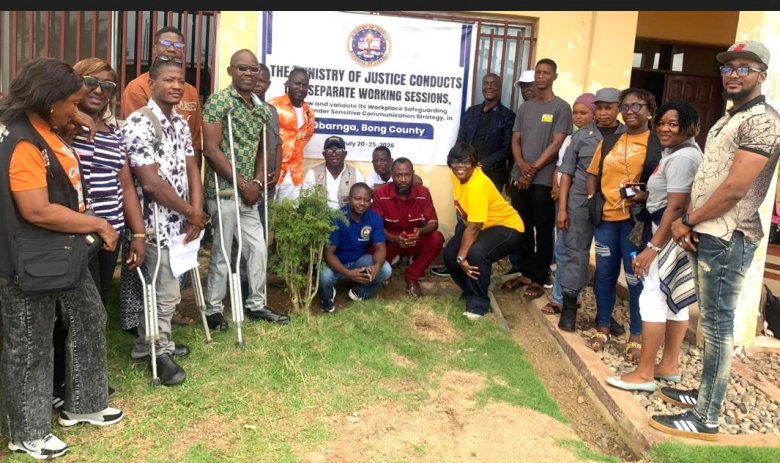
Bong County Attorney Cllr. Jonathan N. Flomo has praised the Ministry of Justice’s Workplace Safeguard Policy and Gender-Sensitive Communication Strategy as essential tools for strengthening the ministry’s commitment to justice, fairness, equality and professionalism.
By Franklin Doloquee From Gbarnga, Bong County.
Delivering closing remarks at the end of a six-day working session in Gbarnga City, Bong County, Cllr. Flomo said both frameworks are central to building an internal culture that reflects the principles ministry staff are constitutionally mandated to uphold.
“The Workplace Safeguard Policy represents the Ministry’s collective commitment to ensuring every employee works in an environment of dignity, mutual respect, fairness and accountability, with zero tolerance for harassment, discrimination, intimidation, retaliation, abuse of authority and other forms of workplace misconduct,” he said.
He described the Gender-Sensitive Communication Strategy as a practical roadmap for promoting equality, inclusiveness, respect and professionalism in both internal and public-facing communications.
Cllr. Flomo said successful implementation of the two documents will create a safer, more inclusive workplace and enhance public confidence in the Ministry of Justice as an institution that practices the values it enforces.
He commended participants, county justice officials, civil society representatives and ministry directors for their professionalism and active engagement during the deliberations.
He also praised the Minister of Justice and Attorney General Cllr. Natu Oswald Tweh and development partners, including UN Women–Liberia and its Country Representative Abul Hasnat Monjurul Kabir for supporting the Gender Social Inclusion Unit in finalizing the instruments.
Assistant Director of the Gender Social Inclusion Unit, Laward, thanked county authorities for the opportunity to technically review and validate the two documents, saying they will strengthen gender-responsive communication, workplace conduct and professional standards.
He echoed praise for Minister Tweh and UN Women–Liberia for their technical and financial support.
Mr. Laward said the validated documents, now awaiting final approval, will promote decent work ethics, protect employees from workplace provocation and advance accountability.
He added the strategy will unify messaging across gender pathways in the ministry by promoting inclusive representation, gender-inclusive language, visibility, empowerment and awareness for social change.
He noted the drafting process drew on national and international protocols to align the instruments with global standards. The review and validation took place in two three-day sessions.
During the workshop, participants formed three working groups to read the documents and provide inputs and recommendations to the approving committee.
Separately, the Gender Social Inclusion Unit, in partnership with UN Women–Liberia, is conducting a Gender-Responsive Prison Assessment in Bong, Lofa and Nimba Counties.
The assessment will examine how correctional facilities serve women (including pregnant detainees and mothers with infants), persons with disabilities and vulnerable male detainees. It will evaluate prison infrastructure, health services, rehabilitation programs and protection protocols through a gender lens.
Findings from the assessment will identify systemic policy and practice gaps, align prison practices with Liberia’s obligations under CEDAW, UNSCR 1325 and the National Action Plan on Women, Peace and Security, and provide evidence to strengthen institutional accountability and advance inclusive justice reforms.
Support Independent Journalism
Your support helps FrontPage Africa continue delivering independent, credible, and impactful journalism. Every contribution strengthens our ability to investigate, inform, and hold power accountable while keeping quality journalism accessible to our readers.
Support our journalism or subscribe to receive the latest FrontPage Africa stories and updates.