Monrovia — President Joseph Boakai has called for urgent and coordinated action to resolve Liberia’s persistent non-performing loan (NPL) problem, warning that the crisis is restricting access to credit and threatening the country’s broader economic growth.
Jaheim T. [email protected]
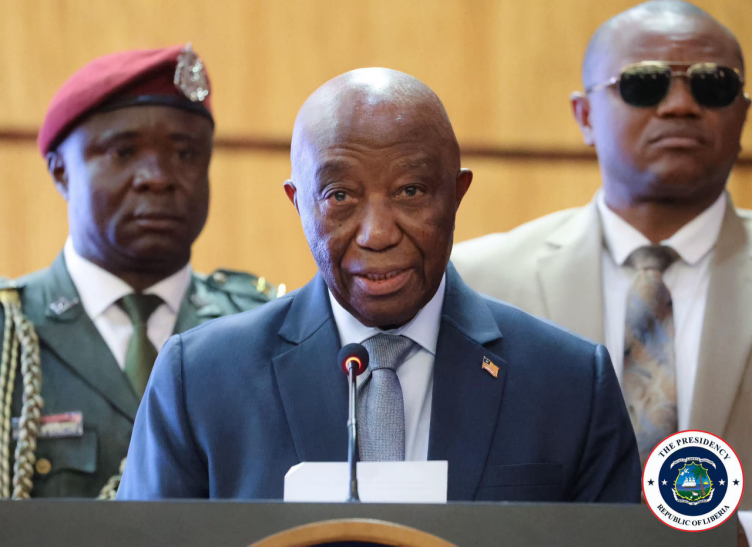
Speaking Wednesday, September 9, at the opening of the National Conference on the Resolution of Non-Performing Loans at the Ministerial Complex in Monrovia, President Boakai said the issue must no longer be treated as merely a technical banking concern, but as a national development challenge.
The three-day conference, convened by the Central Bank of Liberia, is being held under the theme, “Resolving Non-Performing Loans to Unlock Access to Finance for Private Sector Growth and Job Creation.”
The gathering brings together government officials, commercial banks, regulators, the judiciary, the Legislature, private sector representatives and development partners to examine the causes of distressed loans and develop measures to improve credit recovery and expand access to financing.
President Boakai said the consequences of unpaid loans extend far beyond bank balance sheets.
“This issue, in my view, is really about people,” the President said, pointing to farmers seeking financing to expand production, young entrepreneurs looking for capital, businesses hoping to expand and create jobs, and depositors whose funds must be protected.
He warned that when loans remain unpaid, money that should circulate through the economy becomes trapped, forcing banks to become more cautious and making credit harder and more expensive for legitimate borrowers.
“That is why the theme of this conference … is both timely and important,” Boakai said. “This is not simply a banking problem. It is a national development challenge.”
Liberia’s NPL Burden
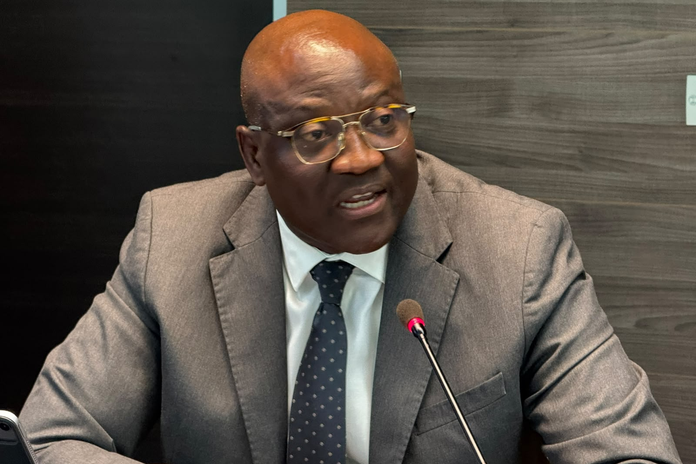
CBL Executive Governor Henry F. Saamoi provided a stark picture of the problem, revealing that Liberia’s banking sector recorded a non-performing loan ratio of 19.1 percent at the end of 2024, nearly twice the prudential benchmark.
Although the ratio declined to 12.9 percent in 2025, Saamoi cautioned that the improvement was driven largely by loan restructurings and write-offs rather than sustainable recoveries.
The figures, he said, underscore the need for structural reforms aimed at strengthening repayment performance, credit discipline and debt recovery.
“Liberia’s elevated level of non-performing loans demands decisive action,” Saamoi said.
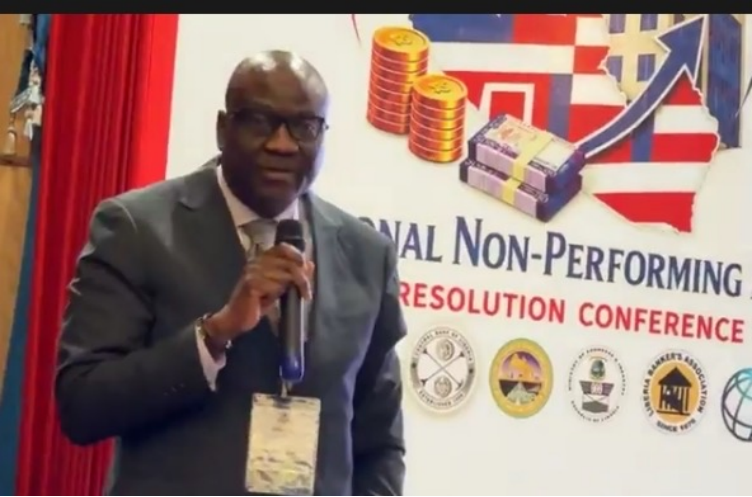
He compared Liberia’s situation with other countries, noting that Ghana recorded an NPL ratio of 21.8 percent in 2024, while Nigeria recorded 8.1 percent, Guinea 6.7 percent and The Gambia 4.6 percent.
According to Saamoi, international experience shows that systemic NPL problems cannot be resolved through isolated action by regulators or banks.
“Governments must play their part. Regulators must play their part. Banks must play their part. The judiciary must play its part. Borrowers must play their part and development partners must play their part,” he said.
Boakai Demands Accountability
President Boakai stressed that resolving the existing stock of bad loans must be accompanied by measures to prevent new ones.
He called for stronger credit reporting systems, improved land administration and collateral registration, better use of technology, expansion of responsible digital financial services and reforms to Liberia’s insolvency framework.
He also placed responsibility on both lenders and borrowers.
“Banks must lend responsibly and conduct proper assessments of those to whom they lend,” Boakai said. “Borrowers must also understand that loans are obligations that must be repaid.”
He further emphasized the importance of enforceable contracts and collateral, as well as an effective judiciary capable of resolving disputes fairly and efficiently.
“Contracts must mean something. Collateral must mean something,” he said.
But the President reserved some of his strongest remarks for what he described as Liberia’s tendency to produce recommendations without sufficient follow-through.
“The success of this conference will not be measured by the speeches we make or the recommendations we write. It will be measured by what we do after we leave this room,” Boakai said.
“Liberia has had many conferences. We have produced many good reports and recommendations. What our people need now is implementation.”
He urged participants to leave the conference with clear commitments, assigned responsibilities, realistic timelines and a mechanism for monitoring implementation.
Finance Minister Links Government Arrears to Bad Loans
Finance and Development Planning Minister Augustine Kpehe Ngafuan broadened the discussion, arguing that government’s own payment practices can contribute to the accumulation of non-performing loans within the banking sector.
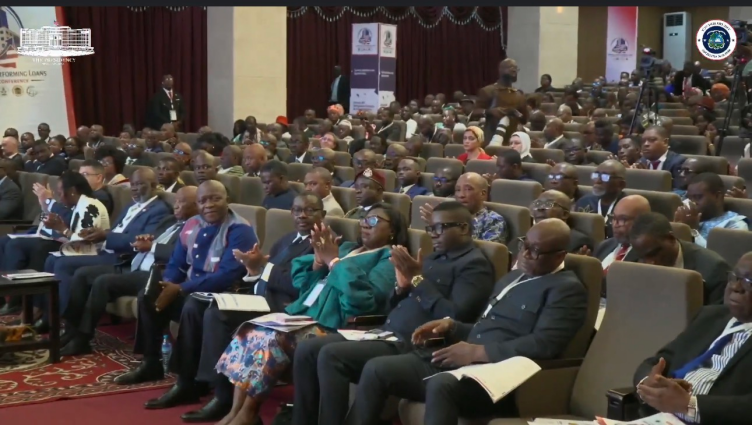
Ngafuan explained that when government fails to pay contractors, suppliers and service providers on time, those businesses may struggle to service loans they previously obtained from commercial banks.
“What begins as a government arrear can eventually end up as a non-performing loan on the balance sheet of a commercial bank,” Ngafuan said.
He said the Boakai administration is therefore seeking to restore government’s credibility as an economic actor by honoring legitimate financial obligations.
“When this government contracts with you, government must pay you,” Ngafuan declared.
He acknowledged that the administration inherited significant legacy obligations but said the government is addressing them within available fiscal space while seeking to avoid creating new arrears.
Ngafuan said the current national budget provides nearly US$235 million for debt service, including more than US$90 million for commercial debt.
He also cited approximately US$25 million budgeted for debt service to the World Bank, arguing that government must demonstrate the same repayment culture it expects from citizens and businesses.
“We cannot call upon citizens and businesses to honor their obligations to banks while government fails to honor its obligations to those banks,” he said.
From Bad Loans to Productive Capital
For the CBL governor, the ultimate objective is not merely to reduce the NPL ratio but to free up capital for productive economic activity.
Saamoi said the conference is expected to produce three key outputs: a conference communique, an NPL resolution policy roadmap and a reform action plan.
The roadmap is expected to identify practical reforms in credit risk management, debt recovery, collateral enforcement and credit discipline, while also assessing the regulatory, legal and judicial systems governing loan recovery.
Ngafuan said resolving distressed assets should ultimately redirect capital toward agriculture, manufacturing, construction, trade, technology, housing and other productive sectors.
He argued that government alone cannot employ every Liberian and that sustainable job creation requires a stronger private sector capable of investing, innovating and expanding.
President Boakai similarly linked the NPL crisis to his administration’s ARREST Agenda for Inclusive Development, which seeks to expand employment, empower women and young people, strengthen agriculture and food security, improve infrastructure and grow Liberian businesses.
The President said those ambitions cannot be achieved without a financial system capable of providing affordable and reliable financing.
A Test of Implementation
The conference comes at a time when Liberia’s financial sector continues to face the twin challenge of improving loan recovery while expanding access to credit for businesses and households.
For Boakai, the challenge now is to move beyond diagnosis.
“We know the problem. We have brought the right institutions together. Now we must move from discussion to action,” he said.
Saamoi echoed that position, describing the conference as an opportunity to establish a new chapter in Liberia’s financial sector—one marked by stronger banks, healthier balance sheets, greater financial inclusion, expanded access to credit, increased investment and more jobs.
“The ultimate measure of success of this conference will not simply be a lower NPL ratio,” Saamoi said. “Success will be reflected in greater access to credit, better repayment terms and performance, stronger businesses, expanded investment, increased employment opportunities and improved livelihoods for our people.”
For the Boakai administration, the resolution of bad loans has therefore become part of a broader economic question: how to unlock capital trapped in distressed assets and put it back to work in an economy where farmers, businesses, entrepreneurs and young Liberians are demanding greater access to finance.
Support Independent Journalism
Your support helps FrontPage Africa continue delivering independent, credible, and impactful journalism. Every contribution strengthens our ability to investigate, inform, and hold power accountable while keeping quality journalism accessible to our readers.
Support our journalism or subscribe to receive the latest FrontPage Africa stories and updates.