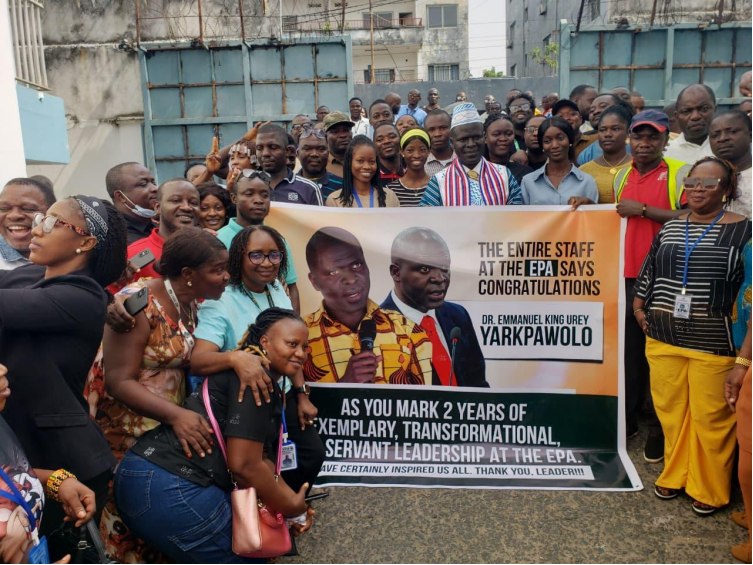
Monrovia — What unfolded at the headquarters of the Environmental Protection Agency (EPA) last Thursday was far more than a simple anniversary gathering; it was a defining moment that captured two years of reform, resilience, and renewed purpose under the leadership of Executive Director Dr. Emmanuel K. Urey Yarkpawolo.
By Selma Lomax, [email protected]
Staff had assembled under the guise of a routine engagement, yet the atmosphere quickly transformed into one of celebration and reflection, marked by singing, applause, and heartfelt tributes in honor of a leader many credit with reshaping Liberia’s foremost environmental institution.
When Dr. Urey assumed office on February 19, 2024, the Agency faced significant institutional and financial challenges. The EPA’s cash balance was nearly depleted, governance structures required strengthening, and public confidence in regulatory enforcement needed restoration.
Through deliberate institutional reforms, weekly financial reviews, and strengthened internal controls, the Agency gradually restored financial stability and governance discipline. Transparent reporting mechanisms and prudent fiscal management reversed the near zero balance and repositioned the institution on firmer financial ground, reinforcing accountability at every administrative level.
Central to this transformation was a comprehensive restructuring process. A validated organogram clarified roles and responsibilities, while a landmark salary reform addressed long standing concerns regarding staff welfare and professionalism.
These measures were not merely administrative adjustments; they signaled a cultural shift within the Agency. Employees began to experience improved morale, clearer direction, and renewed confidence in leadership.
The introduction of regular internal engagements, including the Know Your Environment forum, institutionalized staff learning and knowledge sharing through structured technical sessions, strengthening internal capacity and professional development.
Infrastructure development became a visible symbol of reform. The relocation of the EPA headquarters to a modern facility in Mamba Point provided a professional environment aligned with the Agency’s national mandate.
A Freeport sub-office was opened to enhance oversight of imported chemicals and hazardous materials, ensuring closer monitoring of substances entering the country. Complementing these developments was the operationalization of a state of the art environmental laboratory, enabling in house testing of water, soil, and air quality.
This scientific capacity reduced reliance on external facilities and anchored regulatory decisions in empirical evidence, strengthening credibility in enforcement actions and environmental assessments.
Enforcement itself emerged as a defining hallmark of Dr. Urey’s tenure. Between 2024 and 2025, the Agency conducted more than two thousand compliance inspections across the country, targeting operations in mining, agriculture, manufacturing, and other sectors. Multiple non- compliance notices and halt orders were issued, while substantial fines were levied against polluters, including large corporations.
The principle was clear: remediation obligations are separate from statutory penalties, and payment of fines does not absolve offenders from restoring damaged ecosystems. This firm approach marked a new era of environmental accountability in Liberia.
Decentralization further strengthened the Agency’s effectiveness. Operational EPA offices and County Environmental Committees were established in all fifteen counties, with inspectors fully deployed nationwide.
For the first time, EPA participated in the February 11th Arm Forces Day Celebration. Forty-Five EPA inspectors from all 15 counties participated in the event, boosting the inspectorate morale and strengthening relationship between the EPA and the Ministry of National Defense.
Enforcement and community engagement were no longer confined to Monrovia; regulatory oversight was brought closer to communities, improving response times and deepening public participation in environmental protection. This expansion fostered a more inclusive model of governance in which citizens became active stakeholders in safeguarding their surroundings.
Scientific and regulatory milestones underscored the Agency’s growing technical competence. The safe containment and removal of radioactive Cesium 137 at the John F. Kennedy Medical Center in 2024, achieved with support from the International Atomic Energy Agency, reached approximately 95 percent containment efficiency and established Liberia’s first significant radiation safety response benchmark.
A nationwide radiation inventory across medical and industrial facilities was completed, and chemical licensing oversight surpassed established targets. Critical regulations were finalized or advanced, including Lead Paint standards set at ninety parts per million, Noise Pollution controls, National Radiation Regulations, and draft policies on National Air Pollution and Carbon Markets.
Environmental governance also gained strategic direction through the launch of the EPA’s Five Year Strategic Plan for 2025 to 2029, a thirty two million United States dollar roadmap aimed at modernization, institutional strengthening, and sustainable environmental management. A one stop shop known as the Environmental Knowlagent system was launched where all information about Liberia’s environment including EPA reports are available for public consumption.
Strengthened Environmental and Social Impact Assessment governance restored transparency and accountability in permitting processes, supported by weekly financial reporting and personnel reforms.
On the international stage, Liberia’s environmental diplomacy reached new heights. The submission of the country’s third generation
Nationally Determined Contribution elevated its climate commitments under global frameworks. Participation in high level forums, including COP30, the United Nations Environment Assembly, the United Nations General Assembly, and the African Ministerial Conference on the Environment, amplified Liberia’s voice in global environmental discourse.
The hosting of Liberia’s second National Pavilion at COP30 in Belém, Brazil, and the launch of the Natural Capital Atlas positioned the country as an emerging destination for climate finance and nature based investment.
Liberia further demonstrated global commitment through the ratification of the Minamata Convention on Mercury and the signing of the Biodiversity Beyond National Jurisdiction treaty, reinforcing dedication to responsible stewardship of natural resources.
These cumulative achievements explain why staff members chose to honor Dr. Urey at his two-year milestone. In a public sector environment where spontaneous recognition is uncommon, the tribute symbolized appreciation for decisive leadership, institutional stability, and measurable progress realized within a short span of time. The ceremonial gown presented during the celebration reflected deep respect for a leader whose stewardship many believe restored pride and purpose to the Agency.
Dr. Urey emphasized that transformation is never the work of one individual alone, but the product of shared vision, coordinated effort, and sustained commitment.
He reaffirmed dedication to strengthening environmental governance, advancing climate resilience, and ensuring that Liberia’s natural resources are managed responsibly for present and future generations.
Support Independent Journalism
Your support helps FrontPage Africa continue delivering independent, credible, and impactful journalism. Every contribution strengthens our ability to investigate, inform, and hold power accountable while keeping quality journalism accessible to our readers.
Support our journalism or subscribe to receive the latest FrontPage Africa stories and updates.