A Canadian retiree’s search for African gold turned into a months-long con involving fake shipping companies, a phony “minister,” strongbox theater, and a scheme so elaborate he compares it to “an academy award performance.”
By Rodney D. Sieh, [email protected]
Monrovia – Gerry Pettle wants one thing understood before anything else: he isn’t writing to embarrass himself.
“I am writing you on the advice of two friends of your country,” the 71-year-old Canadian says in a note to FrontPageAfrica explaining why he’s going public, “and not necessarily in agreement to make this complaint a public humiliation of myself.” He calls himself “a Canadian, born young fellow at the age of 71” — a wry touch from a man who, by his own account, was taken for more than $100,000 USD by a network of scammers in Liberia over the course of several months this year.
It started, as these things often do, with a friend of a friend.
A Favor from Sam
Pettle knew a man named Sam Berkel, who in turn knew a man named Paul — a Liberian expatriate originally from Toronto. Paul, Sam said, had a way to get gold out of Liberia. Pettle now calls it what it was: “a scheme.” At the time, he had no reason to doubt it.
Paul asked Pettle and Sam for $20,000 to secure a shipment of gold he’d bring back to Toronto himself. The two split the cost and wired the money in installments — a few thousand dollars a day, spread out to avoid suspicion. The gold never arrived. Paul never flew back. When Pettle finally reached him, the excuses began: a delay, then another delay, then the claim that Paul himself had been robbed — the gold and the money “switched” out from under him by unnamed thieves.
It should have ended there. It didn’t.
The Dubai Pitch
A week later, Paul had a new plan: he’d have a kilo of gold worked into jewelry and meet Pettle in Dubai, where Pettle could collect it, pay off the man Paul supposedly owed, and recoup his original $20,000 plus a profit. The cost of entry this time was smaller — $3,500 for airfare and jewelry-making — but the outcome was the same. The money vanished. So, for a while, did Paul.
When Paul resurfaced, he offered something even more improbable: a stranger claiming to have millions in marked American cash that needed “washing” for a fee. Pettle refused outright. “Paul, F off,” he recalls telling him. “You’re mental.”
Two days later, Paul was back on the phone with yet another connection — a man with a diplomatic passport, capable of moving gold across borders without permits. Paul said he didn’t trust the man directly but knew someone who did: a fixer who went by “Boylan,” whose real name, Pettle later learned, was Jensen Gonkarnue.
Boylan, Peter, and the Compound
Jensen — “Boylan” — called Pettle personally, addressing him warmly as “Doc.” He vouched for a Liberian gold trader named Peter John, describing a house near the residence of Liberia’s president as proof of legitimacy. On a call, Peter told Pettle he had hundreds of kilos of gold sourced from local miners and sent a photograph appearing to show roughly a thousand kilos stacked on a floor. All Pettle had to do, Peter said, was cover the shipping tax.
It was the first of many taxes.
Pettle sent $12,500 by USDT for the initial tax. Then came a $14,500 charge for air freight and insurance to a company calling itself Noble Shipping — complete with an invoice and a bank routing number, giving Pettle, for the first time, something resembling a paper trail. He and a new partner, Robert, paid it. The package, he was told, was on its way.
It was around this time a second trader, a man named Ben, contacted Pettle claiming to have five kilos of his own gold and to have heard of Pettle’s reputation through a woman named Bernice. A pattern was forming — taxes, shipping fees, insurance, one new stranger after another — but Pettle, already deep in, kept going.
Flying to Liberia
By the time Pettle boarded a flight to Liberia in June, he had lost thousands and gained nothing but promises. He was met at the airport by Boylan, carrying a single assayed kilo of gold as “collateral” against the money already spent.
The next day brought a scene Pettle still describes in almost cinematic terms: a drive down a rough, barely marked road to a barbed-wire compound, a honked horn, a gate that opened and closed behind the car, a second gate, and finally a run-down exterior giving way to a surprisingly polished interior — televisions, desks, a busy office floor.
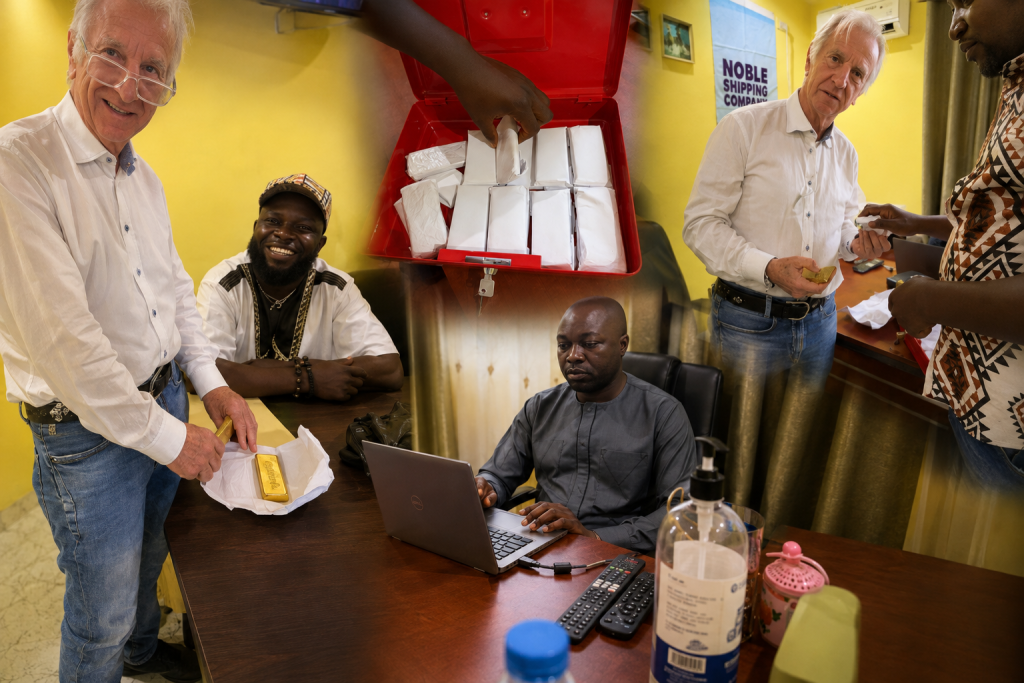
There, in the office of a man identified only as “Mr. Hill,” security guards produced strongboxes belonging to Peter and Ben. Each man opened his own box with his own key, revealing, Pettle says, ten kilos in one and thirty in the other. Then two more men — introduced as Moses and Patrick — arrived unannounced with five kilos of their own.
Pettle agreed to take five kilos total, combined from all three sources, with Peter — who held a diplomatic passport — set to fly back to Canada with him and the gold. The running total by then was roughly $68,000.
Then came the final charges: $6,000 to expedite an “expired” export license, and additional tax for the extra kilos, bringing the total to nearly $29,000 more. Robert wired it. Everyone, Pettle recalls, seemed satisfied when the meeting ended.
The Passport Standoff
Afterward, Peter asked for the one kilo Pettle was still holding as collateral. Pettle refused — it was the only tangible thing he had for his money. He offered a trade instead: the gold for Peter’s passport, so that if he’d been cheated, he’d at least have a photograph to bring to authorities. Peter refused and left angrily.
Days later, a man named Elijah Teahjay — who Pettle says “looked the most legitimate” of everyone he’d met — invited him to a second compound, even more polished than the first, complete with flags and a formal reception area. There, armed guards wheeled in a case holding what Pettle estimates was 300 kilos of gold and told him to take his pick. The new deal: $24,000 up front, $110,000 per kilo on delivery in Canada, payable within 72 hours. The gold, Elijah assured him, would simply be handed to him after customs. “We do it all the time,” he said.
The Man in the Yellow Shirt
The unraveling began with a knock at Pettle’s hotel room door. A representative from Noble Shipping arrived unannounced with an official-looking export license and a new tax bill — $21,000, then, minutes later, a second bill for $27,500. When Pettle tried to photograph the documents, the man blocked his camera, insisting they weren’t his to keep, even though he’d paid for them.
Suspicious, Pettle called Elijah and sent him a photo of the receipt, threatening to involve police if it wasn’t legitimate. Within minutes, a large man in a yellow shirt appeared at the hotel, identifying himself as “Todd” — Liberia’s minister of minerals, he claimed, though he carried no badge, only a worn business card.
What followed, Pettle says, played out “like the end of a lousy movie”: Todd confronted the Noble Shipping representative in front of him, questioned him about the missing export license, and asked Pettle to get into a car. Pettle refused to get in fully, kept one foot on the pavement, and agreed only to meet again the next morning. Within minutes of that encounter ending, his phone lit up with calls from what felt like a dozen different people connected to the scheme, all anxious to know why he’d mentioned police.
Getting Out
By his final night in Liberia, Pettle believed he might be in real danger. As far as the network knew, he’d genuinely gone to authorities. A woman named Grace — another gold contact who’d surfaced days earlier — offered to come collect him from the hotel. He nearly accepted, then reconsidered: if Grace was part of the same web, leaving with her might not be safe either. Instead, a hotel worker moved him quietly to a different room for the night. He slept, and the next morning, he left the country.
An Unlikely Postscript
Pettle did file a report with local police — six officers, he says, took his statement and had him sign it. What strikes him most, looking back, is what they never asked for: the names of the men involved, which he had; the passport used, which he had; or a single phone number from the dozens who called him during the ordeal.
“This is the beginning of a dormant complaint,” Pettle writes. But his closing line is the one that lingers: despite everything, he says his real ambition is still “to come back and bring investment to your beautiful country” — if Liberia will have him.
Support Independent Journalism
Your support helps FrontPage Africa continue delivering independent, credible, and impactful journalism. Every contribution strengthens our ability to investigate, inform, and hold power accountable while keeping quality journalism accessible to our readers.
Support our journalism or subscribe to receive the latest FrontPage Africa stories and updates.