‘I Will Dismiss You’ – Liberia news The New Dawn Liberia, premier resource for latest news https://share.google/dpQ5oJ9IY2EyIwK1O
By: Austin S. Fallah – A True Son of the Planet Earth Soil: [email protected]
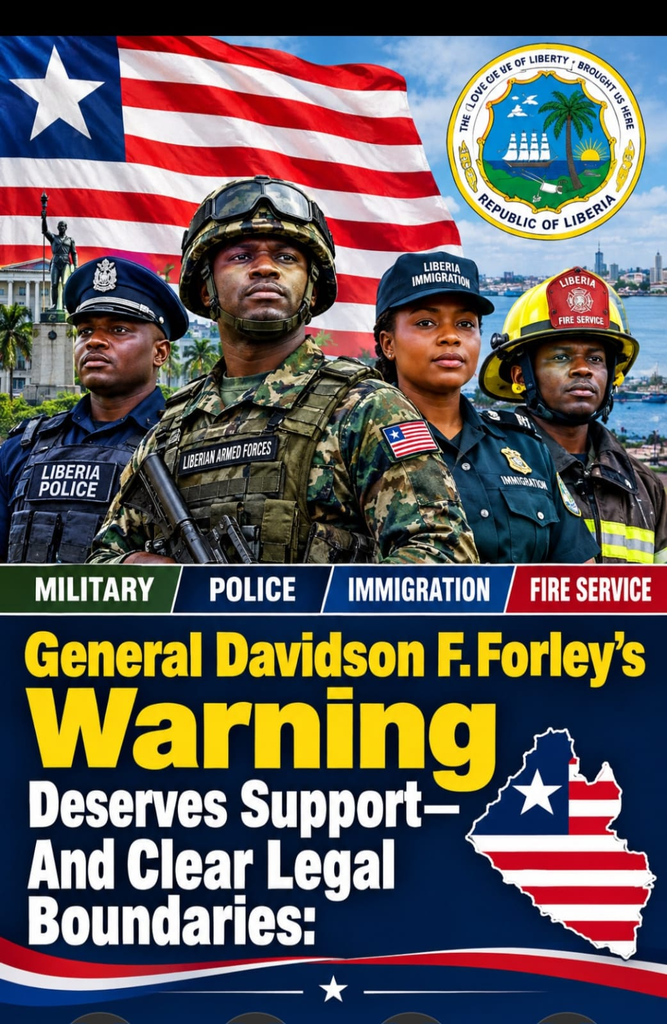
At a time when many Liberians are deeply concerned about public safety, the protection of human life, and the responsibilities of state institutions, a strong statement by the Chief of Staff of the Armed Forces of Liberia, General Forley, deserves serious national attention.
General Forley, who is widely regarded as an intellectual, nationalist, and academician, reportedly declared during remarks at the graduation of Immigration Officers that he would dismiss Army personnel who stand by and do nothing while a citizen is being brutalized or while someone is attempting to kill a fellow citizen.
As reported by the ‘New Dawn’ newspaper, the statement was unmistakably forceful: members of the Armed Forces of Liberia must not become silent spectators when human beings are subjected to violence.
The moral principle behind this message is difficult to dispute.
No uniformed officer, no public servant, and indeed no citizen with a functioning conscience should be comfortable watching another person be beaten, tortured, assaulted, or killed without making any reasonable effort to prevent it.
A country cannot call itself safe, stable, or civilized if its people routinely look away while violence unfolds before them.
The General’s words should therefore be received not merely as a warning to soldiers, but as a wake-up call to every air-breathing, human-conscious Liberian.
They speak to the kind of society Liberia must become: one in which the value of human life is defended, violence is confronted, and public officials understand that their authority carries an obligation to act.
Yet, while the message deserves broad support, it also requires careful clarification.
The phrase, “I will dismiss you if you stand there and do nothing,” is powerful and morally compelling, but without further definition, it could be misunderstood.
If it is interpreted too broadly, some Armed Forces of Liberia personnel could mistakenly assume that any action taken in the name of protecting a citizen is automatically justified.
That would be dangerous.
A military officer’s duty to protect life must always be exercised within the limits of law, professional ethics, rules of engagement, human rights standards, and the constitutional order.
The issue, therefore, is not whether soldiers should intervene to protect citizens from imminent harm.
Of course they should, where they are lawfully authorized and where intervention is necessary.
The issue is how they should intervene, under what conditions, with what level of force, and under whose authority.
General Forley’s statement would become even stronger, and much safer for both civilians and service members, if it were accompanied by a clear explanation of what lawful, proportionate, and authorized intervention means in practice.
Liberia’s history makes this clarification especially important.
The country has endured conflict, insecurity, institutional breakdown, and periods when armed actors were feared rather than trusted.
For many Liberians, seeing men and women in uniform can evoke both hope and anxiety.
Hope, because a disciplined national security force can protect communities and uphold the state’s authority.
Anxiety, because uniforms have also been associated, in different periods of Liberia’s history, with abuse, intimidation, arbitrary force, and impunity.
The postwar rebuilding of the Armed Forces of Liberia was intended to create a professional military that serves the nation rather than political interests, respects civilian authority, and operates under democratic principles.
This progress must be guarded carefully.
The AFL must never be allowed to become a force that acts according to personal judgment, emotional impulse, or broad interpretations of patriotic duty.
Even when intentions are good, actions taken without legal limits can create more harm than protection.
A soldier who sees a citizen being brutalized has a human obligation to care.
A soldier who sees an attempted killing has a professional obligation not to ignore a clear and immediate threat to life.
But concern alone is not enough.
The response must be measured.
The service member must assess the situation, call appropriate authorities when possible, identify the threat, issue lawful commands, seek to de-escalate the confrontation, and use only the force reasonably necessary to protect life.
Being a victim does not give an officer unlimited authority.
Likewise, the fact that a suspected attacker is committing violence does not mean that an officer is free to punish the person outside the law.
This distinction is essential.
There is a difference between intervention and retaliation.
Stopping an assault is different from inflicting vengeance.
There is a difference between using proportionate force to restrain a dangerous person and using excessive force because one is angry, frightened, or eager to demonstrate power.
If General Forley’s remarks are understood as encouraging immediate protection of threatened citizens through lawful means, they reflect sound moral leadership.
If they are misunderstood as approving whatever action soldiers believe is necessary, however excessive or unauthorized, then the message could unintentionally undermine the very public trust it seeks to strengthen.
Remember that the Armed Forces of Liberia is not the same institution as the Liberia National Police.
The police are generally the primary domestic law enforcement agency responsible for crime prevention, arrest, investigation, and maintaining public order.
The military has a different constitutional and institutional role.
In certain emergencies or circumstances, military personnel may assist civil authorities or take action to protect lives.
But such involvement should not blur the lines between military defense and civilian policing.
A democratic society depends on clearly defined roles.
When armed forces are routinely drawn into ordinary civilian disputes or crimes without proper rules and oversight, the risk of militarizing public life increases.
Citizens may fear that any disagreement, protest, or disturbance could trigger military intervention.
Soldiers, meanwhile, may be placed in situations for which they are not trained or legally assigned.
This can produce confusion, mistakes, and unnecessary violence.
For that reason, the General’s statement should be followed by institutional guidance.
The Public Affairs department of the AFL should explain, in direct and understandable terms, when soldiers have a duty to intervene in a situation involving imminent violence against civilians.
It should also state when soldiers should contact the police, their commanders, or other appropriate authorities.
The force should make clear that intervention must be consistent with military regulations, national law, human rights obligations, and established command procedures.
Such guidance does not weaken the General’s warning.
It strengthens it. It tells soldiers: “You must not stand idly by when a life is in immediate danger, but neither may you act recklessly, unlawfully, or beyond your authority.”
That is the balanced message a professional armed force needs.
Clear guidance should include at least several basic principles.
First, military personnel should act to protect life when there is an immediate and credible threat of serious physical harm or death, particularly when no other capable authority is available to respond in time.
Second, they should use de-escalation whenever possible. Verbal commands, separating parties, calling for support, and seeking police assistance may often resolve a crisis without force.
Third, any force used must be necessary and proportionate to the threat.
Fourth, once the immediate danger has passed, the matter should be transferred to the appropriate civilian law-enforcement authorities.
Fifth, all significant interventions should be documented and subject to review.
These principles would protect citizens, but they would also protect soldiers.
An Army officer should not be left to guess whether their actions will later be condemned as unlawful.
If the AFL expects personnel to intervene in emergencies, it must provide the training, equipment, legal education, reporting procedures, and command support they need to do so professionally.
Soldiers need to know what they can do, what they cannot do, and what they must do when confronted with violence against civilians.
Training is especially important.
It is not enough to tell a soldier, “Do not stand there and do nothing.”
The soldier must be trained to recognize imminent threats, distinguish between a public fight and a life-threatening assault, communicate effectively under pressure, preserve evidence, manage crowds, and avoid escalating violence.
Personnel must also understand that a person accused of a crime remains entitled to dignity and due process.
The purpose of intervention is to stop harm and preserve life, not to become judge, jury, and executioner.
The same expectation of moral courage should extend beyond the AFL.
General Forley’s statement rightly challenges the culture of silence that often allows violence to flourish.
In too many communities, people witness domestic abuse, mob violence, assault, armed robbery, sexual violence, or threats against vulnerable persons and choose not to get involved.
Sometimes they are afraid. Sometimes they believe the matter is “private.” Sometimes they assume someone else will act.
But silence can be deadly.
Every Liberian has a role to play in building a safer country.
This does not mean that unarmed civilians should recklessly confront armed criminals or place themselves in grave danger.
It means that they should report crimes, seek help, support victims, cooperate with lawful investigations, discourage mob justice, and refuse to normalize violence.
A society that protects life cannot be built only by soldiers, police officers, immigration officers, judges, or politicians.
It must also be built by market women, students, teachers, religious leaders, business owners, community elders, journalists, and young people.
The graduation of Immigration Officers was an appropriate setting for General Forley’s message.
Immigration officers, like military personnel and police officers, stand at a point where state authority meets ordinary people.
Their conduct can either build trust or deepen public suspicion.
They must understand that public service is not simply about enforcing rules; it is also about protecting human dignity.
A state official who ignores brutality in front of him or her fails the public.
But an official who responds with lawlessness also fails the public.
The challenge is to act decisively without abandoning discipline.
The General should therefore be commended for insisting that members of the Armed Forces of Liberia cannot be indifferent to violence against citizens.
His statement rejects cowardice, passivity, and the dangerous belief that public servants should simply watch while innocent people suffer.
It affirms a basic truth: the uniform is not merely a symbol of power. It is a symbol of responsibility.
However, moral urgency must be accompanied by legal precision.
Liberia does not need a military that stands by while citizens are harmed.
Neither does it need a military whose personnel believe that noble intentions excuse unauthorized conduct.
The country needs disciplined defenders who understand both courage and restraint; who will step forward when lives are in danger; and who will do so in a way that respects the law, civilian authority, and the rights of every person.
General Forley’s words can become a valuable national standard if they are properly clarified.
The AFL should issue guidance defining the duty to intervene, the limits of military authority, the requirement for proportionate force, and the procedures for coordination with civilian law-enforcement agencies.
Such clarification would ensure that no soldier can use the General’s statement as an excuse for abuse, intimidation, or excessive force.
At the same time, it would make clear that inaction in the face of preventable brutality is unacceptable.
Liberia’s security institutions must be strong, but strength is not measured by weapons, threats, or force alone.
True strength is shown through discipline, accountability, compassion, professionalism, and respect for the rule of law.
A soldier who protects a threatened citizen lawfully demonstrates strength.
A soldier who abuses authority demonstrates weakness.
A commander who demands action but also establishes clear limits demonstrates responsible leadership.
The nation should support General Forley’s central message: no officer should stand idle while a citizen is being brutalized or killed.
But support must be joined with a call for clarity. Protecting citizens is not a license for unchecked action.
It is a duty that must be carried out lawfully, proportionately, and with full respect for the democratic principles Liberia continues to build.
Support Independent Journalism
Your support helps FrontPage Africa continue delivering independent, credible, and impactful journalism. Every contribution strengthens our ability to investigate, inform, and hold power accountable while keeping quality journalism accessible to our readers.
Support our journalism or subscribe to receive the latest FrontPage Africa stories and updates.