
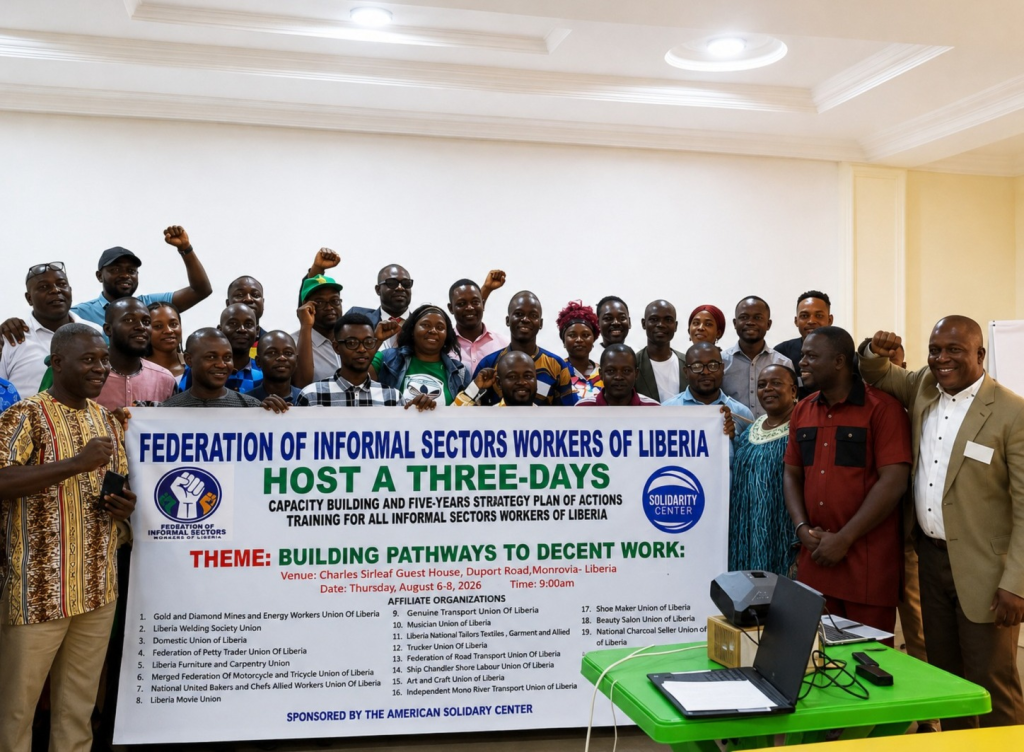
MONROVIA – The Federation of Informal Sectors Workers of Liberia (FISWOL), with support from the American Solidarity Center (ASC), has launched a three-day capacity-building and five-year strategic action planning workshop aimed at equipping informal workers with the knowledge, skills and tools needed to strengthen their livelihoods and advocate for improved working conditions.
The training, which opened Thursday, Aug. 6, in Paynesville, brings together FISWOL members from across Liberia under the theme, “Building Pathways to Decent Work.” Participants include representatives of the American Solidarity Center, the Office of the United Nations High Commissioner for Human Rights (OHCHR), the Ministry of Labour, the Liberia Labour Congress, development partners, facilitators, FISWOL’s national leadership, union and association leaders, petty traders, transport workers and artisans.
Delivering the opening statement, FISWOL President Elvis A. Tamba said the workshop is designed to broaden members’ understanding of Liberia’s labor laws, the benefits available to workers and effective ways to engage the government on issues affecting the informal sector.
He described decent work as more than just having a job, saying it encompasses fair income, workplace safety, social protection and respect for workers’ rights.
“Decent work means fair income — work that can feed one’s family and save for tomorrow; a safe workplace — no more injuries in the market or on the road without help; social protection — access to health, training and a voice; and respect and rights — being recognized by government and partners as real workers,” Tamba said.
He emphasized that Liberia’s informal sector accounts for nearly 80% of the country’s economy, making it indispensable to national development.
“The ‘pathway’ starts here. It starts with us organizing, learning new skills, and demanding better. The informal sector is not a temporary place. We are 80% of Liberia’s economy. If Liberia must grow, the pathway must pass through FISWOL,” he declared.
Tamba said the workshop is expected to achieve three key objectives: increasing members’ knowledge of their labor rights, strengthening practical business skills and developing actionable plans that will improve the lives of informal workers nationwide.
According to him, participants will gain a better understanding of labor laws, the benefits they are entitled to and effective ways to engage government institutions. They will also receive training in record-keeping, savings, customer service and business growth strategies.
“When we leave here, what will each association do to bring ‘Decent Work’ to its members?” he asked.
Tamba stressed that the program is intended to transform lives rather than simply distribute certificates.
“To my comrades: Come with an open mind. Ask questions. Share your struggles. What you learn here, you must teach 10 people in your markets or garages.”
He also appealed to the government and development partners to extend their support beyond the training.
“We thank you. But ‘Pathway to Decent Work’ cannot end in this hall. Walk with us. Help us with access to loans, with training centers, with health insurance for informal workers.”
He further challenged FISWOL’s leadership to remain committed after the workshop by monitoring progress and ensuring that no member is left behind.
“Comrades, the journey to Decent Work begins with one step. And that step is today. Let us use these three days wisely. Let us leave here united, skilled, and ready to build a better future for all informal workers.”
Also speaking, American Solidarity Center Country Director Deddeh Tulay said the training focuses on advancing workers’ rights and strengthening organizations within Liberia’s informal economy.
She explained that the initiative is being implemented in collaboration with the Office of the United Nations High Commissioner for Human Rights (OHCHR) to create a platform where petty traders, transport workers and other informal sector actors can share experiences, identify common challenges, understand labor rights and develop practical organizational strategies.
“It is important to emphasize the essential role informal workers play in Liberia’s economy,” Tulay said, adding that the sessions are designed as collaborative learning exchanges rather than lectures.
Representing OHCHR Country Representative Christian Mukosa, Human Rights Officer Melvin Nyanway reaffirmed the agency’s commitment to supporting FISWOL’s institutional development.
Nyanway said the country representative regards the federation as a valued partner and wants to move beyond repeated training sessions toward governance reforms and concrete policy outcomes.
“The Country Representative is fully supportive of the FISWOL President’s vision for the association,” Nyanway said, noting that OHCHR remains committed to helping the organization grow and strengthen its advocacy efforts.
Support Independent Journalism
Your support helps FrontPage Africa continue delivering independent, credible, and impactful journalism. Every contribution strengthens our ability to investigate, inform, and hold power accountable while keeping quality journalism accessible to our readers.
Support our journalism or subscribe to receive the latest FrontPage Africa stories and updates.