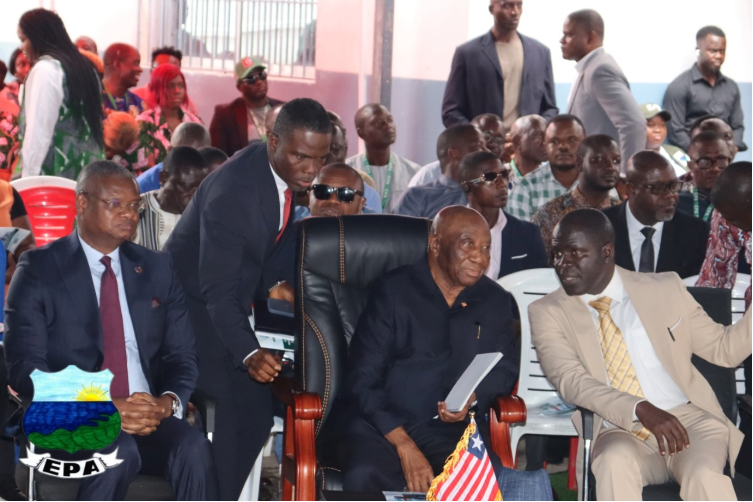
AT THE dedication of the Environmental Protection Agency’s permanent headquarters and the commissioning of its Elemental Analyzer on July 16, 2026, President Joseph Nyuma Boakai declared: “Dr. Urey Yarkpawolo is a gift to this nation.”
THIS WAS more than ceremonial praise. It was a public recognition of what purposeful leadership can accomplish when technical competence, courage, discipline and prudent financial management are applied to public service.
PUBLIC OFFICIALS should ultimately be judged by the institutions they strengthen, the reforms they implement and the lasting value they create for the country. On that standard, Dr. Emmanuel K. Urey Yarkpawolo’s leadership of the EPA has become one of the notable examples of institutional progress under the Boakai administration.
LIBERIANS HAVE become accustomed to hearing ambitious promises from public officials. Too often, those promises fail to produce measurable improvements. The transformation taking place at the EPA stands out because the results are visible, verifiable and capable of delivering long-term national benefits.
A PERMANENT headquarters, a modern environmental laboratory, expanded scientific capacity, renewable-energy infrastructure, stronger international partnerships, more active environmental enforcement and a roadmap for decentralizing environmental services are tangible achievements, not political slogans. These developments support the broader principle that public officials must be evaluated by the lasting institutions and national assets they create.
WHEN DR. Yarkpawolo assumed leadership of the EPA in February 2024, the Agency faced serious financial, administrative and operational challenges. Employee morale was low, vehicles and other assets were in poor condition, working environments were inadequate, environmental violations were increasing, and the Agency continued to operate from rented premises without building permanent value for the government.
THE EASIEST response would have been to manage the decline, blame previous administrations and continue conducting business as usual. Instead, Dr. Yarkpawolo and his team began rebuilding the institution.
INTERNAL financial oversight was strengthened. Senior management began receiving regular information on revenues and expenditures. Procurement and administrative spending came under closer scrutiny. Employee accountability, professional development and internal communication received greater attention. Grievance and innovation mechanisms were introduced to give employees opportunities to raise concerns and propose solutions.
THESE REFORMS may not always attract newspaper headlines, but they are the foundations upon which effective public institutions are built. The most visible achievement of this transformation is the acquisition of the EPA headquarters and laboratory property.
FOR YEARS, taxpayers financed rental payments without creating a lasting government asset. Under the present leadership, the Agency controlled costs, accumulated savings and negotiated the purchase of the property for US$800,000, including applicable taxes and fees. The lowest appraisal reportedly valued the property at about US$1.3 million.
IN PRACTICAL terms, the EPA secured a national asset for substantially less than its assessed value while ending an expensive cycle of recurring rent. At an annual rental cost exceeding US$100,000, the government could have spent more than the purchase price over several years and still owned nothing.
That cycle has now been broken.
THE PROPERTY includes approximately 1.8 acres of land, around 80 offices, conference rooms, reception areas, a library, a GIS laboratory, parking facilities, a warehouse, a generator house and a fenced compound. It is supported by a 60-kilowatt solar system with inverter and battery backup, reducing dependence on fuel and demonstrating the renewable-energy principles the EPA promotes nationally.
THE lesson extends beyond the EPA.
GOVERNMENT INSTITUTIONS should not be satisfied merely with maintaining existing operations. They should plan strategically, improve efficiency and leave behind assets that continue serving the Liberian people long after current officials have departed.
THE COMMISSIONING of the Elemental Analyzer provides another justification for the President’s statement. For many years, Liberia has attempted to regulate mining, agriculture, water pollution, forestry, waste disposal and coastal development without adequate domestic scientific capacity. Environmental samples often had to be sent abroad, increasing costs, delaying results and limiting opportunities for Liberian scientists and students.
THE ELEMENTAL Analyzer, valued at approximately €100,000 and provided through the International Atomic Energy Agency, significantly strengthens Liberia’s ability to conduct sophisticated environmental analysis within its own borders. Its importance extends far beyond the walls of the laboratory.
FARMERS CAN benefit from better information about soil quality and organic content. Water bodies can be assessed more effectively. Mining and industrial activities can be monitored using stronger scientific evidence. Researchers can study mangroves, wetlands, sediments, plants and carbon storage. Liberia can also generate improved data to support climate negotiations, forest protection and access to international carbon and climate financing.
UNIVERSITIES AND research institutions now have greater opportunities to collaborate with the EPA, conduct locally relevant studies and train a new generation of Liberian scientists. The analyzer therefore represents not merely a piece of equipment, but an investment in knowledge, national sovereignty and evidence-based decision-making.
DR. YARKPAWOLO’S leadership has also reinforced the message that environmental protection is not an obstacle to development. Responsible environmental management is a foundation for sustainable economic growth.
AGRICULTURE depends on healthy soils. Fisheries depend on clean rivers, coastal waters and protected mangroves. Mining requires effective regulation to prevent communities from bearing the cost of private profit. Public health depends on clean water, proper waste management and pollution control. Climate resilience requires science, planning, renewable energy and functioning institutions.
THE EPA’s recent direction recognizes these connections and places environmental governance at the centre of Liberia’s development agenda. The Agency has also sought to extend its presence beyond Monrovia. County offices have been opened or strengthened, while plans for regional laboratories, environmental learning centres, public-awareness programmes and partnerships with universities and local governments demonstrate a commitment to making environmental protection a truly national undertaking.
THIS IS particularly important because communities experiencing illegal mining, deforestation, water pollution, coastal erosion and other environmental threats are often located far from the capital. An EPA that exists mainly in Monrovia cannot adequately protect the entire country.
UNDER DR. Yarkpawolo’s leadership, the Agency has also become more visible in national and international discussions on climate change, biodiversity, renewable energy, pollution control, carbon markets and sustainable development. International partners are increasingly engaging the EPA not simply as a beneficiary, but as a national institution capable of developing programmes, managing partnerships and providing technical leadership.
NONE OF this means that the EPA’s work is complete or that its leadership should be placed beyond criticism. Serious challenges remain. Illegal mining, wetland destruction, deforestation, coastal erosion, poor waste management, industrial pollution and the growing effects of climate change will continue to test the Agency.
THE EPA must therefore deepen transparency, strengthen enforcement, maintain its scientific equipment, protect the independence of regulatory decisions and ensure that environmental laws are applied fairly, regardless of political influence, nationality or economic status.
NEVERTHELESS, achievements should be acknowledged when they are earned. Constructive criticism is essential in a democracy, but so is recognition of public officials who deliver measurable progress. A society that refuses to recognize competence risks creating a culture in which results matter less than rumours, political divisions and personal attacks.
PRESIDENT BOAKAI’S statement therefore carries significance beyond one individual. By describing Dr. Yarkpawolo as a gift to the nation, the President highlighted the qualities Liberia should expect from public officials: knowledge, discipline, innovation, integrity, prudent financial management and commitment to building institutions that endure.
DR. YARKPAWOLO is a gift to Liberia not simply because of his academic qualifications or the position he occupies. He is a gift because he has demonstrated what is possible when education is placed at the service of the country, when public resources are treated as a sacred trust, and when leadership seeks to leave behind permanent national value rather than temporary headlines.
THE CHALLENGE now is to sustain these reforms, expand them and inspire similar transformation throughout the public sector. That would be the most fitting tribute to a public servant whom the President has rightly recognized as “a gift to this nation.”
Support Independent Journalism
Your support helps FrontPage Africa continue delivering independent, credible, and impactful journalism. Every contribution strengthens our ability to investigate, inform, and hold power accountable while keeping quality journalism accessible to our readers.
Support our journalism or subscribe to receive the latest FrontPage Africa stories and updates.