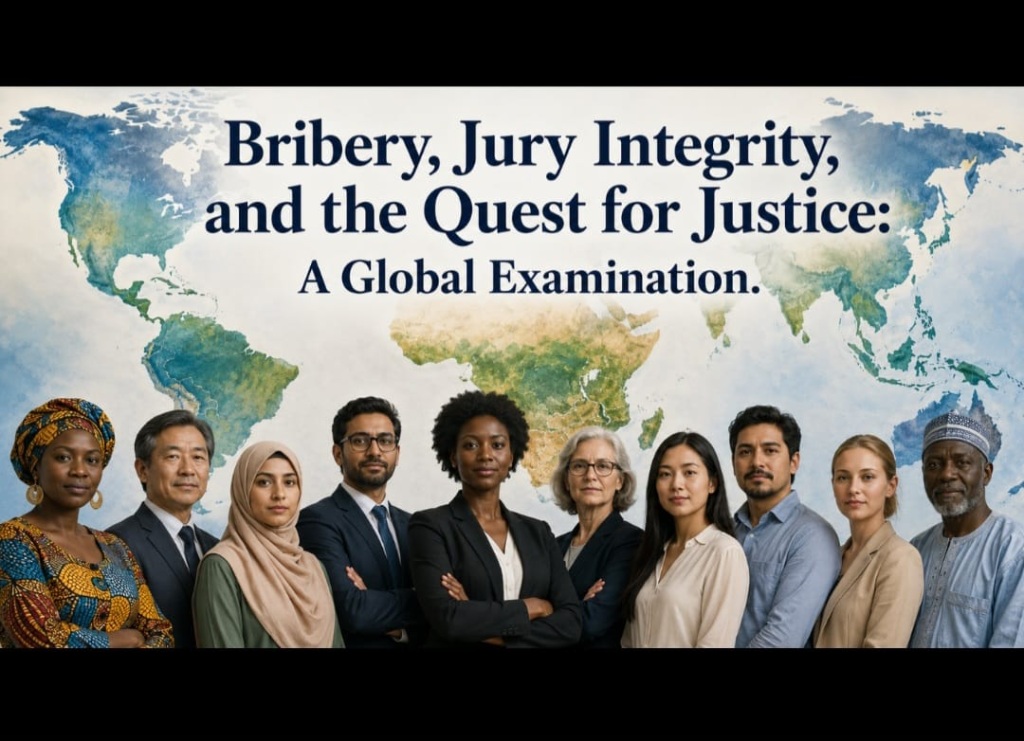
Bribery, jury integrity, and the pursuit of justice are foundational to the rule of law. Across the globe, legal practitioners, authors, and world leaders have explored the tensions between systemic corruption and the moral imperative of fairness.
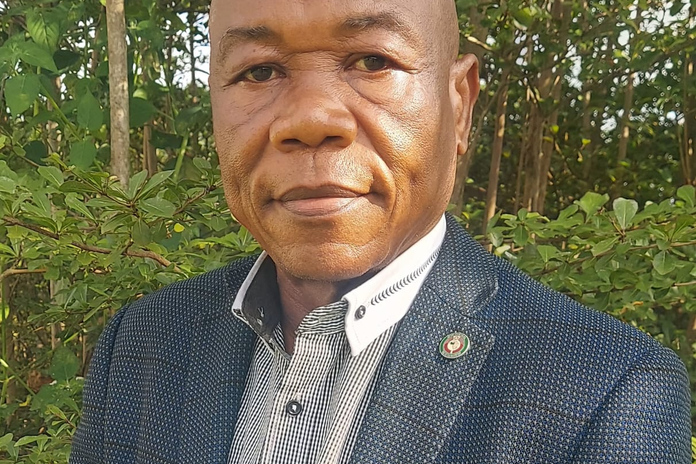
By: Austin S Fallah – A True Son of the Planet Earth Soil:[email protected].
Graham Greene (Novelist): “I have often noticed that a bribe has that effect. It changes a relation. The man who offers a bribe gives away a little of his own importance; the bribe, once accepted, he becomes the inferior, like a man who has paid for a woman.”
Frank Serpico (Public/Former NYPD Officer): “The fight for justice against corruption is never easy. It never has been and never will be. It exacts a toll on ourselves, our families, our friends, and especially our children. In the end, I believe, as in my case, the price we pay is well worth holding on to our dignity.”
Miguel de Cervantes (Novelist): “When the severity of the law is to be softened, let pity, not bribes, be the motive.”
United States Supreme Court (Snyder v. United States): Differentiating the concept of an upfront agreement from a gift, the Court noted that “[b]ribes” are “payments made or agreed to before an official act to influence the official to carry out that future official act,” which American law inherently treats as corrupt.
On Jury Integrity and the Lay Public Atticus Finch, from Harper Lee’s To Kill a Mockingbird (Novel): “A court is no better than each … of you sitting before me on this jury. A court is only as sound as its jury, and a jury is only as sound as the people who make it up.”
Thomas Jefferson (Politician/Founding Father): “I consider trial by jury as the only anchor ever yet imagined by man, by which a government can be held to the principles of its constitution.”
Robert Frost (Poet): “A jury consists of twelve persons chosen to decide who has the better lawyer.”
Lysander Spooner (Political Theorist): “If a jury has not the right to judge between the government and those who disobey its laws, and resist its oppressions, the government is absolute, and the people, legally speaking, are slaves.”
Dr. Martin Luther King Jr. (Public/Civil Rights Leader): “Injustice anywhere is a threat to justice everywhere.”
Bob Marley (Musician/Public): “You will never find justice in a world where criminals make the rules.”
Oliver Wendell Holmes Jr. (Supreme Court Justice): “The life of the law has not been logic; it has been experience.”
Archibald MacLeish (Poet): “The business of the law is to make sense of the confusion of what we call human life to reduce it to order, but at the same time to give it possibility, scope, even dignity.”
Karl Kraus (Austrian satirist and writer): “Corruption is worse than prostitution. The latter might endanger the morals of an individual, the former invariably endangers the morals of the entire country.”
“Miguel de Cervantes (Spanish novelist, Don Quixote): “When the severity of the law is to be softened, let pity, not bribes, be the motive.”
George Orwell (British novelist): “A people that elect corrupt politicians, impostors, thieves and traitors are not victims… but accomplices.”
Harper Lee (American novelist): “A court is only as sound as its jury, and a jury is only as sound as the people who make it up.”
Winston Churchill (British politician and Prime Minister): “The jury system has come to stand for all we mean by English justice. The scrutiny of honest jurors provides defendants and plaintiffs alike a safeguard from arbitrary perversion of the law.”
Lysander Spooner (American legal theorist and abolitionist): “But for their right to judge the law, and the justice of the law, juries would be no protection to an accused person…”
Lord Chief Justice Mathew Hale (English jurist): “…it is the conscience of the jury that must pronounce the prisoner guilty or not guilty.”
James Baldwin (American novelist and essayist): “If one really wishes to know how justice is administered in a country, one does not question the policemen, the lawyers, the judges, or the protected members of the middle class. One goes to the unprotected—those, precisely, who need the law’s protection most!”
Victor Hugo (French novelist, Les Misérables): “Being good is easy, but what is difficult is being just.”
Ferdinand I (Holy Roman Emperor): “Fiat iustitia, et pereat mundus.” (Let justice be done, though the world perish.)
In any legal system, the sanctity of a jury’s verdict is paramount.
Yet scenarios arise that challenge this notion, particularly when allegations of bribery impugn the integrity of the judicial process.
Can a judge request an investigation into alleged jury tampering after a non-guilty verdict?
Furthermore, does such an examination conflict with double jeopardy protections?
This adda explores these critical queries by providing an extensive examination through various legal systems worldwide, African Courts, International Courts, London Courts, US Courts, Canadian Courts, European Courts, Australian Courts, and Caribbean Courts, drawing correlations and setting legal precedents for future consideration.
African Courts: Balancing Justice and Integrity:
In several African nations, legal systems have grappled with allegations of jury tampering.
For instance, in Kenya’s High Court, the case of “R v. Mwangi” highlighted the issue of bribery influencing the jury’s decision.
Here, the judge overturned the not-guilty verdict after credible evidence surfaced of bribes paid to jury members.
The Court held that the integrity of the jury is crucial, and any taint of it can lead to a mistrial.
The Kenyan legal system illustrates that bribes compromise the jury’s function, prompting courts to investigate claims of misconduct.
This reflects a judicial recognition that, while double jeopardy protects defendants from being tried for the same crime, it does not shield them from the consequences of illegitimate verdicts obtained through corruption.
Thus, the precedent established is that courts in African nations can initiate investigations to uphold the integrity of judicial outcomes, recognizing that maintaining public confidence in the justice system supersedes the protections afforded by the double jeopardy rule.
International Courts: Universal Standards:
The International Criminal Court (ICC), located in The Hague, offers a lens through which global justice can be examined.
The case of “Prosecutor v. Thomas Lubanga Dyilo” demonstrates the ICC’s commitment to judicial integrity.
Although not directly addressing jury bribery, the principles established establish the necessity of due process and fair trials.
In situations where jury integrity is questioned, such as when allegations arise after the verdict, the ICC can initiate investigations.
The court leans on the premise that ethical trials take precedence over the finality of verdicts.
Should credible allegations of juror misconduct, such as bribery, surface, they can result in the overturning of a verdict, as the court must ensure that justice is served fairly, not simply expediently.
This reaffirms that the protection against double jeopardy does not apply when the verdict is acquired unconstitutionally.
London Courts: A Historical Perspective:
The British legal framework has long emphasized the integrity of jury verdicts. In the landmark case of “R v. Young”, jurors used an electronic Ouija board to communicate with the deceased during deliberations, purportedly prompting the Court of Appeal to overturn the verdict.
Such cases underscore the readiness of London courts to investigate irregularities in jury conduct, particularly when external influences are at play.
In cases involving alleged bribes, British law provides mechanisms for retrial under extraordinary circumstances.
Similar to the precedent set by “Young”, if a former juror comes forward alleging bribery, the court could deem the foundational misconduct to warrant a retrial and overrule the not-guilty verdict.
London courts thus reaffirm the idea that safeguarding justice sometimes requires scrutinizing prior verdicts, thereby drawing the line against double jeopardy when jury integrity is at stake.
US Courts: A Dual Focus on Rights and Integrity:
In the United States, the Fifth Amendment guarantees against double jeopardy, ensuring that no one shall “be subject for the same offense to be twice put in jeopardy.”
However, the case of “United States v. Martin Linen Supply Co.” provides insight into situations in which jury verdicts may be overturned for substantial procedural errors or misconduct.
The United States v. Edgerly (a case that went through the Massachusetts state courts), in which a juror disclosed attempts at bribery after a non-guilty verdict, exemplifies a situation in which a retrial was supported.
The Supreme Court’s affirmation of the trial judge’s discretion to investigate jury conduct reflects a recognition that while double jeopardy serves as an important protection, it does not apply when the verdict is fundamentally compromised by corruption.
In such instances, the demand for justice and an impartial verdict takes precedence, granting judges the power to address juror irregularities.
Canadian Courts: The Role of Judicial Integrity:
Canada’s judicial framework universally upholds the integrity of the jury’s function.
In “R v. O’Connor”, where post-verdict claims of juror misconduct surfaced, the Supreme Court of Canada recognized that such claims warranted careful review.
Although the case primarily addressed the rights of the accused, it underscored the importance of maintaining jury integrity.
If allegations of bribery or coercion are substantiated, Canadian courts may annul previous verdicts, thereby initiating retrials.
This establishes a clear precedent: despite protections against double jeopardy, maintaining the sanctity of the justice system underscores the need to promptly and thoroughly address allegations of jury corruption, thereby promoting the integrity of Canadian jurisprudence.
European Courts: Safeguarding Rights and Fair Trials:
The European Court of Human Rights (ECHR) has a meticulously structured approach towards maintaining judicial fairness.
In “Pope v. France”, the court ruled that a jury could be investigated for conduct that could threaten the integrity of a verdict.
The lessons here resonate across European legal frameworks: juror misconduct should warrant reevaluation of verdicts, even if it means nullifying prior decisions.
In cases of bribery allegations, member states can proceed with investigations and potential retrials, reinforcing the principle that the pursuit of justice outweighs the constraints of double jeopardy.
When external influences compromise jurors, the public’s faith in the judicial process is jeopardized, serving as a reminder of the necessity for utmost standards of integrity across European courts.
Australian Courts: Emphasizing Fairness:
Australia’s legal frameworks allow for significant judicial discretion when examining jury misconduct.
The High Court of Australia has previously addressed cases where jurors acted improperly.
In “Smith v. The Queen”, a jury’s reliance on unrelated information led to the House of Lords allowing a retrial based on the principles of fairness and reasonable doubt.
Bribery allegations against jurors would similarly prompt investigations; should evidence surface indicating that a bribe influenced a not-guilty verdict, Australian courts can annul such outcomes.
This approach ensures that, despite the double jeopardy principle, preserving the integrity of the legal process and ensuring fairness to victims or society takes precedence in Australia’s judicial ethos.
Caribbean Courts: Navigating Judicial Ethics:
In the Caribbean, courts have encountered instances requiring the consideration of allegations against jurors.
For instance, in the Jamaican case of “R v. Gordon”, where a juror alleged that they were offered a bribe, the court promptly halted proceedings and initiated an investigation.
This affirms Caribbean courts’ commitment to addressing potential corrupt practices within their systems.
Similar to other jurisdictions, when evidence of bribery comes to light, the verdict may be set aside, leading to a retrial.
Such measures solidify the importance of honesty in jury functions, setting a regional precedent that encourages scrutiny of jury conduct when allegations arise.
The integrity of a jury’s verdict forms the cornerstone of judicial systems worldwide.
Allegations of bribery not only threaten individual cases but undermine public faith in the judicial process itself.
Through a comprehensive examination of various legal systems, including those of African, International, London, US, Canadian, European, Australian, and Caribbean Courts, it is evident that when juror integrity is compromised, the principle of double jeopardy is outweighed by the imperative to investigate and rectify potential injustices.
Judges across these jurisdictions have the authority to investigate jury conduct, overturn unsound verdicts, and grant retrials when necessary.
This fosters a legal landscape where justice is served not just in words but in actions that uphold the core values of fairness, integrity, and public trust.
By establishing and solidifying such precedents, future judicial systems can adapt to ensure the sanctity of verdicts remains unassailable.
Support Independent Journalism
Your support helps FrontPage Africa continue delivering independent, credible, and impactful journalism. Every contribution strengthens our ability to investigate, inform, and hold power accountable while keeping quality journalism accessible to our readers.
Support our journalism or subscribe to receive the latest FrontPage Africa stories and updates.