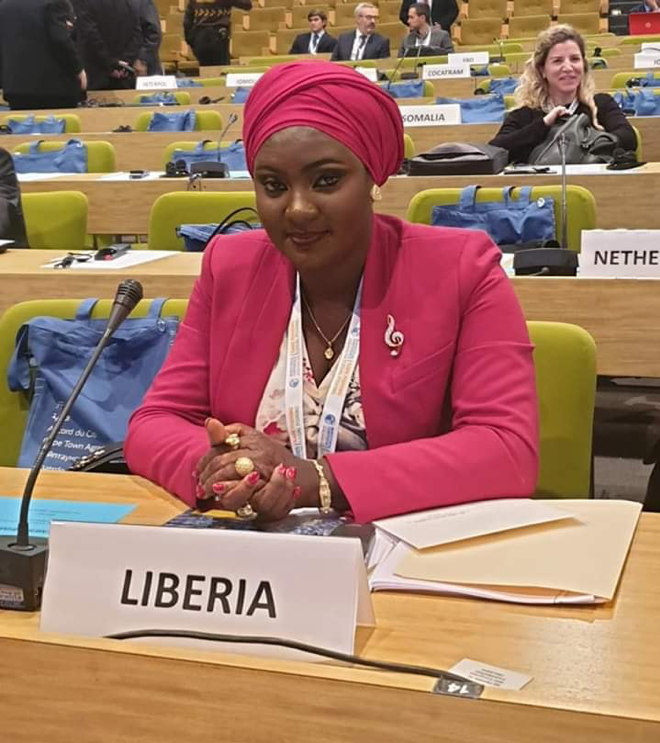
Madrid – The Liberian government, through the Director-General of the National Fisheries and Aquaculture Authority (NaFAA), has signed the Cape Town Agreement, committing to the full implementation of the international fisheries protocols.
The Cape Town Agreement, among other things, provides for standards, compliance on the minimum requirements on the design, construction, equipment, and inspection of fishing vessels of 24 meters and above operating on high seas and not the Exclusive Economic Zone.
Signing the agreement Monday at the Ministerial conference on fishing vessel safety and IUU fishing of the IMO in Malaga, Spain, Mrs. Emma Glassco called on all members of the IMO states to consider signing the Cape Town Agreement.
Said Glassco: “Liberia believes that by ratifying the CTA, member states will have the ability to significantly reduce the exploitation of both the oceans and the people who depend on them”.
She added: “The agreement’s entry into force would improve safety and working conditions in one of the most dangerous professions in the world and minimize opportunities for unscrupulous operators to profit from the IUU fishing operations”.
According to a dispatch from the Ministerial Conference, the Liberian Fisheries boss made it known that Liberia, as a Coastal State, Flag State, and Port State, is committed to ensuring compliance in its National Fishing vessels inspectorate and Compliance programs”.
Disclosing the success story of Liberia in the Maritime world, madam Glassco intimated that “Liberia as the second largest ship registry in the world has made significant strides in ensuring a well-managed and professional maritime system in keeping with international protocol of the highest safety standards”.
Glassco averred that the fact that Liberia was one of the first countries to sign onto the ILO Convention as well as the 2006 Maritime Labor Convention, it remains committed to ensuring that these international protocols and conventions are fully utilized in the management of its maritime sector.”
The NaFAA Boss said Fisheries is now an independent entity of government by law and that the National Fisheries and Aquaculture Authority has the responsibility to ensure the proper management of the Fisheries sector, covering fish resources, fishing vessels and crew, as well as fisher folks and fish farming.
As a leading National sector entity, madam Glassco said the Fisheries office has established that the need to adopt international best practices for the governance of the sector cannot be overly emphasized and in achieving same, has strengthened its Inspectorate program, under the MCS division as well as acceded to several international convention, such as the IWC, FAO Post State Measure Agreement and adopted a National Plan of Action on IUU”.
The Liberian Fisheries Director stressed that the Cape Town and Torremolinos agreements provide an opportunity to strengthen already strong compliance program for safety of fishing vessels at sea.
She acknowledged that since the development of the Torremolinos Agreement and the Cape Town Agreement, Liberia has not signed onto the agreement, because it has been engaged in consultations regarding the terms of the treaties.
The Fisheries director, however, said that Liberia recognizes that the agreements provide standards for compliance on the minimum requirements on the design, construction, equipment, and inspection of fishing vessels of 24 meters and above operating on high seas and not the EEZ”.
The NaFAA Boss explained that the Liberia Maritime Authority conducts safety inspection to conform to the International Convention for the Safety of Life at Sea (SOLAS) convention for merchant ships, while the Agreement empowers the Fisheries Authority and other labor agencies to conduct a safety inspection of fishing vessels and crews in our Port that conforms to our measures of safety.
She said Liberia remains aware that the treaty consists of minimum safety measures for fishing vessels that mirror the International Convention for the Safety of Life at Sea (SOLAS) which is an internationally binding treaty on safety for merchant vessels that was entered into force in 1980 and calls for harmonized fisheries, labor, and safety inspections”.
Madam Glassco noted that as a coastal state, committing to the agreement would provide higher safety standards for fishing vessels operating in Liberia’s coastal waters. As such, she said, that this would include minimizing risk to our nationals who work as crew and our observers onboard these foreign-flagged vessels. She disclosed that “Liberia has a 100% Observer coverage for all domestic trawlers”.
A dispatch quoting madam Glassco indicated that the new standards for compliance may mitigate chance of vessel incidents in their waters such as foundering, fire, capsizing, or collision that would usually require assistance from their maritime authority or coast guard.
Commenting more on the agreement, madam Glassco noted that it would also allow inspection of foreign-flagged vessels and would increase the transparency of the fishing operations.
The NaFAA Director General confirmed that regular inspections in line with the CTA will make fishing activities and vessels’ safety and working conditions more transparent and safer. “Vessel operators will be encouraged to invest in the safety and welfare of their crews, mitigating the exploitation of their crew and additionally, the regular inspections will also discourage vessel operators to fish illegally.”
Support Independent Journalism
Your support helps FrontPage Africa continue delivering independent, credible, and impactful journalism. Every contribution strengthens our ability to investigate, inform, and hold power accountable while keeping quality journalism accessible to our readers.
Support our journalism or subscribe to receive the latest FrontPage Africa stories and updates.