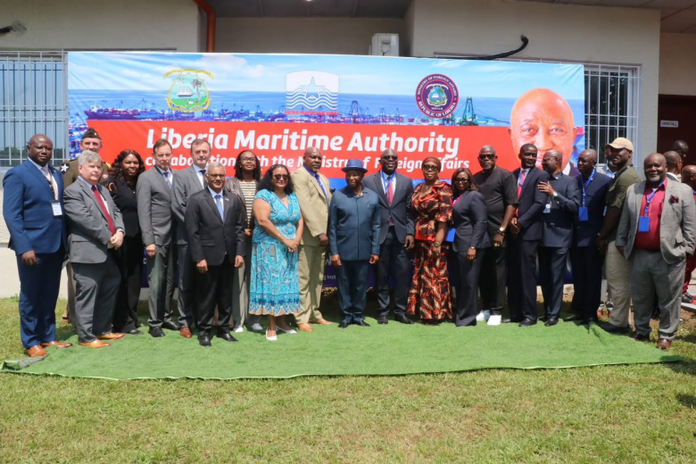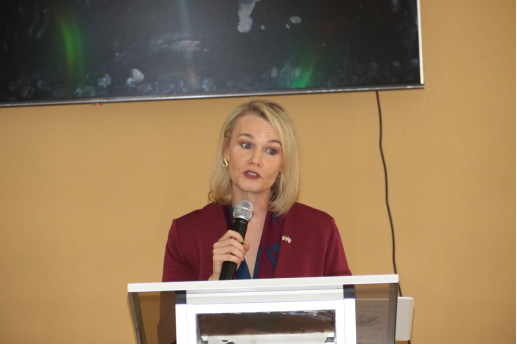
Monrovia – America wants to do more business with Liberia than anyone can imagine, US U.S. Chargé D’affaires Kristin Gilmore has told a gathering of entrepreneurs and personalities in Monrovia.
By Emmanuel Weedee-Conway
Speaking at a stakeholders’ gathering held at the Liberia Chambers of Commerce, the US envoy stated that the African Growth and Opportunity Act (AGOA) has provided eligible African countries with preferential access to the world’s largest consumer market.
The gathering marks series of activities in commemoration of this year’s US Global Entrepreneurship Week (GEW). GEW is an annual worldwide campaign celebrating innovators, startups, and small business founders. This year’s event runs November 16–22, 2026, under the theme: “Entrepreneurs Thrive Here”
More Opportunities For Liberia
With AGOA now extended through December 2028, she said Liberia has an opportunity to turn that access into something more tangible such as increased exports, more investment, additional jobs, and greater income for Liberian families.
Lessons from Other African Countries’ Success Under AGOA
In 2024 alone, she recounted, Kenya exported approximately US$533 million in apparel to the United States, Madagascar exported approximately US$355 million, while Lesotho exported approximately US$151 million.
She noted that these are real products from real African businesses with real customers in the United States that are generating revenue and creating jobs in their respective countries.
To her, Liberia does not need to replicate Kenya’s garment industry overnight, even though these examples demonstrate an important point which suggests that access to a market is valuable only when businesses are prepared to serve it.
Liberia’s Export Potential and Products for the American Market
The US official disclosed that Liberia has products that American businesses can use, and some of them have already been discussed at this gathering.
“These include natural rubber, which supports manufacturing and industrial supply chains; cocoa, which can supply American chocolate and food producers; and sustainably sourced palm oil and palm kernel oil, which are used in soaps, cosmetics, and personal care products,” explained the US diplomat, adding that these are not simply possibilities on paper.
“JPAM Liberia, for example, has built a business around processing locally sourced palm kernels and exporting oil to an American soap manufacturer. Its products are now reaching American consumers through retail supply chains.”
She referenced the JPALM’s story as the kind of success story the US wants to see multiply across Liberia; thus, calling on Liberian-owned businesses to make it happen.
“A Liberian entrepreneur identifies a product. A Liberian business improves its processing and quality. An American buyer finds a reliable supplier. Both Liberian and American businesses and communities then benefit from the resulting economic activity. That is what mutually beneficial trade looks like.”
Export Readiness – Meeting International Market Standards
On the heel keeping the hope alive, there is, however, an important distinction between having a product and being ready to export it, which she reminded local entrepreneurs about.
Export readiness, the US Head of Mission simplified, means consistently meeting a buyer’s quality standards.
“It also involves understanding packaging, labeling, certification, and shipping requirements. Businesses must be able to deliver the right quantity, at the right time, and at the right price.”
“For those of you who are already doing this, I want to recognize your accomplishments. You are not simply running a business; you are demonstrating Liberia’s ability to compete internationally.”
Government’s Role in Removing Trade Barriers
Madam Gilmore urged the Government of Liberia to play leading role in ensuring that the products of local entrepreneurs meet the required standard for export, reckoning that businesses cannot do everything alone.
According to her, exporters need efficient ports, predictable customs procedures, reliable payment systems, and clear information about market requirements.
“The U.S. Embassy, and I personally, have been actively engaging with government officials, port operators, and businesses on practical trade barriers, including cargo clearance and payment processing delays,” Gilmore reminded the called meeting.
The US government official pointed out that government’s role is critical because unnecessary delays add costs, and that every additional cost makes a Liberian product potentially less competitive in the American market.
“Improving trade facilitation benefits American companies, but it also benefits Liberian entrepreneurs seeking to reach customers abroad.”
Strengthening the U.S.-Liberia Economic Partnership Through Trade and Investment
As part of a broader approach to the U.S.-Liberia economic partnership is moving from a relationship centered on assistance toward one driven by trade, investment, and private enterprise, revealed Envoy Gilmore.
With the private sector creating businesses, jobs, and lasting wealth, she maintains that government’s responsibility is to help create the conditions for those businesses to succeed.
Call to Action for Entrepreneurs, Government, and Exporters
My encouragement to everyone here is straightforward.
In a clarion call to entrepreneurs, she craved them to think beyond Liberia’s borders.
“Identify what makes your product competitive. Learn what American buyers require and build the relationships needed to reach them.”
To the government and trade promotion partners, she called on them to join hand to turn AGOA eligibility into a practical export strategy by identify promising products, help businesses overcome specific export obstacles, and measure success in shipments, sales, and jobs.
At the same time, Gilmore requested that businesses that are already exporting share their experiences.
“The assistance you provide to other Liberian entrepreneurs will help them follow the same path.”
Accordingly, Gilmore believes that the extension of AGOA is an open door to greater commercial opportunities.
“AGOA opens the door. Export-ready Liberian businesses are the ones who will walk through it. The opportunity is here. The market is here. And the United States welcomes the opportunity to build stronger commercial partnerships with Liberia. America wants to do more business with Liberia than anyone can imagine.”
Liberian Entrepreneurs Urged Seize AGOA Opportunities
In remarks, Montserrado County Electoral District #1 Representative, Rugie Barry urged Liberian entrepreneurs, particularly women and young business owners, to take advantage of the African Growth and Opportunity Act (AGOA), stressing the importance of meeting international standards to successfully access the United States market.
At the meeting, Rep. Barry shared her personal experience as an entrepreneur and exporter by highlighting the challenges she encountered while processing and exporting Liberian-made food products to the United States.
How The Successful Journey Began
Barry, who said she had spent most of her life in the private sector before entering the Legislature, disclosed that she established the Liberia Business Incubator on November 4, 2010.
“My interest in agricultural processing and exports grew after participating in the African Women’s Entrepreneurship Program, a U.S. State Department initiative designed to increase women’s participation in business and international trade. During my visit to an African store in the United States, I noticed that cassava and other African food products were already being sold, and that inspired me to believe that Liberia could produce and export similar products,” she asserted.
The Montserrado County lawmaker recounted how she began purchasing cassava from local women farmers, processing it into flour, and packaging it for export.
The Setbacks That Occasioned The Journey And Lessons Learned
At the very start, Rep. revealed how her initial efforts encountered setbacks after product testing revealed bacterial contamination, something she attributed to the water used in washing the cassava.
But the setbacks were perhaps lessons to learn from, narrating that, that experience taught her important lessons about food safety, hygiene, product consistency, and the need to maintain appropriate processing standards.
Rep. Barry emphasized that proper packaging and labeling, including barcodes, nutritional information, ingredients, and expiration dates, are essential requirements for businesses targeting international markets.
“Exporting food products to the United States requires several regulatory procedures, including registration with the U.S. Food and Drug Administration (FDA), securing a certificate of origin, obtaining a phytosanitary certificate from the Ministry of Agriculture, and completing other relevant documentation.”
According to her, exporters must also work with an American agent and customs broker to ensure that the necessary information is submitted before their goods leave Liberia. She cautioned that failure to comply with these requirements could result in costly delays and possible losses.
Illustrating the financial consequences of inadequate preparation, Rep. Barry recalled an incident in which one of her export containers was delayed at a U.S. port because of documentation challenges, including the absence of a required phytosanitary certificate.
US Gov’t Extolled
The District #1 Representative commended the U.S. government for extending AGOA, describing the decision as an important opportunity for Liberian businesses to expand their presence in the American market.
She encouraged entrepreneurs to learn from the challenges and experiences of existing exporters, invest in product quality, and ensure compliance with international standards, while urging women entrepreneurs to remain persistent despite setbacks.
“We failed. We got up. We corrected our mistakes and continued,” Rep. Barry indicated, reflecting on her journey.
She then expressed optimism that AGOA would help create greater opportunities for Liberian businesses with preparation to take advantage of the program.