Monrovia – In 2003, a group of Liberian women nearly gave up on the peace talks in Accra because they had no money. Leymah Gbowee told a gathering in Monrovia this week that a US$10,000 grant from the African Women’s Development Fund kept them going. To women who had buried husbands, sons and neighbors, she said, it felt like a million dollars.
By Rodney D. Sieh
The war they were trying to end had reached every corner of the country. There was “not a single home in this country that had not been touched by the war,” Gbowee recalled. An estimated 250,000 Liberians died between 1989 and 2003.
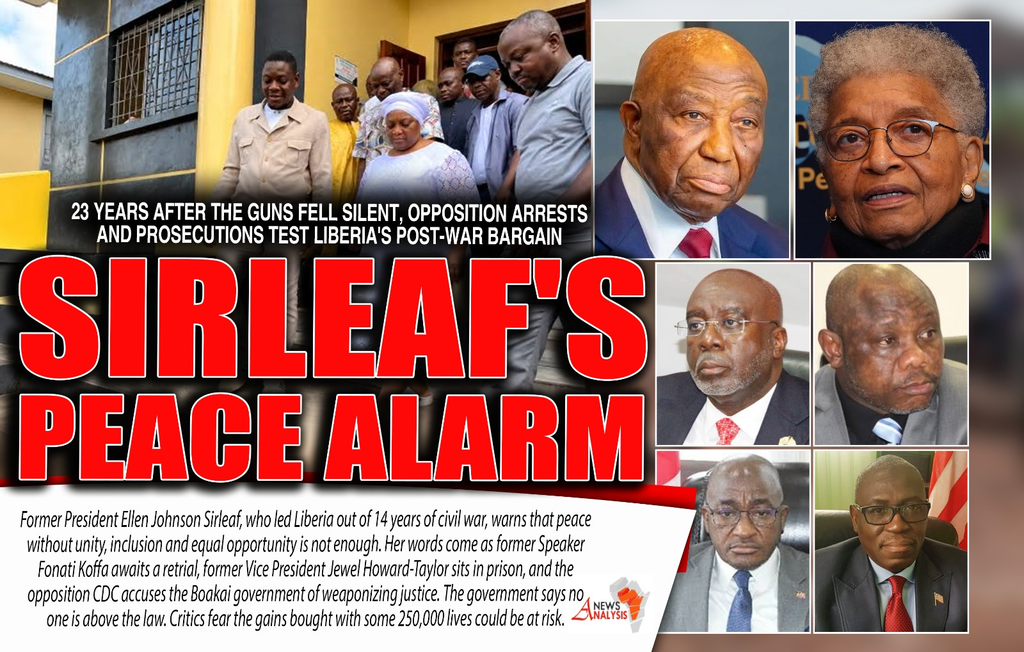
Also speaking at Monday’s gathering was former President Ellen Johnson Sirleaf, who led the country out of those ashes. Sirleaf, who turned 88 last month, delivered a warning. Twenty-three years of unbroken peace, she said, could be undone if Liberia’s leaders fail to build unity, inclusion and equal opportunity.
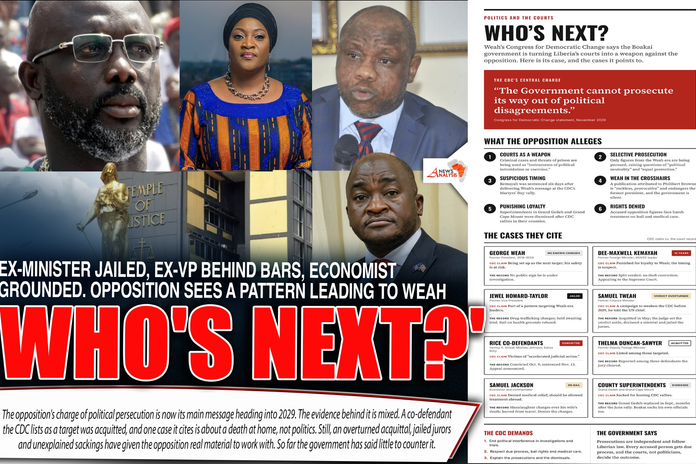
She did not name President Joseph Boakai or any case. But her words land at a tense moment. A former House speaker faces a retrial over the burning of the Capitol. A former vice president sits in Monrovia Central Prison awaiting a drug trial. And the main opposition party says the justice system has been turned into a weapon against it. Critics fear the government’s approach, whatever its legal merits, could chip away at the fragile consensus that has held Liberia together since 2003.
“Peace is not enough”
Sirleaf spoke at the West African Women Peacebuilding Convening, hosted by the Gbowee Peace Foundation Africa. Foreign Minister Sara Beysolow Nyanti was also on the program.
She traced Liberia’s unraveling to the April 1980 coup that toppled President William R. Tolbert, Jr. From there, she said, the country lost not only its peace but almost everything it had built. She urged Liberians to celebrate 23 years without war, then warned that peace alone was not enough. It had to be matched by unity, inclusion and equal opportunity, and those in power, she said, should beware.
She also told the women in the room that their work was unfinished. “Women brought the peace, now women must help keep the peace,” she said.
Coded as it was, the message was not hard to read in Monrovia. Exclusion, a sense that the state belonged to one group, was a thread that ran through the grievances of 1980 and the wars that followed.
A warning from someone who knows the cost
Few Liberians are better placed to issue such a warning, and few carry more of the history it touches. Sirleaf took office in January 2006, little more than two years after the Accra peace agreement ended 14 years of civil war. She inherited a country with no electricity grid, gutted ministries, disarmed but restless ex-fighters and roughly 15,000 UN peacekeepers on the ground.
Over 12 years, she oversaw two elections, debt relief, the UN mission’s drawdown and, in 2018, the first peaceful transfer of power from one elected Liberian president to another in decades. The 2011 Nobel Peace Prize she shared with Gbowee recognized that work.
Her record is not without question marks.
In 2009, the Truth and Reconciliation Commission recommended that she be barred from public office for her early support of Charles Taylor, a recommendation the Supreme Court later held unconstitutional. Critics also accused her government of nepotism and of letting corruption take root.
But on the narrow point she raised this week, her experience is hard to dismiss. Her government kept rivals inside the tent, including some who had fought on opposite sides of the war. The peace she managed was built on the idea that no group should feel it had been pushed outside the system.
The cases
The former speaker. J. Fonati Koffa was Speaker of the House when a fire tore through the Capitol Building’s joint chambers on December 18, 2024, at the height of a bitter fight over his removal. In 2025, a special grand jury handed down a 63-count indictment against him and 13 others, including sitting lawmakers, on charges ranging from arson to attempted murder.
FrontPageAfrica’s own reading of that indictment found no direct evidence tying Koffa to the planning or execution of the fire, only hearsay and links through his staff. Koffa resigned the speakership in May 2025. On January 2, 2026, the trial judge dissolved the jury, citing alleged juror misconduct. In August, the Supreme Court rejected Koffa’s petition and cleared the way for a retrial. Nearly two years after the fire, he still has no verdict.
The former vice president. On August 19, Jewel Howard-Taylor was on her way to catch a flight to Accra, where she was due to give a keynote speech, when authorities stopped her at Roberts International Airport. Prosecutors charged her with drug trafficking and money laundering tied to the cocaine network behind Liberia’s largest drug busts. They allege she accepted payments and met members of the network in Dubai. She denies the charges.
On September 24, Criminal Court “C” denied her bail. The 63-year-old former senator, who lost her son Philip in January, has been held at Monrovia Central Prison since. Reports say the leaders of Ghana, Côte d’Ivoire and Rwanda privately questioned the circumstances of her arrest. Former President George Weah has called her detention political persecution.
The others. Former Finance Minister Samuel Tweah was acquitted by a jury in May in a US$6.2 million corruption case. Last week, former Foreign Minister Dee-Maxwell Saah Kemayah and others were sentenced to 10 years over Saudi-donated rice. In August 2025, police helped carry out a court-ordered eviction that ended with the demolition of the CDC’s Congo Town headquarters. And Weah himself now faces unconfirmed talk of being called in for questioning, which the government has dismissed.
The government’s case
The Boakai administration rejects the charge of persecution. Officials argue that a government elected on a promise to fight corruption and impunity cannot exempt people because they belong to the opposition. The Unity Party has pointed to the drug crackdown as proof that the law is being applied evenly.
Boakai made the point bluntly after the CDC headquarters was torn down. “The law is the law,” he told reporters, insisting the police were enforcing a court ruling, not a political decision.
The record is not one-sided. Juries have acquitted as well as convicted. Tweah walked free, and two defendants in the rice case were sent for retrial after jurors could not agree.
Kemayah’s conviction came after a full trial, and he keeps his right to appeal. The cocaine seizures were real, and the pressure on Liberia to confront trafficking is coming from its own citizens and its foreign partners alike.
The opposition, for its part, has not always backed its claims of selective prosecution with evidence. But perception matters in a country where the line between political defeat and personal danger was once very thin.
Why critics fear for the peace
The worry is less about any single case than about the pattern, and about what it tells the losers of Liberia’s elections. Since 2003, the country’s peace has rested on an unwritten bargain: you can lose power without losing your freedom, your property or your life.
The CDC says it kept its side of that bargain. Its leaders like to point out that the party conceded the 2023 election when Weah lost by a razor-thin margin. “We conceded the election peacefully with a margin of just 17,000 votes,” Janga Kowo, then the party’s secretary-general, told supporters in June 2025, warning that the government had crossed a red line. When the party’s headquarters came down, Weah urged supporters not to take the law into their own hands. That restraint has held. The fear is that it will not hold forever.
There is also a double standard that many Liberians notice. The government moves quickly against today’s opponents, but justice for the war’s victims keeps slipping. The TRC recommended a war crimes court in 2009. Boakai has backed one, but lawmakers will not take up the bill until January 2027, and the proposed US$1.2 billion national budget sets aside no money for it. Many of the men accused of atrocities in the TRC report have died without facing a judge.
For families who lost a father at a checkpoint or a daughter in a massacre, that contrast is hard to accept. Accountability that reaches the current opposition but not the warlords can look less like justice and more like politics.
What is at stake
Liberia heads toward the 2029 elections with its peace intact but its politics raw. How the courts handle Koffa’s retrial and Howard-Taylor’s case will shape whether Liberians see a government cleaning house or settling scores.
The test implied by Sirleaf’s warning is simple to state and hard to meet. Prosecutions must be swift, transparent and visibly evenhanded. They must reach allies as readily as rivals, and they must sit alongside a real reckoning with the war, not in place of one.
Gbowee’s generation of women prayed outside the negotiating rooms in Accra until the men inside signed. The peace they won has now outlasted the war that came before it. Whether it outlasts this moment depends on whether every Liberian, in power or out of it, still believes there is a place for them inside the system.