MONROVIA – The Independent National Commission on Human Rights (INCHR) has signed two separate Memoranda of Understanding with the leadership of War Victims of Liberia under the banner Liberia Massacre Survivors Association (LIMASA), and the Liberia Peacebuilding Office (LPBO), in a move officials describe as a shift from ceremony to practical action for victims and communities.
By Emmanuel Weedee-Conway
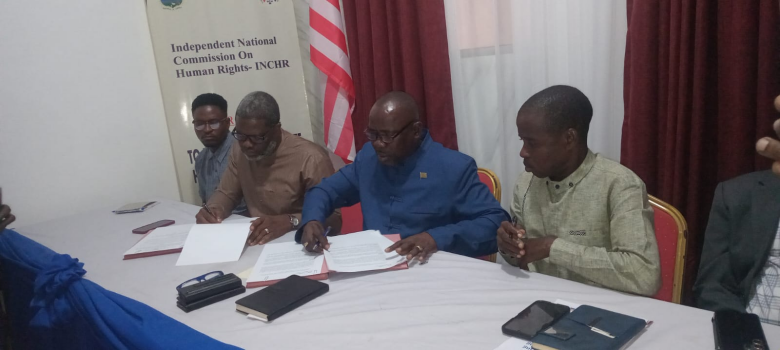
The signing, held on Tuesday at the head offices of INCHR, brought together three institutions with distinct but complementary mandates for victim support, peacebuilding, and human rights protection under formal frameworks for coordination, information-sharing, and joint response.
For the Commission, the partnership with war victims carries a specific message: victims are not merely beneficiaries, but stakeholders whose experiences must shape policy on transitional justice and national reconciliation.
That collaboration, according to the Acting Chairperon of the Commission, Cllr. Mohammed El-dust Fahnbulleh, is already producing results.
Working with the Leadership of War Victims of Liberia, Cllr. Fahnbulleh indicated, recently facilitated medical assistance for four war victims in Nimba and Montserrado Counties, a modest intervention, it acknowledged, against the enormous needs across the country, but evidence that the commitment extends beyond statements.
The second agreement, with the Liberia Peacebuilding Office, establishes a framework for institutional cooperation on peacebuilding, human rights monitoring, and early warning.
Under the arrangement, both institutions will support each other in promoting peace, protecting the rights and dignity of all people, monitoring developments that threaten peaceful coexistence, and reporting early warning signs of violence, human rights violations, and other forms of abuse.
Acting Chair Fahnbulleh stressed that sustainable peace requires more than the absence of armed conflict. It requires responsive institutions, protected communities, respected rights, and mechanisms capable of identifying tensions before they escalate.
Reparations Take Center Stage
While welcoming progress on memorialization, the Commission used the occasion to press a long-unresolved issue: reparations for victims and survivors of the civil war.
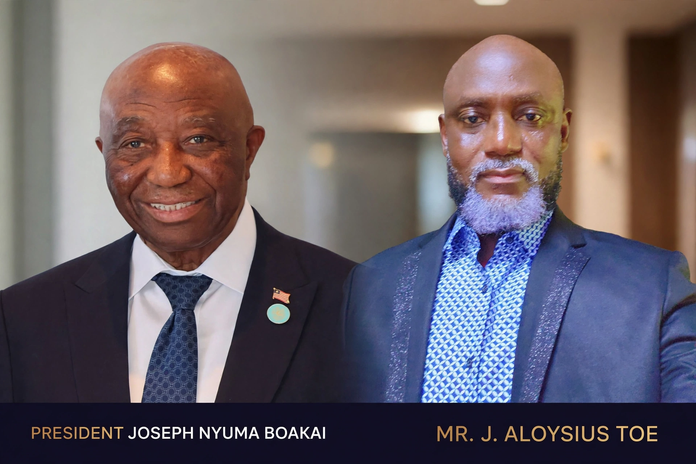
Chairperson Fahnbulleh congratulated President Joseph Nyuma Boakai, Sr. for the launch of the Liberia Peace, Reconciliation and Memorial Museum, calling memorialization an essential component of transitional justice that gives recognition to victims’ suffering, preserves truth, and reinforces the collective determination never to return to violence.
But honoring the dead without addressing the suffering of the living, he warned, leaves an important part of Liberia’s transitional justice obligations unfulfilled. Criminal accountability, truth-telling, memorialization, and reparations are complementary pillars — progress in one should strengthen, not replace, responsibility in the others.
Since the conclusion of the Truth and Reconciliation Commission (TRC), the Commission acting head noted, successive governments have not taken meaningful steps on reparations.
“Many victims still struggle with serious health challenges, physical and psychological trauma, economic hardship, poverty, and the absence of adequate support to rebuild their lives. For them, the war did not end with the signing of peace agreements.”
“Of particular concern, the Commission pointed out, is that the current national budget contains zero allocation for reparations, despite its advocacy for an appropriation.”
Call to the Legislature
Cllr. Fahnbulleh therefore called on the National Legislature — particularly the leadership of the House of Representatives and the Senate — to demonstrate political will by allocating at least US$150,000 as an initial step toward reparations for war victims in the 2027 National Budget.
He acknowledged that the amount will not resolve the full scope of victims’ suffering, but argued it would represent an important starting point, signal government recognition of its responsibility, and move reparations from rhetoric to concrete action.
Closing a Dangerous Gap
For LPBO Executive Director Sheikh S.S. Kamara, the agreement closes a long-standing gap in Liberia’s peace and human rights architecture.
“For too long peace and human rights have walked on two separate roads. When mob justice occurs in Lofa, the PBO early warning system records it. When a woman is beaten over land in Sinoe, INCHR records it as a human rights violation. When a protest turns violent in Grand Cape Mount, PBO records it as a security threat. Same incident, two different books, two different responses and often, no justice for the victim,” Kamara asserted.
The new MOU, he described as historic and the first of its kind, rests on a simple principle: there can be no sustainable peace without human rights, and no human rights without peace.
In practice, the partnership will integrate INCHR’s human rights indicators into the Liberia Early Warning and Early Response Network LERN Platform with a special protected module to ensure confidentiality for victims.
It will also establish a Joint Alert Verification Team in every county, pairing LPBO’s Peace Officer with INCHR’s Monitor to verify alerts together and respond together — one county, one alert, one response.
The two institutions will further produce one Joint County Brief every month, replacing separate reports to Monrovia and serving as the official county report for both the National Human Rights Action Plan and the National Peacebuilding architecture.
Kamara added that early response must be rights-compliant, with County Security Councils acting with human rights information in hand a safeguard against excessive use of force and arbitrary detention.
“A mother in Gbarpolu whose land is taken will now have two institutions listening and acting as one, and a young man in Nimba detained for speaking out will have his rights checked while peace is maintained.”
For his part, the head of Liberia Massacre Survivors Association (LIMASA), Peterson K. Sonyah expressed thanks and appreciation to the country’s human rights office for the partnership.
Sonyah disclosed that an additional 90 massacre centers have been discovered by the group (LIMASA), which it will alert INCHR about to boost as it carries out its function.