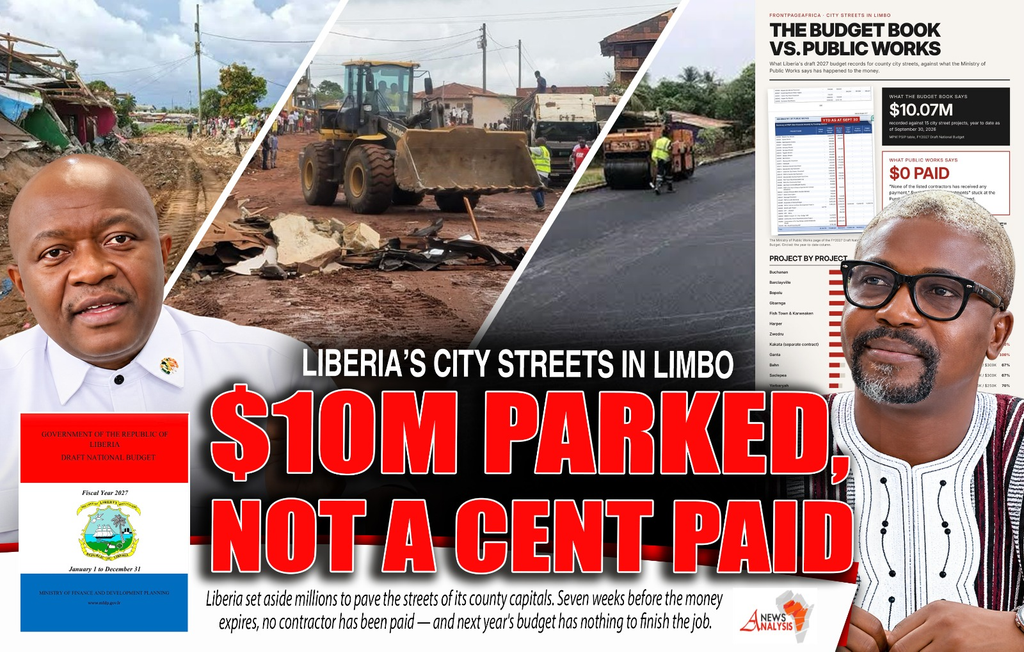
MONROVIA, Liberia — In Liberia’s county capitals, paved streets have been promised many times. This year, the money was finally set aside. The pavement has not followed.
By Rodney D. Sieh
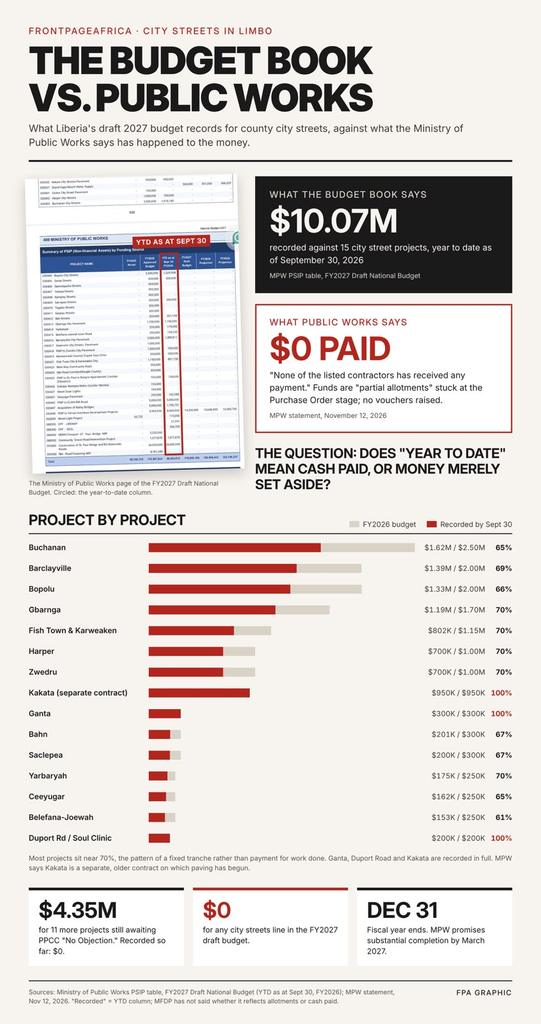
By September 30, the government had recorded more than $10 million against 15 city street projects, in towns from Buchanan on the Atlantic coast to Zwedru near the Ivorian border. The figures appear in the Ministry of Public Works’ pages of the draft national budget for 2027. On Thursday, the ministry said not one contractor had been paid.
The money, it said, is caught in the paperwork of the Ministry of Finance, at the purchase-order stage, a step short of the vouchers that release cash. Contractors will not move equipment onto sites until advance payments arrive. The ministry expects the work to be substantially complete by March 2027.
In Liberia, public money passes several gates before it reaches a contractor.
The Legislature approves it. The PPCC, the procurement regulator, clears the contract. The Finance Ministry releases an allotment, a purchase order commits it to a named firm, and only a payment voucher releases cash. The ministry says most city streets money is stuck at the fourth gate.
The budget book suggests the money may run out before the asphalt arrives. Liberia’s fiscal year ends December 31. In the draft budget for 2027, every city streets line under Public Works is blank.
For a country of about 5.5 million people, where most roads outside the capital are unpaved and many turn to mud in the rainy season, city streets are among the most visible promises of President Joseph Boakai’s government. Public Works Minister Roland Layfette Giddings has called November and December critical months, as the dry season opens the best window to build.
A statement, and numbers that match
The ministry’s statement, headlined “MPW Sets the Record Straight,” followed local media reports that $10.1 million had been disbursed. It urged the public to do due diligence before publishing information about its work.
On its central claim, the government’s own figures support the ministry. Fourteen projects, it says, have cleared Liberia’s procurement watchdog, the Public Procurement and Concessions Commission (PPCC). All 14 show money recorded: $9.12 million of $13.2 million budgeted. The 11 projects still waiting for the commission’s sign-off, known as a “No Objection,” show nothing.
Most of the cleared projects sit close to 70 percent of their budgets.
That is the pattern of a fixed tranche set aside, not of bills paid for work done.
Where the account frays
Not every figure fits. Two projects are recorded in full: $300,000 for streets in Ganta, a trading hub near the Guinean border, and $200,000 for a road to the Duport Road/Soul Clinic community outside Monrovia. The ministry describes all of its allotments as partial. It did not explain the difference.
Then there is Kakata, a market town about 50 kilometres from the capital. The full $950,000 budgeted for its streets is recorded. The ministry says Kakata is a separate, older contract on which paving has begun, but did not say how much the contractor has received. In March, residents complained that work had stood still since November 2025.
Buchanan, the port city that carries the largest allocation at $2.5 million, raises a sharper question.
At a November 3 briefing, Giddings listed it among projects already underway. Nine days later, his ministry said the Buchanan contractor had not been paid and would mobilise only after an advance.
The delays are not new.
In October, Giddings acknowledged the programme was behind schedule. It had been drawn up with legislators, he said, so engineers had to gather data in the field before tendering could begin. He expected the contracts to be finalised with the Finance Ministry within about a month. Six weeks after the September tally, the money still had not moved.
A race against the calendar
The deeper problem is time. Roughly $4.1 million budgeted for the cleared projects has not been set aside at all. The 11 projects still awaiting clearance, worth $4.35 million, range from Greenville and Cestos, whose tenders closed only on October 23, to Sanniquellie, Yekepa, Tappita and the Gibi road in Margibi County. None has a line in the 2027 draft.
Unless unspent balances are carried over, or lawmakers restore the lines before passing the budget, towns could be left with signed contracts and no money to honour them. The same budget page raises wider questions about the ministry’s spending.
A programme to buy road-building “yellow machines” had recorded $8.57 million against a $5.97 million budget, $2.6 million over, and the 2027 draft proposes $14.2 million more. Street lights and two other lines show money recorded with nothing budgeted at all.
Larger projects fared better than the streets. The $26 million St. Paul Bridge and Bo-Waterside roads and the $5 million ELWA–RIA road are recorded in full. Across all its capital projects, the ministry had recorded $80.65 million of $115.4 million, or 70 percent, by September 30.
It is unclear whether the budget’s “year to date” figures record cash paid or money set aside, and whether unspent balances will carry into 2027. It also raises questions as to how much the Kakata contractor has received, and why Ganta and Duport Road are recorded in full.
The ministry closed its statement with a rebuke to its critics: the call for accountability, it said, must come from a position of transparency. In a dozen county capitals, residents will judge that by what is on their streets when the rains return.
Support Independent Journalism
Your support helps FrontPage Africa continue delivering independent, credible, and impactful journalism. Every contribution strengthens our ability to investigate, inform, and hold power accountable while keeping quality journalism accessible to our readers.
Support our journalism or subscribe to receive the latest FrontPage Africa stories and updates.